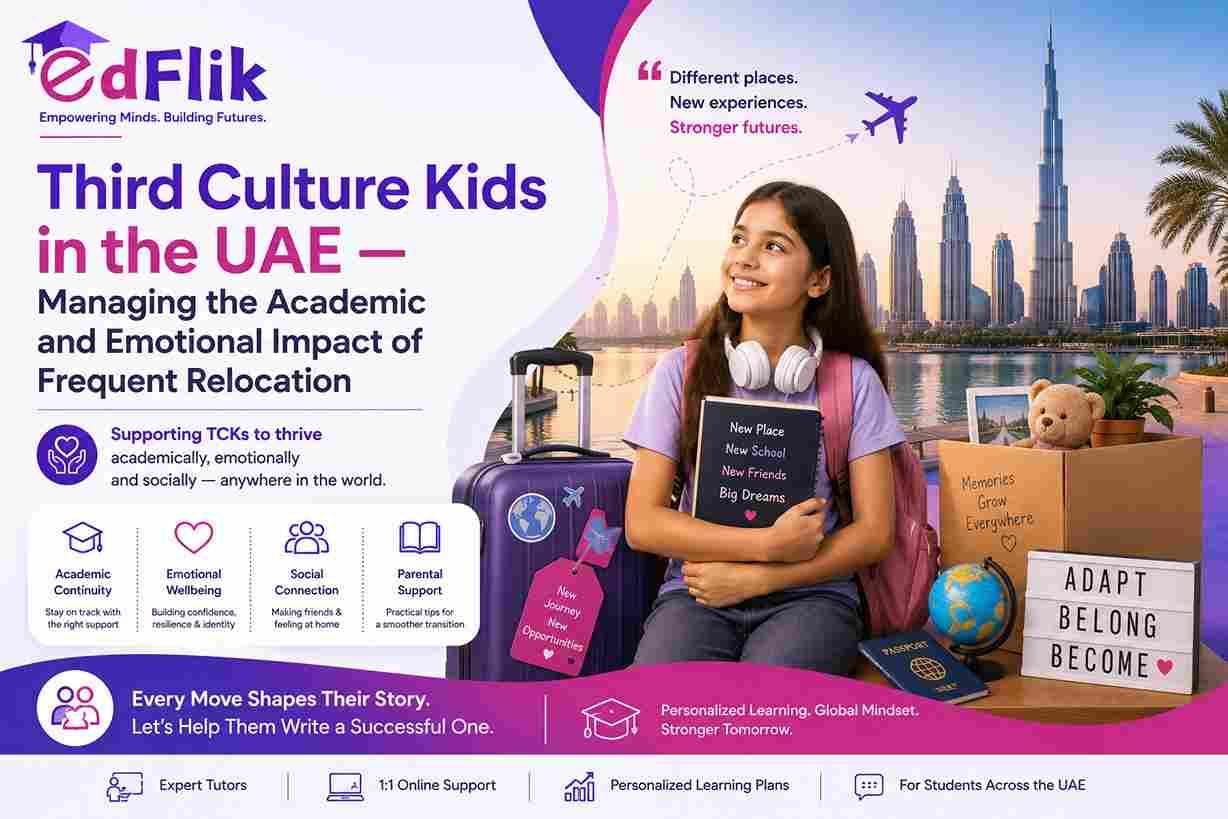
Third Culture Kids in the UAE — Managing the Academic and Emotional Impact of Frequent Relocation
The UAE is home to one of the highest concentrations of internationally mobile families anywhere in the world. A large share of the students in Dubai, Abu Dhabi, and Sharjah's private schools are what developmental researchers call **Third Culture Kids (TCKs)** — children raised for a significant part of their childhood outside their parents' home culture, often moving between countries and school systems more than once before finishing secondary school.
Most UAE education content addresses relocation as a logistics problem — which school to choose, how to transfer mid-year, which documents are needed. Far less addresses what actually happens to a child academically and emotionally when curriculum, culture, and social circle all change at once, sometimes more than once in a school career.
## What Makes the TCK Experience in the UAE Distinct
TCK research generally describes the experience as growing up in a "third culture" — not fully the parents' home culture, not fully the host culture, but a blended identity shaped by mobility itself. The UAE amplifies this in a specific way: the country's population is overwhelmingly expatriate, so a TCK here is often surrounded by other TCKs, in schools built specifically around international mobility (British, American, IB, and Indian curriculum schools with highly transient enrolment).
This produces two opposite effects, often in the same child:
- **A protective effect**: the UAE's international school culture normalises moving, changing schools, and losing friends to relocation, so a TCK here is rarely the only one going through it.
- **A compounding effect**: because turnover is so high, a TCK in the UAE may experience more *relocations of people around them* — friends leaving — even if their own family stays put for years, producing a subtler but repeated form of loss.
## The Academic Side That Gets Overlooked
Curriculum discontinuity is the most concrete academic risk for a relocating TCK, and it is frequently underestimated by families assuming "smart kids adjust." A few specific gaps repeat consistently:
- **Maths sequencing mismatches.** The order in which topics are taught varies significantly between the American Common Core sequence, the UK National Curriculum / Cambridge sequence, the IB PYP/MYP continuum, and Indian curricula. A child moving mid-year between systems can arrive having covered a topic already, or having missed one entirely, without anyone at the new school realising it until a gap shows up in assessment.
- **Language of instruction shifts.** A child moving from a bilingual or non-English system into an English-medium UAE school (or the reverse) faces an academic language transition on top of a social one.
- **Writing convention differences.** British, American, and IB writing and referencing conventions differ meaningfully — a student well-trained in one system's essay structure can be marked down in another for following the "wrong" convention, despite writing competently.
- **Assessment culture shock.** A child moving from a coursework-heavy system into an exam-heavy one (or vice versa) needs explicit teaching in the new assessment style, not just the new content.
## The Emotional Side That Affects Academic Performance
TCK research consistently links relocation to specific emotional patterns that show up in the classroom, even when a child appears to be coping well on the surface:
- **Delayed grief.** A child may perform normally academically for the first term after a move, with emotional processing surfacing months later — sometimes mistaken for a sudden, unexplained dip in motivation or behaviour.
- **Reluctance to invest.** Some TCKs, having experienced multiple losses of friends or school communities, unconsciously under-invest in a new environment as a form of self-protection — which can look like disengagement rather than what it actually is.
- **Identity questions around "home."** Older TCKs in particular can experience a specific kind of disorientation around university applications and personal statements that ask "where are you from" — a question that does not have a simple answer for a child who has lived in three countries.
## What UAE Parents Can Actually Do
- **Request a curriculum mapping conversation with the new school** before or immediately after a move — ask specifically what has been covered and what hasn't, rather than assuming the school will catch every gap through normal assessment.
- **Separate the academic transition from the emotional one in your own thinking** — a dip in performance after a move is not automatically a sign the child can't cope academically; it may be an emotional process working itself out on a different timeline.
- **Keep one thread of continuity where possible** — the same tutor, the same extracurricular activity, or the same online community — even as school and country change. Continuity in even one area meaningfully reduces the disorientation of a full reset.
- **Watch for the "quiet" gaps, not just the obvious ones** — a TCK who seems to be settling in socially can still be carrying a curriculum gap that only surfaces at the next major assessment point.
## How Tutoring Can Bridge a Relocation
For families expecting a move, or newly arrived in the UAE, an online tutor is one of the few forms of support that can span the transition itself — a child can continue with the same tutor before, during, and after a relocation, which removes one major source of disruption at a time when almost everything else is changing. EdFlik's online model means location changes do not require changing tutors, and a curriculum-specific diagnostic session at the start of a new placement can identify sequencing gaps before they show up as unexplained grade drops.
## Frequently Asked Questions:-
**Q: What is a Third Culture Kid?**
A: A Third Culture Kid is a child raised for a significant part of their developmental years outside their parents' home culture, typically due to a parent's career, and who develops an identity shaped by that mobility rather than by a single home or host culture.
**Q: Why are curriculum gaps common when TCKs relocate?**
A: Different education systems (American, British/Cambridge, IB, Indian, and others) sequence topics differently, particularly in Mathematics, so a mid-year move can leave a student ahead in some areas and behind in others without it being immediately visible.
**Q: How long does emotional adjustment typically take after a relocation?**
A: There is no fixed timeline, and researchers note that emotional processing can be delayed by weeks or months after a move, which is why a later, seemingly unexplained dip in motivation or performance is worth treating as connected to the relocation rather than unrelated.
**Q: Can online tutoring help during a relocation specifically?**
A: Yes — because online tutoring is not tied to a physical location, a student can keep the same tutor before, during, and after a move, which provides continuity precisely when the rest of the child's environment is changing.
*EdFlik provides live, 1:1 online tutoring for students aged 3–18 across all seven emirates and internationally, covering IB, IGCSE, A-Level, American, ICSE, SAT, AP, and MOE curricula. Sessions start from AED 45. Free trial class available at [www.edflik.com](https://www.edflik.com).