Understanding Externalities and Government Intervention: Edexcel IAL Microeconomics Revision
Last Updated: September 2026 | By EdFlik Education Team
For students studying Pearson Edexcel International Advanced Level (IAL) Economics (Unit 1: Markets in Action), market failure is one of the most heavily examined topics on the paper. Year after year, examiners test your ability to draw accurate externalities diagrams, analyze welfare loss triangles, and evaluate the microeconomic pros and cons of various government interventions.
When free markets fail to allocate resources efficiently, society suffers from deadweight welfare losses. Understanding why these market failures occur—and how governments attempt to correct them through taxes, subsidies, tradeable permits, and regulation—is essential for securing top grades.
In this comprehensive, exam-focused masterclass revision guide, our expert economics educators break down negative and positive externalities, walk through precise welfare loss diagram analysis, and evaluate government intervention policies.
Part 1: Defining Market Failure and Externalities
Market failure occurs when the free market mechanism (forces of supply and demand) leads to a misallocation of resources, resulting in a net welfare loss to society.
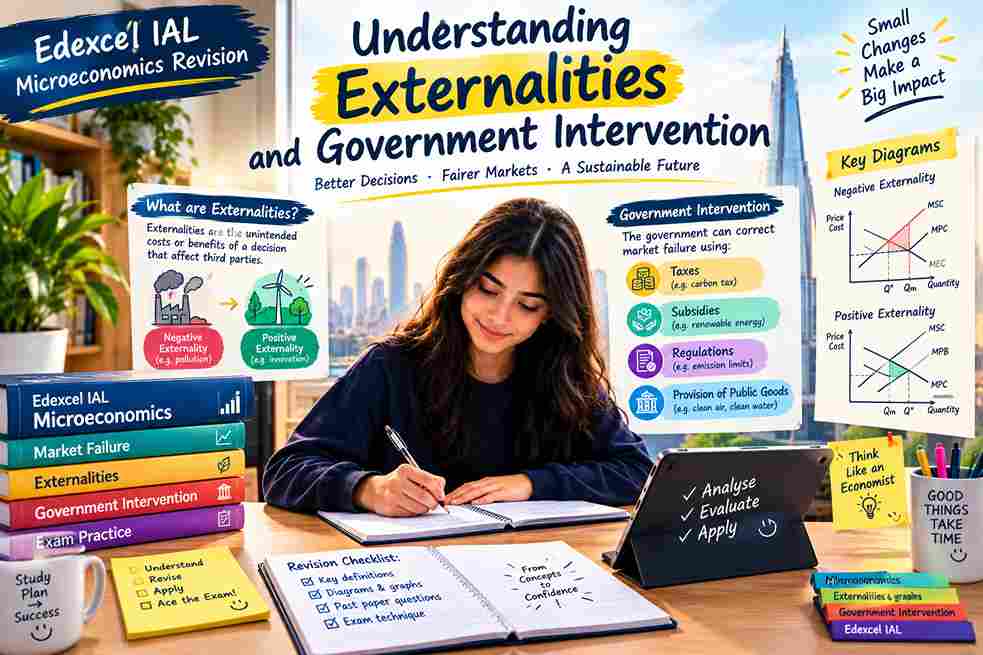
A key source of market failure is the presence of externalities. An externality occurs when the production or consumption of a good or service affects third parties who are not directly involved in the economic transaction. These can be positive (benefits) or negative (costs).
1. Private Costs vs. Social Costs
- Private Cost (MPC): The cost paid directly by the individual producer or consumer (e.g., manufacturing expenses, raw materials).
- External Cost (MEC): The negative impact imposed on third parties (e.g., air pollution, carbon emissions, noise pollution).
- Social Cost (MSC): The total cost to society as a whole:$$\text{MSC} = \text{MPC} + \text{MEC}$$
2. Private Benefits vs. Social Benefits
- Private Benefit (MPB): The benefit received directly by the consumer or producer (e.g., personal satisfaction, utility, or revenue).
- External Benefit (MEB): The positive impact enjoyed by third parties (e.g., herd immunity from vaccinations, a more educated workforce).
- Social Benefit (MSB): The total benefit to society as a whole:$$\text{MSB} = \text{MPB} + \text{MEB}$$
Part 2: Negative Externalities in Consumption and Production
Negative externalities generate external costs, leading to overconsumption or overproduction relative to the socially optimum level.
1. Negative Externalities in Consumption (e.g., Smoking or Driving Cars)
- The Problem: Consumers consider only their private benefits ($\text{MPB}$), ignoring the secondhand smoke or traffic congestion imposed on others ($\text{MSC} > \text{MSB}$ at the free-market equilibrium $Q_1$).
- The Welfare Loss: The free-market equilibrium occurs where $\text{MPB} = \text{MPC}$ (or $\text{MSC}$). However, the socially optimum output occurs where $\text{MSB} = \text{MSC}$. Because $Q_1 > Q_{\text{opt}}$, a deadweight welfare loss triangle is created.
2. Negative Externalities in Production (e.g., Factory Pollution)
- The Problem: Manufacturers ignore the environmental damage caused by their production processes. Therefore, marginal social cost ($\text{MSC}$) lies above marginal private cost ($\text{MPC}$).
- The Result: The free market produces too much of the good at too low a price, resulting in overproduction and environmental degradation.
Part 3: Positive Externalities in Consumption and Production
Positive externalities generate external benefits, leading to underconsumption or underproduction in a free market.
1. Positive Externalities in Consumption (e.g., Education or Healthcare)
- The Problem: Individuals only look at their private benefits ($\text{MPB}$) when deciding how much education to consume. They ignore the wider macroeconomic benefits (higher productivity, lower crime rates, innovation).
- The Result: Free-market output ($Q_1$) is lower than the socially optimum output ($Q_{\text{opt}}$), resulting in unexploited welfare gains.
Part 4: Government Intervention Policies to Correct Market Failure
When markets fail due to externalities, governments step in to restore social efficiency. Edexcel IAL examiners frequently ask you to evaluate the effectiveness of these policies:
1. Indirect Taxation (Pigouvian Taxes)
- How it Works: The government places a specific or ad valorem tax on goods with negative externalities (e.g., carbon taxes, sugar taxes). This shifts the $\text{MPC}$ curve upward, internalizing the externality by making the polluter pay.
- Evaluation:
- Pros: Raises government revenue that can be reinvested into green technologies; aligns with the polluter-pays principle.
- Cons: Difficult to quantify the exact external cost; highly regressive for lower-income households; can create black markets if set too high.
2. Subsidies
- How it Works: The government grants financial assistance to producers of goods with positive externalities (e.g., solar panels, public transport, vaccinations) to lower prices and expand output to $Q_{\text{opt}}$.
- Evaluation:
- Pros: Encourages higher consumption of merit goods; creates long-term positive externalities.
- Cons: Opportunity cost for government spending; producers may capture the subsidy as higher profit margins rather than passing full savings to consumers.
3. Maximum and Minimum Pricing
- Maximum Prices (Price Ceilings): Set below equilibrium to make merit goods affordable (e.g., rent controls), though this can create shortages and excess demand.
- Minimum Prices (Price Floors): Set above equilibrium to discourage the consumption of demerit goods (e.g., minimum unit pricing on alcohol).
4. Tradeable Pollution Permits (Cap and Trade)
- How it Works: The government sets a legal limit on total carbon emissions and issues permits. Clean firms that pollute less can sell their surplus permits to heavily polluting firms.
- Evaluation: Creates a market-based incentive to reduce emissions, but determining the optimal cap remains politically and practically challenging.
5. Government Regulation and Legislation
- How it Works: Outlawing harmful activities entirely or setting mandatory standards (e.g., banning smoking in public indoor spaces or setting emission standards for vehicle manufacturers).
- Evaluation: Easy to understand and enforce, but creates administrative and policing costs, and does not provide financial incentives for firms to innovate beyond the legal minimum.
Part 5: Top 4 Exam Tips to Ace Edexcel IAL Economics Papers
- Label Every Diagram Accurately: In Section B and Section C essay questions, incomplete or incorrectly labeled diagrams (missing axes, curves, or equilibrium points) will instantly cap your marks. Always label price ($P$), quantity ($Q$), origin ($0$), and ensure curves ($\text{MSB}, \text{MSC}, \text{MPB}, \text{MPC}$) are clearly designated.
- Shade the Welfare Loss Triangle Correctly: Practice drawing deadweight loss triangles. The triangle should always point away from the optimal point, bounded by $\text{MSC}$ and $\text{MSB}$ between the free-market quantity and social optimum quantity.
- Use Real-World Economic Context: Edexcel IAL rewards real-world examples. Reference actual policies—such as Singapore's electronic road pricing (ERP) for congestion externalities or carbon pricing initiatives across global economies.
- Structure Balanced Evaluations: When evaluating government intervention, always weigh the Government Failure argument (e.g., regulatory capture, imperfect information, administrative costs) against the market failure it attempts to fix.
Struggling with Edexcel IAL Economics diagrams, quantitative calculations, or essay evaluations? EdFlik offers expert, 1-to-1 online tutoring customized specifically for international school students worldwide, helping you master microeconomics and secure top $A^$ grades.*Book a Free Demo Class Today!
Frequently Asked Questions (FAQs)
Q1: What is the difference between MPC and MSC in externalities?
Ans: $\text{MPC}$ (Marginal Private Cost) represents the direct costs incurred by the producer. $\text{MSC}$ (Marginal Social Cost) includes both private costs and external costs ($\text{MPC} + \text{MEC}$) imposed on third parties.
Q2: Why do negative consumption externalities lead to overconsumption?
Ans: Because consumers only consider their private benefits ($\text{MPB}$) without factoring in the negative impacts on others, they consume up to the point where private benefit equals private cost, ignoring the broader social costs that make the true optimal quantity lower.
Q3: What is government failure, and why is it important in IAL essays?
Ans: Government failure occurs when government intervention in the economy creates a net welfare loss instead of correcting a market failure. Discussing government failure (due to imperfect information, bureaucracy, or unintended consequences) is essential for achieving top evaluation marks in Section C essays.
Q4: How does EdFlik support EdFlik Economics students?
Ans: EdFlik connects international school students globally with vetted, experienced 1-to-1 online tutors specializing in Edexcel IAL Economics, Business, and Mathematics. Our sessions focus on diagram construction, past-paper essay structuring, and exam technique.