When Expats Relocate: Managing School Transitions & Academic Recovery for Relocated Families
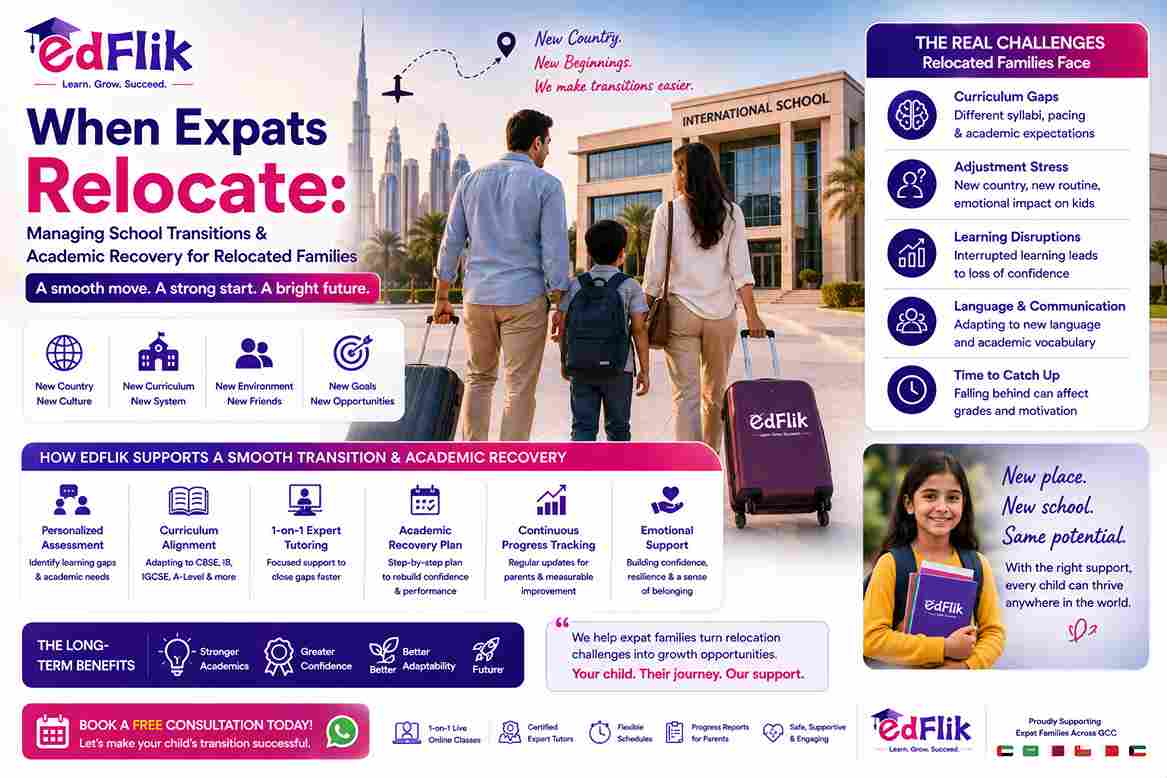
Relocation is a defining experience in the lives of GCC expat families. Whether driven by visa policies, job transfers, career advancement, or educational re-evaluation, relocation disrupts stability, separates children from peer groups, and often forces curriculum changes simultaneously. Research on childhood relocation shows that while most children adapt well, the transition period (first 3-6 months) involves significant academic, social, and emotional challenges. Understanding these challenges and implementing evidence-based recovery strategies transforms relocation from a crisis into a manageable transition with long-term benefits.
This comprehensive guide addresses the complete relocation experience: pre-move preparation, transition psychology, academic recovery strategies, and tutor-backed support frameworks. Unlike generic relocation guides, this guide acknowledges GCC-specific contexts: multiple curriculum standards across emirates, high-frequency school transitions, peer group instability, and the unique emotional dynamics of expat families managing repeated relocations.
The Relocation Reality: What Happens Academically & Emotionally
When a child relocates, multiple disruptions occur simultaneously. First, peer group separation creates emotional distress; children lose established friendships and social status. Second, school environment change (new teachers, new curriculum, new routines) creates cognitive load. Third, many relocations coincide with curriculum changes (IGCSE→IB, CBSE→IGCSE), adding academic disruption on top of social disruption. Fourth, parents' own stress (visa anxiety, job transition) transmits to children, amplifying their distress.
Academic performance typically dips 10-20% in the first 3 months post-relocation. This dip is NOT a sign of reduced ability; it's a normal response to cognitive and emotional overload. Research shows that children with adequate support recover to baseline within 4-6 weeks and often exceed previous performance within 2-3 months. Without support, recovery extends to 4-6 months or longer, sometimes with lasting confidence impacts.
Emotionally, children experience a predictable relocation adjustment curve. Weeks 1-2: excitement/anxiety mix. Weeks 3-6: 'crisis phase'—homesickness, friendship loss, school struggle peaks. Weeks 7-12: adaptation—new routines normalize, new friendships form, academic recovery begins. Months 4-6: integration—child reconnects with confidence, new school feels familiar. Understanding this curve helps parents normalize their child's emotions and avoid over-reacting to mid-transition distress.
Pre-Move Preparation: Setting Your Child Up for Success
Three to six months before relocation, preparation begins. If possible, research the new school: curriculum, teaching methodology, assessment style, co-curricular options. Share this information with your child in age-appropriate ways. 'Your new school has great robotics; I remember you were interested in that' signals that the new environment has appealing aspects.
If curriculum change is involved, alert the current school and arrange records transfer early. Request curriculum mapping documents that show overlap and gaps between the old and new curriculum. This intel allows EdFlik tutors to prepare your child for new curriculum demands even before the move.
Discuss friends and community realistically. 'You'll make new friends; it takes time, but you'll find people you like' is more honest than 'You'll find friends immediately.' Validate that leaving friends is sad while maintaining optimism about new connections. Consider whether your child has hobbies or interests that can provide peer connection points in the new location (sports clubs, coding groups, hobby communities).
If your child is age 8+, involve them in school/location research. Let them see the new school's website, curriculum, clubs, campus photos. Involvement reduces anxiety and builds anticipation. Some schools offer virtual tours or buddy systems; engage with these if available.
The Critical First 6 Weeks: Intensive Tutor Support Framework
The first 6 weeks post-relocation are critical. During this window, intensive tutor support (3-4 sessions per week) across subjects prevents academic lag while simultaneously supporting confidence recovery. EdFlik's relocation support protocol includes three parallel tracks:
Track 1: Academic Catch-Up & Curriculum Bridging. If curriculum changed, EdFlik tutors immediately assess your child's knowledge gaps in the new curriculum and begin targeted bridging. If curriculum stayed the same, tutors assess how the new school's teaching methodology differs from the previous school and help your child adapt to new expectations. Tutors maintain communication with the new school's teachers to ensure alignment on curriculum scope and assessment methodology.
Track 2: Confidence & Identity Reestablishment. Academic confidence often shakes during relocation because familiar success patterns (knowing what the teacher expects, having established study routines, having peer support) disappear. EdFlik tutors explicitly rebuild confidence through: (a) celebrating quick wins (mastering a new concept, successfully completing homework), (b) reframing struggles as normal adjustment, not failure, (c) helping your child articulate their strengths (even if temporary struggles obscure them).
Track 3: Parent-Tutor-School Communication Triangle. EdFlik tutors maintain communication with your child's new school teachers, sharing information about your child's adjustment, previous curriculum background, and learning needs. This communication accelerates teacher understanding of your child's situation and prevents teachers from misinterpreting relocation-related struggle as ability issues.
Months 3-6: Consolidation, Social Integration, & Tutor Step-Down
By month 3, most children have stabilized academically and begun social integration. Tutor frequency can step down from 3-4 sessions to 2-3 sessions per week. Tutor focus shifts from crisis intervention to skill-building and confidence expansion. By month 6, if all metrics are stable, tutor frequency may further reduce to 1-2 sessions per week or pause entirely—with the understanding that tutoring can resume if needed.
Social integration matters as much as academics. Encourage your child to join one or two clubs/activities aligned with their interests. Sustained peer connection outside of academics significantly accelerates overall adjustment. EdFlik tutors often hear reports like: 'My child joined the robotics club last month and suddenly school feels normal'—because peer connection transforms the school environment from alien to familiar.
Special Considerations: Repeated Relocations & Family Resilience
Some GCC families experience repeated relocations (every 2-3 years). Repeated transitions can accumulate stress; some children develop 'relocation anxiety' where each move triggers disproportionate distress. If your child has experienced multiple relocations, prepare them that this transition may feel emotional even though they've 'done this before.' Validate that repeated transitions are harder, not easier, and that their feelings are legitimate.
Consider whether tutoring continuity can bridge relocations. Some EdFlik students who relocate within the GCC continue online tutoring with the same tutor, providing one stable relationship during a transition-heavy period. This continuity is particularly valuable for students with multiple previous transitions.
Frequently Asked Questions
Q1: How long does academic recovery take after relocation?
Typical recovery: 4-6 weeks to baseline with tutor support, 2-3 months to exceed previous performance. Without support, recovery extends to 4-6 months. Individual variation is significant; some children recover faster, others need extended support.
Q2: Should we prioritize academics or friendships during the first few months?
Both matter, but different phases prioritize differently. Weeks 1-6, academics take priority while maintaining peer connection opportunities. Months 2-4, social integration becomes increasingly important. By month 6, balance should stabilize. EdFlik tutors can reduce frequency as social integration accelerates.
Q3: If curriculum changed, does my child need extra tutoring?
Yes, initially. EdFlik recommends additional tutoring (3-4 sessions/week first 6 weeks) if relocation coincides with curriculum change. This prevents double disruption from compounding into long-term lag. After recovery, frequency normalizes.
Q4: How do I manage my own relocation stress so it doesn't affect my child?
Parent anxiety transmits directly to children. Manage your stress visibly (exercise, adequate sleep, social connection) so your child sees you coping constructively. Don't burden your child with your anxieties; instead, model optimism ('This is a change; changes are challenging and manageable').
Start Your Relocation Journey with Expert Support
Sessions from AED 45, free trial at edflik.com. EdFlik tutors specialize in supporting relocated families through smooth transitions and rapid academic recovery.