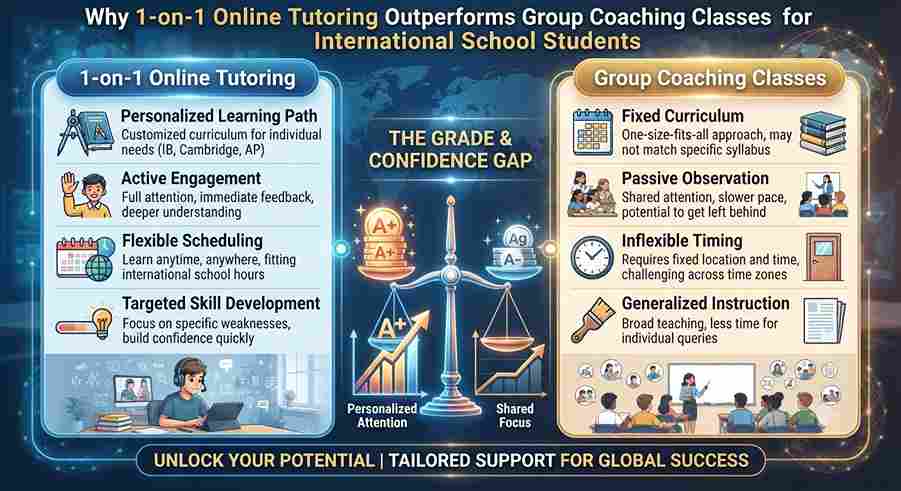
Why 1-on-1 Online Tutoring Outperforms Group Coaching Classes for International School Students
Last Updated: October 2026 | By EdFlik Education Team
For families navigating elite international curricula—whether studying under the International Baccalaureate (IB) Diploma Programme, Cambridge IGCSE / International A-Levels, or rigorous American AP frameworks—academic excellence is rarely achieved through passive learning alone. As internal assessments, predicted grade deadlines, and high-stakes external examinations approach, students often require supplementary academic support.
When parents and students begin searching for academic assistance, they face a pivotal fork in the road: Should we enroll in traditional group coaching classes, or invest in personalized 1-on-1 online tutoring?
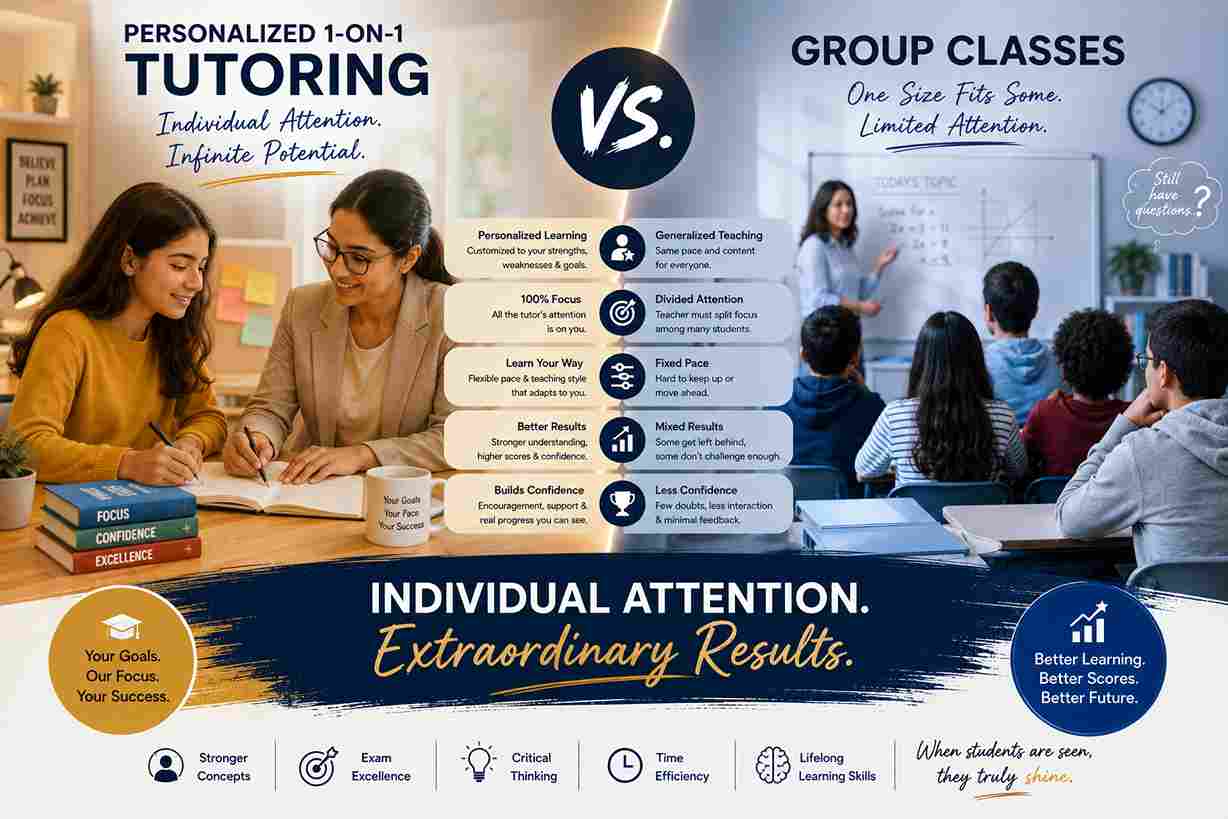
While group coaching centers have long dominated traditional after-school tutoring markets, modern educational research and practical classroom results consistently prove that individualized, 1-on-1 instruction vastly outperforms group settings. In this comprehensive masterclass guide, we explore the cognitive, pedagogical, and practical reasons why 1-on-1 online tutoring is the superior choice for international school students.
Part 1: The Fallacy of the Traditional Group Coaching Model
Group coaching classes operate on an industrial-era educational model: one teacher addressing 10 to 30 students simultaneously at a fixed, uniform pace. While this model may work for broad lectures, it fails catastrophically when applied to rigorous international curricula.
- The Pacing Mismatch: In a group setting, the instructor must teach to the average of the room. This means advanced students are held back, bored, and unchallenged, while struggling students are left behind as the class rushes forward to complete the syllabus.
- The Illusion of Understanding: Sitting in a crowded lecture hall or coaching center listening to an expert explain calculus or organic reaction mechanisms creates an "illusion of competence." Nodding along while a tutor solves a problem on a whiteboard feels like learning, but it does not translate to independent problem-solving during an exam.
- The Fear of Public Failure: Teenage students are acutely sensitive to peer perception. In a group setting, many students hesitate to raise their hands, admit confusion, or ask foundational questions for fear of looking foolish in front of classmates. Consequently, critical knowledge gaps remain unaddressed.
Part 2: The Core Pedagogical Advantages of 1-on-1 Instruction
In stark contrast to group environments, 1-on-1 tutoring puts the student at the absolute center of the educational universe, unlocking several profound psychological and cognitive benefits.
1. Absolute Personalization and Diagnostic Teaching
No two learners process information identically. A skilled 1-on-1 tutor begins by conducting a rigorous diagnostic assessment to pinpoint exact conceptual fractures—whether it is a misunderstanding of calculus limits, confusion over economic equilibrium shifts, or weak essay-structuring skills in humanities. The tutor then discards generic lesson plans to custom-build a syllabus tailored entirely to the student’s unique learning style, strengths, and weaknesses.
2. Active Participation and the Socratic Method
In a 1-on-1 session, hiding is impossible. Students are actively engaged from the first minute to the last. Tutors can employ the Socratic Method—guiding students through complex multi-step problems by asking targeted questions rather than simply handing them answers. This builds genuine cognitive resilience, critical thinking, and intellectual independence.
3. Curriculum Specialization
International school students do not study generic curricula; they require specialized mastery of specific exam boards (e.g., Pearson Edexcel, Cambridge CAIE, IB Organization). A top-tier 1-on-1 tutor is an expert in that exact syllabus and mark scheme, knowing precisely how examiners award marks and which common pitfalls cost students top grades.
Part 3: The Science — Educational Psychology and "Bloom's 2 Sigma Problem"
The superiority of individual instruction is not merely a matter of opinion; it is backed by decades of rigorous educational research.
In the 1980s, educational psychologist Benjamin Bloom conducted landmark research known as "The 2 Sigma Problem." Bloom discovered that students tutored one-on-one using mastery learning techniques performed two standard deviations ($2\sigma$) higher than students learning in conventional classroom environments.
To put that statistic into practical perspective:
- The average student receiving 1-on-1 instruction performed better than 98% of students taught in a traditional group classroom.
- When a student receives undivided attention, immediate feedback, and customized explanations, their brain forms neural connections faster and retains complex abstract concepts with significantly higher fidelity.
Part 4: Why Online 1-on-1 Tutoring Wins on Logistics and Flexibility
Transitioning 1-on-1 tutoring into an interactive online environment adds another layer of unmatched efficiency, particularly for busy international school students in global hubs:
- Eliminating Commute Fatigue: International school students already endure packed academic schedules, after-school sports, Model United Nations (MUN), and extracurricular commitments. Traveling across the city to a physical coaching center wastes precious hours that could be dedicated to rest or study.
- Access to Global Expert Tutors: Online learning breaks down geographical barriers. A student living in Dubai or Abu Dhabi can instantly connect with a world-class Oxford-educated physics mentor or an IB examiner without geographic constraints.
- Interactive Digital Toolkits: Modern online tutoring leverages shared digital whiteboards, screen sharing, stylus annotations, and instant file sharing, allowing students and tutors to collaborate visually in real time just as effectively as sitting side-by-side.
Part 5: Top 4 Pitfalls to Avoid When Choosing Academic Support
- Choosing Tutors Based Solely on Price: Opting for the cheapest group coaching center often results in overcrowded classes, unvetted generalist tutors, and wasted time. Invest in quality over quantity.
- Neglecting Curriculum Alignment: Hiring a tutor who is unfamiliar with your specific exam board (e.g., studying IB Economics HL but getting tutored by someone who only knows standard high school economics) can lead to conflicting terminology and lost exam marks.
- Treating Tutoring as Crisis Management: Waiting until two weeks before final mock exams to seek help guarantees high stress. Consistent, proactive 1-on-1 tutoring builds steady confidence throughout the academic year.
- Passive Tutoring: Allowing a tutor to do the homework for the student rather than guiding the student to solve problems independently. True learning happens when the student holds the digital pen.
Striving for top grades in your IB, IGCSE, or A-Level courses? EdFlik connects international school students globally with elite, vetted 1-on-1 online tutors across math, sciences, humanities, and languages, delivering personalized instruction designed to secure $A^$ and Grade 7 outcomes.*Book a Free Demo Class Today!
Frequently Asked Questions (FAQs)
Q1: How does 1-on-1 tutoring accommodate different student learning speeds?
Ans: Unlike group classes bound by strict school timetables, a 1-on-1 tutor spends as much or as little time on a topic as needed. If a student grasps a concept instantly, they move forward; if they struggle with a complex mechanism, the tutor breaks it down using multiple alternative analogies until mastery is achieved.
Q2: Is online tutoring as effective as in-person tutoring?
Ans: Yes! Educational studies show that when combined with interactive digital whiteboards and high-definition video tools, online 1-on-1 tutoring equals or exceeds in-person instruction because it removes travel friction and grants access to a much wider pool of elite global specialists.
Q3: How are EdFlik tutors vetted for international curricula?
Ans: EdFlik maintains exceptionally rigorous recruitment standards. Our tutors are subject-matter experts, graduates of world-class universities, and specialists deeply experienced in international curricula like the IB Diploma, Cambridge IGCSE/A-Levels, and American AP standards.
Q4: When is the best time of the academic year to start 1-on-1 tutoring?
Ans: The ideal time to begin is at the start of the academic year or semester to build strong foundational habits and prevent knowledge gaps. However, targeted short-term coaching is also highly effective ahead of mock exams or final IB/IGCSE assessment windows.