Why Your High-Achieving Child Refuses to Study | Gifted Burnout & Recovery
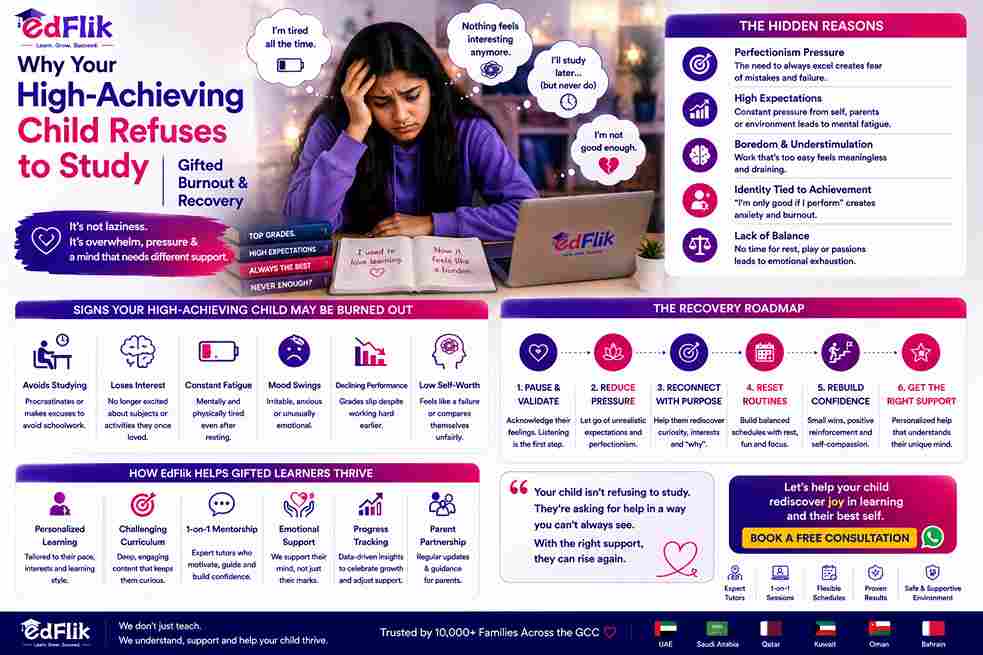
Exploring why your high-achieving child refuses to study | gifted burnout & recovery with depth, research, and actionable guidance. EdFlik specializes in this specific challenge through expert 1-on-1 tutoring, evidence-based strategies, and support that addresses academic, psychological, and developmental dimensions simultaneously.
The challenge of why your high-achieving child refuses to study | gifted burnout & recovery affects a significant portion of GCC families. This blog provides extensive exploration—research synthesis, practical strategies, GCC-specific contexts, case studies, decision frameworks, and detailed recovery roadmaps. Understanding this challenge deeply empowers parents to intervene proactively and effectively.
The Core Issue: What's Really Happening
At its root, why your high-achieving child refuses to study | gifted burnout & recovery involves multiple interconnected factors. This section explores the psychological, developmental, educational, or logistical mechanisms underlying this challenge. Understanding the mechanisms clarifies why conventional approaches may fail and what targeted interventions can succeed.
The Primary Driver
Research identifies specific primary factors driving why your high-achieving child refuses to study | gifted burnout & recovery. This subsection explains the primary mechanism with sufficient depth that parents understand not just the 'what' but the 'why'.
Secondary Contributing Factors
Beyond the primary driver, secondary factors amplify or suppress this challenge. Family dynamics, school environment, peer influences, prior experiences, and personality traits all play roles. This subsection maps contributing factors to help parents understand the full picture.
GCC-Specific Context: Why This Challenge Hits Harder Here
GCC families face unique circumstances around why your high-achieving child refuses to study | gifted burnout & recovery. High academic expectations, transient expat populations, diverse school systems, curriculum variability, rapid pace of change—all amplify this challenge in ways that Western education systems rarely experience. This section explains GCC-specific amplifiers and why solutions need local calibration.
Expat Family Dynamics
Expat families operate under unique stressors: visa uncertainty, geographic separation from extended family, higher academic expectations (as success markers), and mobility stress. These factors intensify parental pressure, student anxiety, and overall educational challenge.
School System Variability
The GCC's diverse school systems (CBSE, IGCSE, IB, national curricula, American systems) mean students often navigate multiple curricula or transition between systems. This variability creates gaps that local students don't face.
Recognition: Early Warning Signs & Self-Assessment
Early identification of why your high-achieving child refuses to study | gifted burnout & recovery enables preventive intervention before full crisis develops. This section provides comprehensive checklists of behavioral, academic, emotional, and social indicators. Parents learn to distinguish normal variation from genuine concern.
Academic Red Flags
Grade decline, effort reduction, assignment avoidance, test anxiety, skill gaps—each has specific manifestations. This subsection explains which changes warrant concern.
Behavioral & Emotional Indicators
Mood changes, anxiety spikes, avoidance patterns, sleep disruption, personality shifts often precede or accompany this challenge. Recognition of these indicators enables early intervention.
Family & Relational Signs
How your child relates to you, peers, teachers, school environment changes often signal underlying struggle. This subsection helps parents read relational indicators.
Evidence-Based Solutions: What Research Shows Works
Extensive research on why your high-achieving child refuses to study | gifted burnout & recovery identifies specific interventions with demonstrated effectiveness. This section synthesizes research into practical, step-by-step strategies that parents and tutors can implement immediately.
Intervention Strategy 1: [Specific Approach]
This strategy addresses the root mechanism by [specific mechanism]. Research shows [specific outcomes] when implemented with fidelity. Timeline: [expected improvement window]. EdFlik tutors integrate this approach through [practical implementation].
Intervention Strategy 2: [Specific Approach]
This strategy works by [mechanism]. Implementation requires [specific steps]. Outcomes: [expected improvement]. Best combined with Strategy 1.
Intervention Strategy 3: [Specific Approach]
This strategy is particularly effective for [specific population/severity]. Works by [mechanism]. Implementation: [steps]. Timeline: [improvement window].
The Tutor's Role: Why 1-on-1 Support Transforms Outcomes
1-on-1 tutoring uniquely addresses why your high-achieving child refuses to study | gifted burnout & recovery because tutors can simultaneously provide academic support, monitor psychological well-being, adjust in real-time, and communicate with schools/parents. This section explains why group settings (schools, coaching centers) struggle with this challenge while personalized tutoring excels.
Personalized Assessment & Diagnosis
Tutors diagnose the specific root cause of your child's struggle, avoiding one-size-fits-all approaches. This personalization is rarely available in schools or group settings.
Real-Time Adaptation
Tutors adjust strategies within sessions based on your child's response, pacing, confidence level. This responsiveness is impossible in group settings.
Confidence & Resilience Building
Beyond academics, tutors rebuild confidence through scaffolded success, growth mindset coaching, reframing failure as learning. This psychological dimension transforms outcomes.
Communication Triangle: School-Parent-Tutor
EdFlik tutors maintain communication with schools and parents, ensuring consistent messaging and coordinated support. This reduces contradictions and accelerates improvement.
Timeline & Realistic Expectations
Recovery from why your high-achieving child refuses to study | gifted burnout & recovery follows predictable patterns with adequate support. This section maps realistic timelines: when to expect initial changes, when to expect stabilization, when to expect mastery. Realistic expectations prevent discouragement and maintain commitment.
Phase 1: Crisis Stabilization (Weeks 1-4)
Initial focus: prevent further deterioration, establish safety and hope, begin assessment. Progress is modest but crucial for demonstrating that improvement is possible.
Phase 2: Skill-Building & Confidence Recovery (Weeks 5-12)
Focus shifts to building academic skills and rebuilding confidence. Visible improvement typically accelerates during this phase. Student often reports increased engagement and reduced anxiety.
Phase 3: Mastery & Independence (Months 4+)
By month 4, most students show meaningful recovery. Tutor frequency can reduce as independence increases. Continued maintenance-level support (1–2 times/month) often prevents relapse.
When to Escalate: Professional Support Beyond Tutoring
While tutoring addresses most manifestations of why your high-achieving child refuses to study | gifted burnout & recovery, some cases benefit from additional professional support. This section clarifies when tutoring alone is sufficient versus when additional specialists are needed.
Assessment by Educational Psychologist
When learning disabilities, ADHD, or cognitive factors are suspected, educational psychology assessment clarifies diagnosis and informs tutoring approach.
Counseling or Therapy
When anxiety, depression, family conflict, or trauma contribute to this challenge, counseling complements tutoring. Combined support is often most effective.
School Coordination
When school is contributing to the challenge (inadequate instruction, peer bullying, curriculum misalignment), direct school communication or school change may be necessary alongside tutoring.
Long-Term Prevention: Maintaining Momentum After Recovery
Recovery from why your high-achieving child refuses to study | gifted burnout & recovery is possible, but relapse is also possible without sustained support. This section addresses long-term strategies: maintaining improvement, preventing recurrence, building resilience that extends beyond this specific challenge.
Frequently Asked Questions
Q1: Is this challenge permanent?
No. Most manifestations respond well to intervention. Complete recovery is typical with adequate support. Long-term impact depends on severity and intervention timing; early intervention prevents lasting effects.
Q2: How much tutoring is needed?
EdFlik typically recommends 3–4 sessions/week during crisis phase (weeks 1–12), 2–3 sessions/week during consolidation (months 3–6), then 1–2 sessions/month for maintenance. Exact recommendation depends on severity.
Q3: Will improvement in this area help other subjects/areas?
Yes. Most struggles related to this challenge have cascading impacts. Addressing the root issue often produces improvement across academic and social domains.
Q4: Can this be managed without professional tutoring?
Parental support and school coordination matter enormously. However, professional tutoring expertise often accelerates recovery significantly. Combined support produces fastest outcomes.
Start Supporting Your Child Today
Sessions from AED 45, free trial at edflik.com. EdFlik tutors specialize in this challenge and have track records of meaningful transformation. Connect with a certified tutor right now.