Year 12 to Year 13 Transition: A-Level Study Planning for UAE Students
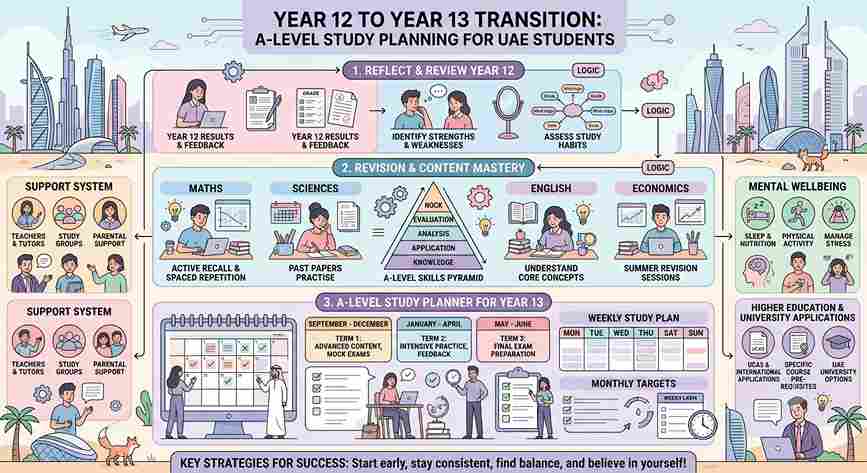
Who this is for: UAE private school students (Years 12–13 / AS to A2 Level) in Dubai, Abu Dhabi, Sharjah, and the Northern Emirates transitioning into their final A-Level year, alongside parents and university guidance counselors preparing for UCAS, US Common App, and regional university application cycles.
What query it owns: how to plan the transition from Year 12 to Year 13 for A-Level success and university admissions in the UAE.
Why this is safe: This guide outlines the strategic academic, application, and revision roadmap for Key Stage 5 students, while EdFlik’s A-Level resource hub provides structured subject guides, university prerequisite matrices, and past-paper revision trackers.
The summer transition between Year 12 (AS Level / Lower Sixth) and Year 13 (A2 Level / Upper Sixth) represents the single most intense, high-stakes academic window in the British education system.
For students enrolled in private international schools across the United Arab Emirates, Year 13 is not merely a continuation of Year 12—it is a significant escalation in conceptual difficulty, synoptic application, and time pressure.
Unlike Year 12, where students focus primarily on mastering core subject content, Year 13 demands that candidates simultaneously manage advanced A2 syllabus topics, finalize UCAS and global university applications, prepare for admissions tests (such as the TMUA, UCAT, or MAT), attend interview preparation sessions, and maintain top performance in October/November mock exams that lock in crucial Predicted Grades.
Without a structured, forward-looking study plan constructed during the summer bridge, many students find themselves overwhelmed by November. This masterclass guide breaks down the structural shift between AS and A2 Levels, provides a 5-phase transition roadmap, details university application alignments, exposes common transition traps.
Key Takeaways
- The AS to A2 Conceptual Jump: A2 topics do not just add new material; they require synoptic integration, linking early Year 12 fundamentals to complex Year 13 applications (e.g., connecting Year 12 Organic Chemistry functional groups to Year 13 Reaction Mechanisms and NMR Spectroscopy).
- The Power of the Summer Bridge: The 8-week summer break between Year 12 and Year 13 is the critical window to consolidate Year 12 weak spots, complete UCAS Personal Statement drafts, and build a head start on Year 13 content.
- Predicted Grade Lock-In: October and November mock exams in Year 13 serve as the primary evidence teachers use to set your final UCAS predicted grades. Treating these early mocks with final-exam seriousness is essential for securing competitive university offers.
- Dual-Track Time Management: Success in Year 13 requires balancing academic revision with university application administration (UCAS references, portfolio submissions, financial documentation, and visa equivalencies).
Part 1: Deconstructing the AS to A2 Level Shift
Many students mistakenly assume that Year 13 will follow the exact same rhythm as Year 12. Understanding the structural differences between these two years helps prevent academic shock:
                  THE STRUCTURAL SHIFT: YEAR 12 VS. YEAR 13
                                     |
      +------------------------------+------------------------------+
      |                                                             |
1. YEAR 12 (AS LEVEL)                                        2. YEAR 13 (A2 LEVEL)
• Modular / Standalone Foundations.                          • Deep **Synoptic Integration** across full 2-year content.
• Lower command-word tariffs (Define, Describe).              • High command-word tariffs (Evaluate, Synthesize, Prove).
• Predictable, topic-isolated exam questions.                • Unseen, multi-topic problem-solving prompts.
• Moderate weekly independent study demands.                 • High volume of independent essay writing / lab analysis.
Why Year 13 Content Feels Harder:
- Synoptic Testing: A2 exam papers actively test synoptic connections across the entire two-year specification. You cannot answer a Year 13 A2 Physics or Mathematics question without fluent recall of Year 12 principles.
- Shift in Mark Scheme Rigor: In Year 13, examiners allocate fewer marks for simple memory recall and significantly more marks for methodology, logical structure, evaluation, and mathematical justification.
- The Compression Window: Because final linear A-Level examinations begin in early May, teachers must complete the complex A2 syllabus by late February or early March, leaving very little room for in-class revision.
Part 2: The 5-Phase Year 12 to 13 Transition Roadmap
To navigate Key Stage 5 smoothly, execute this structured 5-phase transition protocol starting in the summer between Years 12 and 13:
                 THE 5-PHASE TRANSITION PROTOCOL
                                   |
  Phase 1: Summer Gap Audit       ---> Revisit Year 12 mock papers; eliminate core content gaps.
  Phase 2: UCAS & Portfolio Build ---> Complete Personal Statement Draft 1 & university shortlisting.
  Phase 3: A2 Head-Start Reading  ---> Preview the first 2 units of each Year 13 subject syllabus.
  Phase 4: Autumn Mock Lock-In    ---> Prepare intensively for September/October prediction exams.
  Phase 5: Past Paper Acceleration---> Transition to full 2-year linear past papers under timed conditions.
Phase 1: The Summer Knowledge Gap Audit (July)
Before touching any new Year 13 material, conduct a rigorous audit of your Year 12 performance:
- Re-sit your Year 12 end-of-year mock papers under timed conditions.
- Identify specific "high-risk" topic strands where you dropped marks (e.g., Year 12 Differentiation/Integration in Maths, or Energetics in Chemistry).
- Re-write topic summaries and complete classified past-paper drills until you achieve an 80%+80\%+80%+ score on those specific weak areas.
Phase 2: University Application & Personal Statement Building (July – August)
Do not leave your university applications until term starts in September. Use the summer break to complete heavy administrative tasks:
- UK (UCAS): Finalize your 5 university course choices. Write a complete, draft-ready UCAS Personal Statement using the ABC Framework (Action, Benefit, Connection) to detail super-curricular engagement (reading, academic competitions, independent projects).
- US (Common App): Finalize your primary Common App essay prompt and organize supplement questions for target institutions.
- Admissions Tests: If applying for Medicine (UCAT), Law (LNAT), or STEM at top-tier universities (TMUA, MAT, PAT), build a daily 45-minute practice question routine during August.
Phase 3: Preview Year 13 Syllabus Content (August)
Get ahead of the fast-paced classroom instruction by previewing the opening topics for Term 1:
- Review the specification documents for your exam boards (e.g., Cambridge CAIE, Pearson Edexcel, or AQA).
- Read the first 2 chapters of each Year 13 textbook.
- Create flashcards or summary maps for core A2 terminology and key formulas before your first day of class in September.
Phase 4: Autumn Mock Exam Lock-In (September – October)
September and October are critical months for locking in university offers:
- UAE schools conduct early autumn mock examinations or continuous modular assessments to finalize UCAS Predicted Grades.
- Treat these autumn assessments with final-exam intensity. Scoring top grades (A∗/AA^*/AA∗/A) in these mocks provides your teachers with clear, objective evidence to issue competitive predicted grades on your university reference.
Phase 5: Linear Past Paper Acceleration (November – May)
Once predictions are submitted, shift your focus entirely toward linear exam mastery:
- Transition from topical worksheets to full, timed 2-year linear past papers.
- Build an Error Logbook categorizing missed questions into three buckets: Knowledge Gap, Misread Prompt, or Mark Scheme Wording Failure.
- Re-try every missed past-paper question 7 days later to ensure long-term retention.
Part 3: Managing the UAE Academic & University Application Landscape
Students studying in the UAE face unique timelines and regional requirements that must be integrated into their Year 13 study plan:
                    UAE YEAR 13 CALENDAR INTEGRATION
                                    |
  • October 15: Oxbridge, Medicine, Dentistry & Veterinary UCAS Deadline.
  • November 1: US Early Action / Early Decision Deadlines.
  • January 25: UCAS Equal Consideration Deadline for all UK Courses.
  • March – April: UAE Ministry of Education (MoE) Equivalency Filings & Local Uni Applications.
  • May – June: Final A-Level Written Examination Window.
Key Regional Considerations for UAE Students:
- Attestation & Equivalency Prep: Ensure your Year 10 (IGCSE), Year 12 (AS), and upcoming Year 13 records are properly attested by educational authorities (KHDA in Dubai, ADEK in Abu Dhabi, or the Ministry of Education) early in Term 2 if you intend to apply to local UAE universities or government scholarship programs.
- Balancing School Term Breaks: Use the December winter break and spring term break for high-density, uninterrupted past-paper revision blocks rather than passive reading.
Part 4: Top 4 Transition Traps That Cost UAE Students Offers
- Relying on Last-Minute Cramming: Assuming you can revise Year 13 content in the final month before exams. The volume and synoptic depth of A2 subjects make late cramming ineffective.
- Neglecting Year 12 Content: Focusing exclusively on new A2 topics while allowing Year 12 foundational knowledge to decay. Remember, final A-Level papers evaluate the entire 2-year specification.
- Writing Personal Statements During Mock Exams: Delaying university essay drafts until October, causing application stress to collide directly with critical mock exams.
- Ignoring Mark Scheme Key Terms: Writing lengthy, descriptive essay paragraphs instead of incorporating exact specification keywords and structured evaluation demanded by A-Level mark schemes.
For expert 1-on-1 tutoring support to master Year 13 A-Level content, navigate past-paper mark schemes, and secure top university offers, book a class on EdFlik.
Frequently Asked Questions (FAQs)
Q1: Can I drop a subject at the start of Year 13?
Ans: Yes. Many students in UAE schools take 4 subjects at AS Level in Year 12 and drop down to 3 subjects at A2 Level in Year 13, which is the standard requirement for UK university entry. However, if you are applying for Engineering at top institutions or taking Further Mathematics, carrying 4 subjects through Year 13 can be advantageous.
Q2: How much independent study should I do per week in Year 13?
Ans: A good benchmark is 4 to 5 hours of independent study per subject per week outside of scheduled classroom hours. This time should be split between completing homework, consolidating class notes, and completing timed past-paper questions.
Q3: What happens if my Year 12 AS grades were lower than expected?
Ans: If your AS grades were below target, discuss a re-sit strategy with your school for the autumn or May/June series. Simultaneously, use the summer bridge to build a portfolio of strong performance in early Year 13 assessments to demonstrate an upward academic trajectory to your teachers.