A-Level History Tutor UAE 2026 — Cambridge 9489 Source Analysis, Essays and Historiography Guide
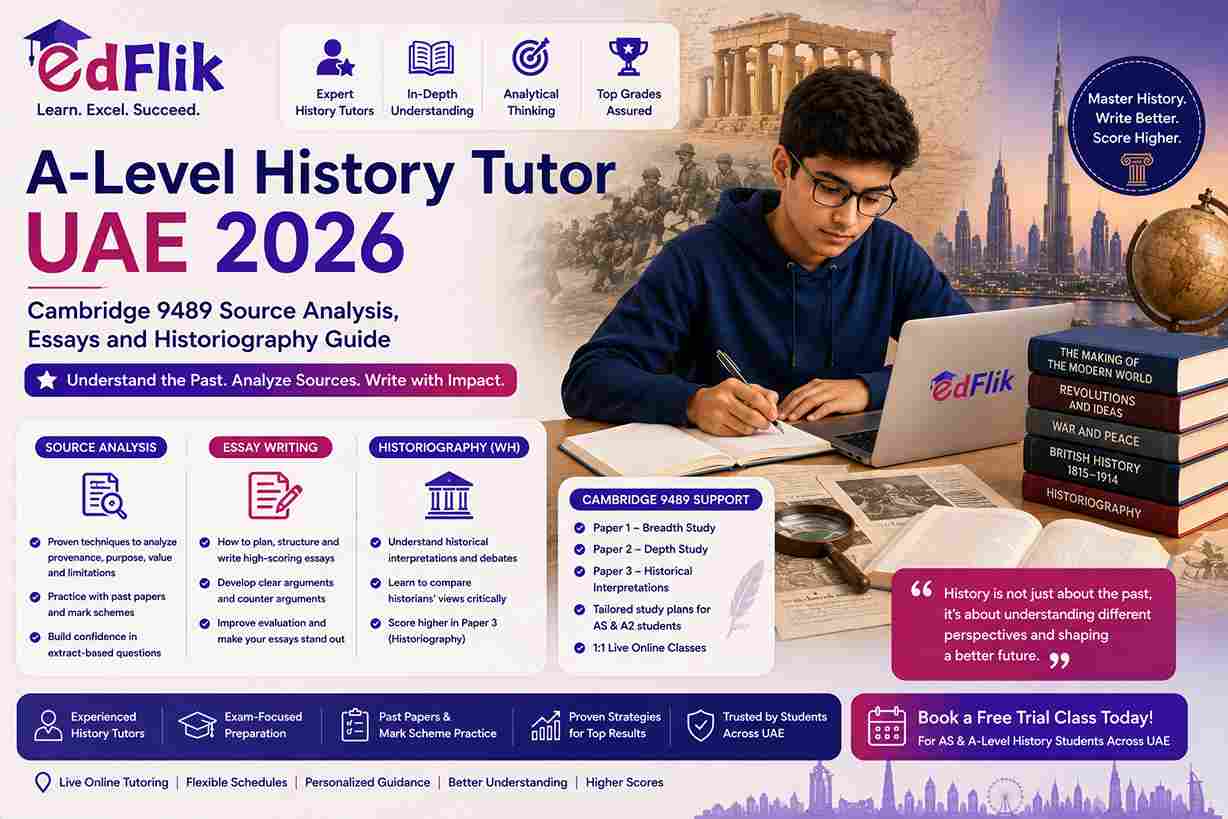
A-Level History (Cambridge 9489) is one of the most popular humanities A-Levels at UAE British curriculum Sixth Forms — and the subject where the gap between students who understand history and students who write history essays at A-grade level is most pronounced. The distinction is entirely about analytical writing: A-Level History examiners do not reward students who know more history, they reward students who argue more effectively using historical evidence. This guide covers the specific writing skills, source analysis frameworks, and historiographical awareness that produce high-grade Cambridge A-Level History results.
Cambridge A-Level History (9489) — Paper Structure
|
Paper |
What It Tests |
Duration |
Mark
Allocation |
Key Skill |
|
Paper 1 —
Document Study |
Historical
sources analysis — evaluate sources for value and limitations as historical
evidence |
2 hours |
40 marks |
OPCVL source
evaluation; cross-referencing multiple sources; assessing historical
significance |
|
Paper 2 —
Historical Essay |
Extended
analytical essay on a thematic or regional historical study |
2 hours |
40 marks |
Analytical
essay structure; argument-led paragraphs; historiographical awareness |
|
Coursework |
Independent
historical enquiry comparing historical interpretations of a topic within the
studied period |
Up to 3,500
words |
40 marks |
Historiographical
comparison; primary and secondary source evaluation; sustained argument
construction |
The Most Important Distinction: Analytical vs Narrative Writing
A-Level History is the subject where this distinction matters most. Two student responses to "Why did the First World War break out in 1914?":
Narrative response (earns Level 2-3): "In 1914, the assassination of Franz Ferdinand in Sarajevo sparked a series of events that led to war. Austria-Hungary issued an ultimatum to Serbia. Serbia did not accept all terms. Austria-Hungary declared war on Serbia. Russia began to mobilise..."
Analytical response (earns Level 4-5): "The outbreak of war in 1914 is best explained by the rigidity of the alliance systems rather than the immediate trigger of the Sarajevo assassination. Fischer argued that German aggression drove European powers toward war, while Taylor's revisionist account emphasised the role of railway timetables in making war inevitable once mobilisation began. The evidence suggests that systemic factors — alliance obligations, the Schlieffen Plan's inflexibility, Russian mobilisation protocol — constrained diplomatic options more decisively than any single political decision..."
The analytical response makes an argument in the first sentence, references historiographical debate, and uses evidence to support a position. The narrative response tells a story. Cambridge marks the argument.
Source Analysis — The OPCVL Framework Applied
Paper 1 document questions ask students to evaluate sources for their value and limitations. The OPCVL framework provides the structure:
|
OPCVL Element |
What to
Address |
Common Error
to Avoid |
|
Origin |
Who wrote it?
When? In what context (personal letter, official speech, propaganda poster,
memoir)? |
Simply naming
the author without addressing how their position affects the source's
reliability or bias |
|
Purpose |
Why was it
produced? For whom? With what intent? |
Conflating
origin and purpose — they are different questions; a politician's speech has
an origin (politician, date) and a purpose (to persuade a specific audience
of a specific position) |
|
Content |
What does the
source say, show, or claim? What is its central message? |
Copying out
long passages instead of summarising the key point and connecting it to the
historical question |
|
Value |
How is this
source useful to a historian studying this topic? What does it reveal about
attitudes, events, or decision-making? |
Saying a
source is "valuable because it is primary" — primacy alone does not
determine value; what specific historical question it illuminates is the key |
|
Limitation |
What does the
source not show? What bias, omission, or selective emphasis is evident? |
Saying a
source is "biased" without explaining specifically what the bias is
and how it affects the source's reliability for the specific question |
Historiography — What UAE Students Need to Know
For each major topic in Cambridge A-Level History, knowing 2-3 historians and their arguments is sufficient for upper-band marks. Examples for commonly studied A-Level History topics:
• World War One origins: AJP Taylor (revisionist — Serbian crisis and alliance system, not deliberate German aggression); Fritz Fischer (intentionalist — German aggression drove events); John Keegan (military factors — inflexibility of war plans made war inevitable once mobilisation began)
• Hitler and Nazi Germany: Ian Kershaw (Hitler's ideology and decision-making); Richard Evans (structural factors in the Nazi state); Intentionalists vs Structuralists (debate over whether the Holocaust was a planned programme from the outset or evolved from cumulative radicalisation)
• Cold War: John Lewis Gaddis (revisionist US perspective); E.H. Carr (structural causes of superpower rivalry)
|
EdFlik
A-Level History tutors are Cambridge 9489 specialists — analytical essay
structure, OPCVL source analysis, historiographical framework building, and
coursework guidance within Cambridge Academic Integrity Policy. From AED 65
per session. Free diagnostic. Book at www.edflik.com or WhatsApp +91 88788
96600. |
Frequently Asked Questions
Q: What does Cambridge A-Level History (9489) cover?
Paper 1 (document study, 2 hours), Paper 2 (historical essay, 2 hours), and coursework (historical enquiry, up to 3,500 words). Topics vary by school option selection — commonly European, international, or regional history from 1789 onward.
Q: What is source analysis in A-Level History and how is it marked?
Evaluating historical documents for value and limitations using OPCVL (Origin, Purpose, Content, Value, Limitation). Cambridge rewards analytical precision — how origin and purpose affect a source's value for a specific historical question — not mere description.
Q: How should A-Level History essays be structured?
Analytically, not narratively. Every paragraph opens with an argument (Point), supports it with specific historical evidence (Evidence), explains how evidence proves the point (Explanation), and links back to the question (Link). Chronological storytelling earns Level 2-3 at most.
Q: What is historiography in A-Level History?
How historians have interpreted historical events — schools of historical thought, debates between named historians, and how understanding has evolved. Cambridge awards upper bands for referencing specific historians (AJP Taylor, Fischer, Kershaw) and explaining why they disagree.
Q: How is A-Level History coursework assessed at Cambridge?
3,000-3,500 word historical enquiry comparing historical interpretations. Marked on: knowledge and understanding, source evaluation, argument construction, communication quality. Teacher-marked and Cambridge-moderated. Focus is historiographical debate, not event narration.