A-Level Maths Tutor UAE 2026 — Cambridge 9709 Pure, Statistics and Mechanics Guide
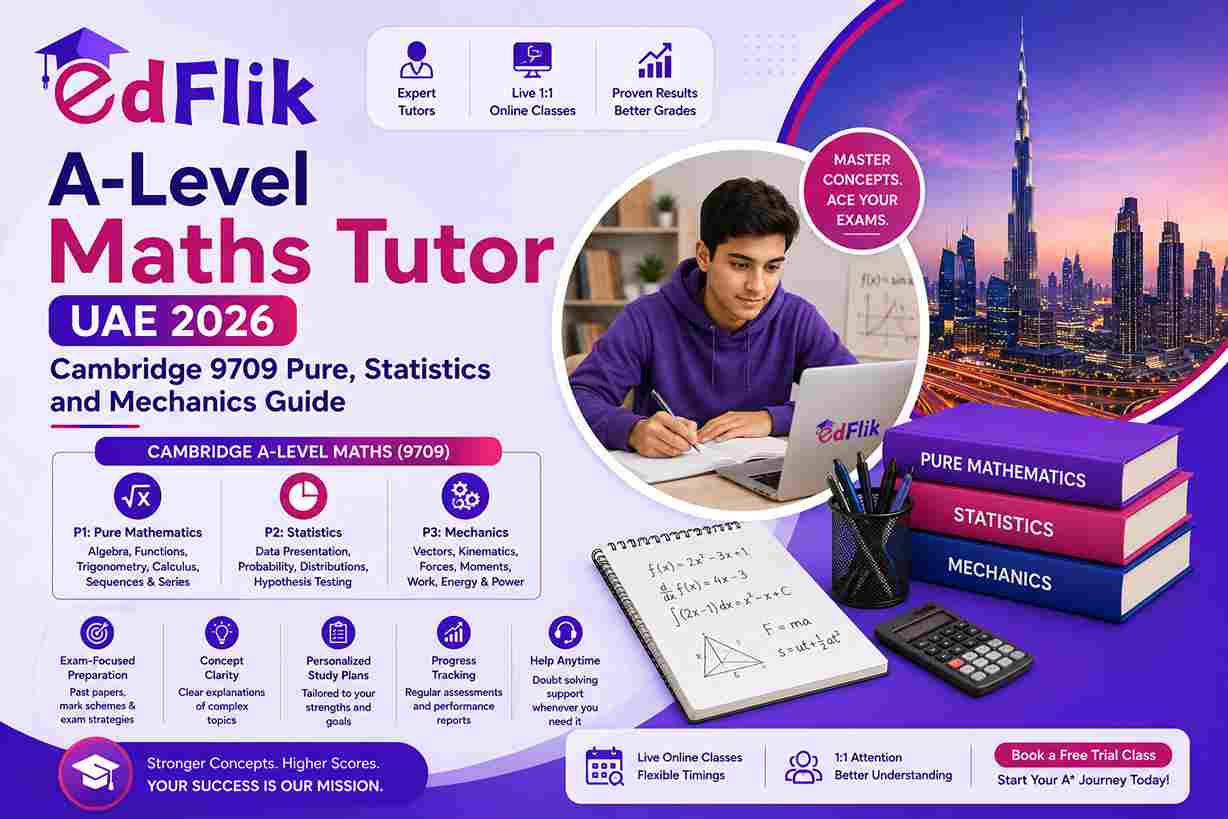
A-Level Mathematics (Cambridge 9709) is the most-taken A-Level subject at UAE British curriculum schools — and the one where the difficulty jump from Year 12 to Year 13 most consistently catches students unprepared. A-Level Maths begins with familiar algebra and introduces calculus gradually in Year 12. By Year 13, the content has moved to complex numbers, advanced integration techniques, differential equations, and vectors in 3D — a significant mathematical leap that students who have managed without tutoring in Year 12 frequently find difficult to handle without support. This guide covers the full A-Level Maths structure, the highest-priority Year 13 topics, and what effective tutoring provides.
Cambridge A-Level Maths (9709) — What Each Paper Covers
|
Paper |
Year |
Content |
Duration |
Marks |
|
Paper 1 — Pure
Maths 1 |
Year 12 / AS |
Algebra
(quadratics, functions, transformation of graphs), coordinate geometry,
trigonometry (ratios, identities, sine/cosine rule), differentiation
(product/chain/quotient rules), integration (reverse differentiation, area) |
1h 45min |
75 marks |
|
Paper 2 — Pure
Maths 2 |
Year 12 / AS |
Further
algebra (polynomial division, partial fractions), trigonometry (compound
angles, double angle), logarithms and exponentials, calculus (implicit
differentiation, integration by substitution) |
1h 15min |
50 marks |
|
Paper 3 — Pure
Maths 3 |
Year 13 / A2 |
Complex
numbers, vectors in 3D, differential equations (first order), numerical
methods (Newton-Raphson, iteration), advanced integration (by parts, partial
fractions) |
1h 45min |
75 marks |
|
Paper 4 —
Mechanics 1 OR Statistics 1 |
Year 12 or 13 |
Mechanics:
forces, kinematics, Newton's laws, moments / Statistics: data representation,
probability, binomial distribution, normal distribution, hypothesis testing |
1h 15min |
50 marks |
|
Paper 5 —
Probability and Statistics 1 |
Year 12 or 13 |
Data
representation, probability, discrete random variables, Poisson distribution,
normal distribution |
1h 15min |
50 marks |
|
Paper 6 —
Statistics 2 |
Year 13 |
Sampling,
estimation, hypothesis testing, chi-squared, correlation and regression |
1h 15min |
50 marks |
Year 13 — The Three Hardest Topics
1. Advanced Integration (Paper 3)
Year 13 Pure Maths introduces three integration techniques not covered in Year 12: integration by parts (∫u dv = uv - ∫v du — applying the LATE rule: Logarithm, Algebraic, Trigonometric, Exponential to choose u), integration by substitution (recognising f(g(x))g'(x) form and substituting u = g(x)), and integration using partial fractions (splitting a rational function into simpler fractions before integrating). Each requires a specific recognition pattern before the technique can be applied — the most common Year 13 error is applying the wrong technique to a question.
2. Differential Equations
A-Level Maths introduces two methods for first-order ordinary differential equations: variable separable (separating variables to opposite sides and integrating both sides independently — used when dy/dx = f(x)g(y)) and the integrating factor method (for equations in the form dy/dx + P(x)y = Q(x) — multiply through by e^(∫P dx) to make the left side an exact derivative). The most common error: failing to include the constant of integration correctly, or applying the variable separable method to a non-separable ODE.
3. Complex Numbers
Year 13 complex numbers require: Argand diagram representation (real axis horizontal, imaginary axis vertical); modulus-argument (polar) form r(cosθ + i sinθ) or re^(iθ); multiplication and division in polar form; De Moivre's theorem for integer and fractional powers; finding nth roots of complex numbers. Students who have not encountered complex numbers before Year 13 find this the most conceptually unfamiliar topic in A-Level Maths.
A-Level Maths vs IGCSE — The Transition Gap
Students who achieved grade A or A* in IGCSE Extended Maths have a good foundation for Year 12 A-Level Maths — but the transition involves genuine new content that builds quickly. The most important pre-Year-12 gaps to close:
• Algebraic fluency: A-Level assumes rapid, accurate algebraic manipulation — students who had to work slowly through algebra at IGCSE will find the pace of A-Level overwhelming without explicit speed practice
• Trigonometry: IGCSE trigonometry covers basic ratios; A-Level begins with identities (sin²θ + cos²θ = 1; tan θ = sin θ/cos θ) and compound angle formulae — typically not covered in IGCSE
• Functions and transformations: IGCSE covers function notation briefly; A-Level begins with composite functions, inverse functions, and graph transformations — deeper treatment requiring explicit revision before September
|
EdFlik
A-Level Maths tutors are Cambridge 9709 specialists — separate from IGCSE and
IB specialists. Sessions target the specific paper, component, and Year 12 or
Year 13 stage of each student. From AED 65 per session (Year 12); AED 70 per
session (Year 13). Free diagnostic. Book at www.edflik.com or WhatsApp +91
88788 96600. |
Frequently Asked Questions
Q: What does Cambridge A-Level Maths (9709) cover?
Six papers across two years: Pure Maths 1 (Year 12), Pure Maths 2 (Year 12), Pure Maths 3 (Year 13 — hardest), and three applied papers (Mechanics 1, Statistics 1 and 2 — school chooses the combination). Pure papers carry the most marks.
Q: What is the hardest part of A-Level Maths for UAE students?
Year 13 Pure Maths 3: advanced integration techniques (by parts, by substitution, partial fractions), differential equations (variable separable and integrating factor), and complex numbers (Argand diagram, polar form, De Moivre's theorem).
Q: How is A-Level Maths different from IGCSE Extended Maths?
A-Level introduces calculus from first principles, advanced algebra (partial fractions, binomial series), compound angle trigonometry, 3D vectors, and proof by induction — all significantly beyond IGCSE Extended content. A* at IGCSE is necessary but not sufficient for comfortable Year 12 A-Level Maths.
Q: Which UAE schools offer A-Level Maths?
All UAE British curriculum Sixth Forms — Repton, Brighton College, Cranleigh, BSAK, Kings, Nord Anglia, Regent, and GEMS Sixth Form schools all offer Cambridge 9709. A-Level Further Maths (9231) at a smaller number including GEMS Wellington, Repton, Brighton, and Cranleigh.
Q: Should UAE students take A-Level Maths or IB Maths AA HL?
Determined by which school the student attends — you cannot mix A-Level and IB qualifications. If at a British A-Level school, Cambridge 9709 is the route. Both lead to equivalent university outcomes for STEM and competitive degree applications.