
A-Level Law Tutor UAE 2026 — Cambridge 9084 Essay Technique, Cases and Legal Reasoning Guide
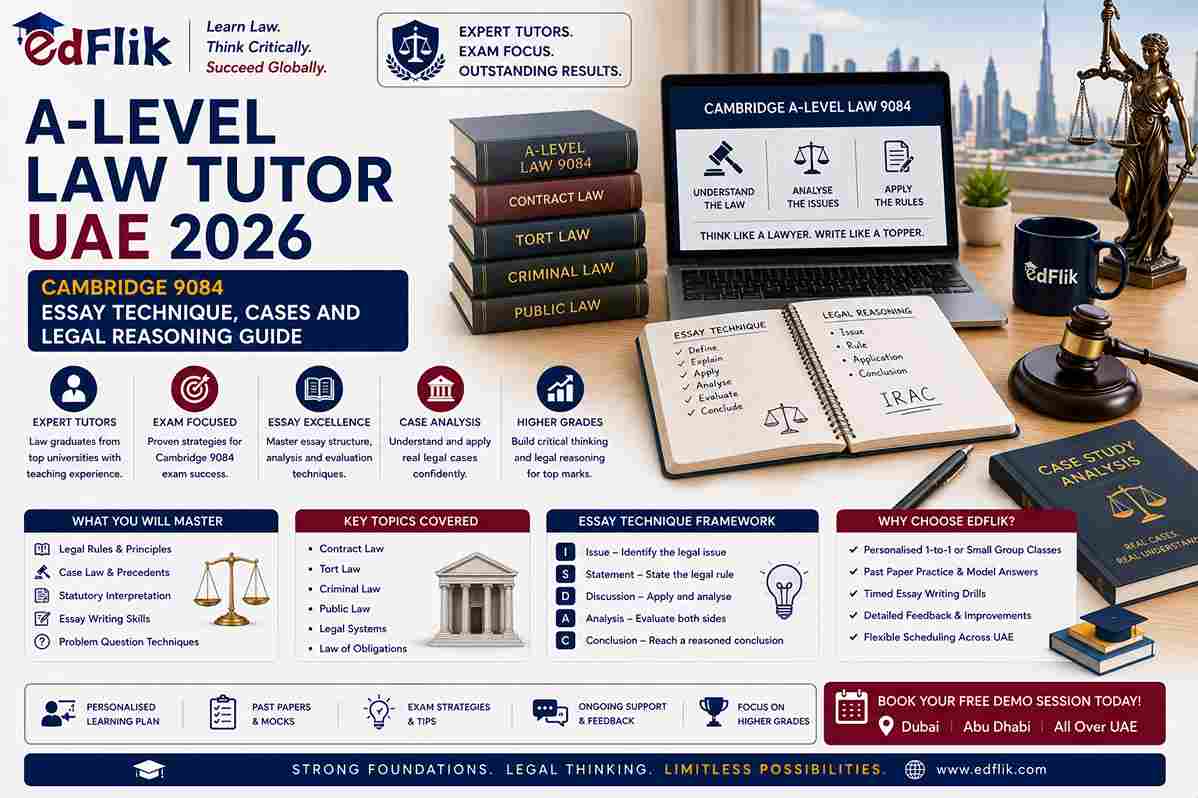
A-Level Law (Cambridge 9084) is a powerful A-Level choice for UAE students targeting Law, Politics, Philosophy, or any degree where analytical writing and structured reasoning are central skills. It is also frequently misunderstood — most UK Law degrees do NOT require A-Level Law, and most universities value broad analytical subjects alongside it. This guide covers what A-Level Law actually teaches, the IRAC problem-solving method that drives marks, and the specific techniques that differentiate grade A from grade B responses.
A-Level Law in UAE — Who Should Consider It
A-Level Law is most valuable for students who:
• Are genuinely interested in how the legal system works and find legal reasoning intellectually engaging
• Write analytically well and enjoy building structured arguments from rules and evidence
• Are considering Law, Politics, International Relations, Criminology, or PPE at university
• Attend a UAE Sixth Form that offers it — or are willing to study it as a private candidate via online tutoring and sit Cambridge papers independently
|
A-Level Law
is NOT required by UK Law schools including Oxford, Cambridge, UCL, LSE,
Durham, or Exeter. Admissions tutors at these schools look for evidence of
reading, analytical thinking, and genuine interest in law demonstrated
through the UCAS personal statement and super-curricular engagement. A
student with AAA in History, English, and Economics is equally competitive
with one who has AAA including Law. |
Cambridge A-Level Law (9084) — Content Overview
|
Component |
Paper |
Content Areas |
|
AS Level —
Paper 1 |
The Legal
System and Contract Law |
Court
hierarchy and personnel; sources of law (statute, precedent, delegated
legislation); statutory interpretation rules (literal, golden, mischief,
purposive); doctrine of precedent (ratio decidendi, obiter dicta,
distinguishing, overruling); formation of contract (offer and acceptance,
consideration, intention to create legal relations); contract terms,
vitiating factors (misrepresentation, mistake, duress, undue influence);
remedies |
|
A2 Level —
Paper 2 |
Law of Tort |
Negligence
(duty of care — Caparo test, breach, causation, remoteness of damage);
occupiers liability (Occupiers Liability Acts 1957 and 1984); nuisance
(private and public); Rylands v Fletcher; psychiatric injury (primary and
secondary victims); defences (contributory negligence, volenti); remedies in
tort (damages, injunctions) |
|
A2 Level —
Paper 3 |
Criminal Law |
Actus reus
(acts, omissions, causation); mens rea (intention, recklessness, negligence);
coincidence of AR and MR; specific offences (murder, voluntary and
involuntary manslaughter, GBH, ABH, assault, battery); defences
(self-defence, consent, intoxication, insanity, automatism, duress,
necessity) |
The IRAC Method — The Most Important Technique in A-Level Law
Problem scenario questions in A-Level Law require applying legal rules to specific fact situations. The IRAC framework ensures all marks are earned:
|
IRAC Step |
What It
Requires |
Mark-Earning
Behaviour |
|
Issue |
Identify the
specific legal question raised by the scenario |
State the
precise legal issue: "The issue is whether D is liable in negligence for
the psychiatric injury suffered by C" |
|
Rule |
State the
correct legal rule with the relevant case name |
Name the case
that established the rule AND state what the case decided: "In Caparo
Industries v Dickman [1990] the courts established a three-part test for duty
of care: foreseeability, proximity, and fair, just and reasonable" |
|
Application |
Apply the rule
to the specific facts of the scenario |
Apply directly
to the scenario facts — not a general restatement of the rule: "In this
case, it was foreseeable that D's driving would injure a bystander such as C,
as..." |
|
Conclusion |
State how the
law would apply to reach a specific outcome |
"Therefore,
D is likely to be found liable in negligence and C may recover damages for
psychiatric injury" |
The Most Common UAE Student Error in IRAC
Stating the legal rule without applying it to the specific scenario facts. A response that says "The defendant must owe a duty of care, breach it, and cause the claimant's damage" — without then working through each element against the specific facts of the scenario — earns only rule marks, not the significantly higher-value application marks.
Essay Question Technique — Law Reform and Evaluation
A-Level Law essay questions ask students to evaluate legal rules, discuss reform proposals, or critically assess how a legal principle operates. Grade A essays in A-Level Law:
• Describe the legal rule accurately with relevant cases as authorities
• Evaluate the rule — what it achieves well, what its limitations are, where it produces inconsistent or unfair outcomes
• Discuss reform — what has been proposed by the Law Commission or other bodies, whether it has been implemented, whether it would improve the law
• Reach a justified conclusion about whether the current law is satisfactory or whether reform is needed
Essential Cases for Each A-Level Law Component
|
Area of Law |
Essential
Cases |
What Each
Establishes |
|
Contract —
Offer and Acceptance |
Carlill v
Carbolic Smoke Ball Co [1893]; Hyde v Wrench [1840]; Adams v Lindsell [1818] |
An
advertisement can be a binding offer to the world; counter-offer destroys
original offer; postal rule — acceptance effective on posting |
|
Contract —
Consideration |
Currie v Misa
[1875]; Chappell & Co v Nestlé [1960]; Williams v Roffey Bros [1990] |
Definition of
consideration; adequacy not required; practical benefit as consideration |
|
Negligence |
Donoghue v
Stevenson [1932]; Caparo v Dickman [1990]; Bolam v Friern Hospital [1957] |
Neighbour
principle; three-part duty test; professional standard of care |
|
Psychiatric
Injury |
Alcock v Chief
Constable [1991]; White v Chief Constable [1999] |
Primary vs
secondary victim distinction; requirements for secondary victim claims |
|
Murder and
Manslaughter |
R v Woollin
[1998]; R v Cunningham [1957]; R v Adomako [1994] |
Oblique
intention definition; subjective recklessness test; gross negligence
manslaughter |
|
EdFlik
A-Level Law tutors are Cambridge 9084 specialists covering IRAC problem
scenario technique, essay evaluation and reform, and case knowledge for all
three papers. From AED 70 per session. Free diagnostic trial. Book at
www.edflik.com or WhatsApp +91 88788 96600. |
Frequently Asked Questions
Q: Is A-Level Law available in UAE schools?
Yes, at selected UAE Sixth Forms. Students at schools without A-Level Law can study it online and register as a private candidate through British Council UAE for the Cambridge 9084 examinations.
Q: Is A-Level Law required to study Law at university?
No — most UK Law universities including Oxford, Cambridge, and UCL do not require A-Level Law. Strong analytical subjects like History, English, and Economics are equally valued.
Q: What does A-Level Law (Cambridge 9084) cover?
English Legal System and Contract Law (Paper 1), Law of Tort — negligence, nuisance, psychiatric injury (Paper 2), and Criminal Law — murder, manslaughter, non-fatal offences, defences (Paper 3).
Q: What is the most important skill in A-Level Law?
IRAC (Issue, Rule, Application, Conclusion) — the framework for problem scenario questions. Application to specific scenario facts (not generic rule restatement) is where most marks are earned.
Q: How are A-Level Law exams structured?
Three papers of 1h 30min each: Paper 1 (Legal System and Contract), Paper 2 (Tort), Paper 3 (Criminal Law). Each paper has both essay questions and problem scenarios requiring IRAC.