A-Level Physics Tutor UAE 2026 — Cambridge 9702 Electricity, Quantum Mechanics and Exam Technique
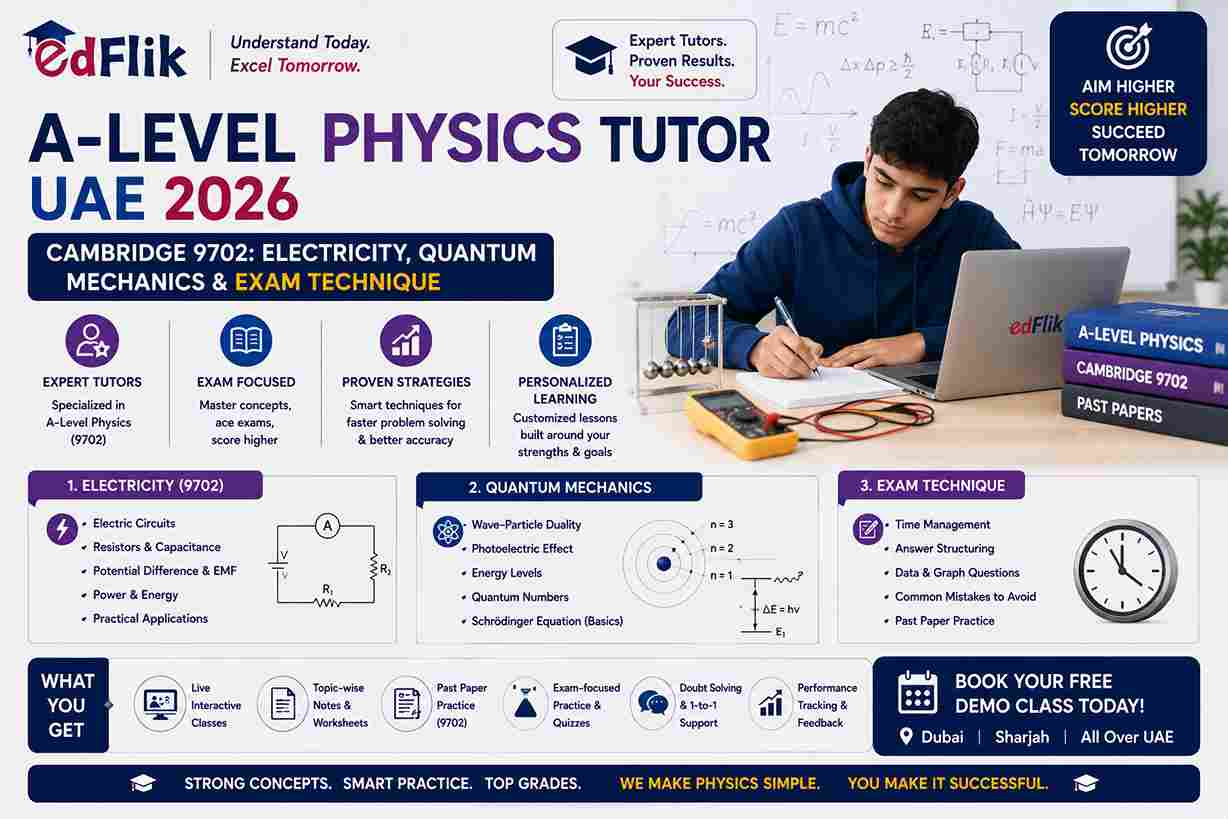
A-Level Physics (Cambridge 9702) is the mandatory science for Engineering, Physics, Architecture, and most STEM programmes at competitive UK and UAE universities. In the UAE, where thousands of students each year apply to Engineering programmes at Khalifa University, Imperial College London, UCL, and Manchester, A-Level Physics is simultaneously the most important and most challenging science credential. This guide covers the five hardest A2 topics, the unique Cambridge Paper 5, and the exam technique that separates A and A* from B and C.
A-Level Physics in UAE Schools — Cambridge 9702 Paper Structure
|
Paper |
Content |
Duration |
% of A-Level |
|
Paper 1 (AS) |
Multiple
choice — AS content |
1 hour 15 min |
15% |
|
Paper 2 (AS) |
Structured
questions — AS content, data analysis |
1 hour 15 min |
25% |
|
Paper 4 (A2) |
Structured
questions — A2 content |
2 hours |
35% |
|
Paper 5 (A2) |
Planning,
Analysis and Evaluation — novel experimental scenario |
1 hour 15 min |
15% |
|
AS
qualification (optional) |
Papers 1 + 2
only |
— |
— |
The 5 Hardest A-Level Physics Topics for UAE Students
1. Electric Fields and Capacitor Charging/Discharging
Electric field calculations (E = V/d for uniform fields; E = Q/4πεᵣε₀r² for radial fields), capacitance (C = Q/V), capacitors in series and parallel, and the exponential charging/discharging equations (Q = Q₀e^(-t/RC); time constant τ = RC) are all A2 topics. The exponential relationship appears in multiple contexts across A-Level Physics — students who understand it in capacitors find it transfers to nuclear decay and SHM energy.
2. Quantum Mechanics and the Photoelectric Effect
The photoelectric effect requires understanding: photon energy E = hf; work function φ (minimum energy to release an electron); maximum kinetic energy Eₖ = hf - φ; stopping potential Vₛ (eVₛ = Eₖ). Graphs of stopping potential vs frequency and maximum kinetic energy vs frequency are frequently asked in data response questions. Students must also know wave-particle duality, de Broglie wavelength (λ = h/mv), and energy levels with photon emission/absorption.
3. Nuclear Physics — Decay, Half-Life and Binding Energy
Radioactive decay calculations: A = A₀e^(-λt) and N = N₀e^(-λt) where λ is the decay constant; half-life t₁/₂ = ln2/λ. Nuclear binding energy: B = (Zm_p + Nm_n - M)c². Mass-energy equivalence: ΔE = Δmc². Students must know the nuclear notation and be able to balance nuclear equations (alpha, beta-minus, and beta-plus decay). Nuclear fission and fusion with energy calculations appear in most A2 Paper 4 examinations.
4. Circular Motion and Simple Harmonic Motion
Circular motion requires: centripetal acceleration a = v²/r = ω²r; centripetal force F = mv²/r = mω²r; angular velocity ω = 2π/T. Simple harmonic motion (SHM): acceleration a = -ω²x (the defining equation); x = x₀sin(ωt) or x₀cos(ωt); v = ±ω√(x₀²-x²); energy (KE maximum at x=0, PE maximum at x=±x₀). The combined treatment of circular motion and SHM (the link between the two through the projection model) appears in examiner reports as a consistent area of student difficulty.
5. Electromagnetic Induction — Faraday and Lenz's Laws
Faraday's Law: EMF = -dΦ/dt (the rate of change of flux linkage). Lenz's Law: the induced EMF opposes the change in flux that caused it (negative sign in Faraday's Law). Applications: generators, transformers (Vₛ/Vₚ = Nₛ/Nₚ = Iₚ/Iₛ for ideal transformers), and the force on a conductor (F = BIl sinθ). The EMF in a rotating coil (EMF = BANω sinωt) requires connecting SHM and electromagnetic induction.
Cambridge Paper 5 — Planning, Analysis and Evaluation
Paper 5 presents a novel experimental scenario and requires students to apply the general experimental logic framework — not specific content knowledge. Key skills required:
• Planning: Identify the independent variable (what you change), dependent variable (what you measure), and control variables (what you keep constant). Suggest apparatus with appropriate precision. Describe the experimental procedure in enough detail to be repeatable.
• Analysis: Process the given data. Use log-log or ln-linear graphs to determine relationships between variables. Find the gradient and y-intercept of straight-line graphs and relate them to physical quantities.
• Evaluation: Identify specific limitations of the method (not "human error" — examiners explicitly mark this as insufficient). Suggest specific, realistic improvements.
|
Paper 5
cannot be revised by learning specific content. It is prepared through
practising the general experimental logic framework with past Paper 5
questions — at least 10 full past papers under timed conditions before the
examination. This is the one A-Level Physics paper where technique practice
matters more than content knowledge. |
A-Level Physics Exam Technique — What Grade A Requires
The distinguishing feature of grade A and A* responses in A-Level Physics extended questions is the systematic presentation of working. Three non-negotiable technique requirements:
• Define all symbols before using them — "where F is force in Newtons, m is mass in kg, and a is acceleration in m/s²"
• Show every intermediate step — even when using a formula the examiner knows is correct, skipping intermediate steps means losing method marks if the final answer is wrong
• State physical principles before applying them — "By Newton's second law, the net force equals mass times acceleration..." before writing F = ma
|
EdFlik
A-Level Physics tutors are Cambridge 9702 specialists. Sessions target Paper
4 derivations, Paper 5 planning and analysis framework, and past paper
technique. From AED 75 per session. Free diagnostic trial. Book at
www.edflik.com or WhatsApp +91 88788 96600. |
Frequently Asked Questions
Q: Is A-Level Physics required for Engineering?
Yes — mandatory for Engineering at virtually all UK universities and UAE engineering programmes. Cambridge 9702 at grade A minimum alongside A-Level Maths is standard for competitive engineering schools.
Q: What is the difference between A-Level Physics and IGCSE Physics?
IGCSE introduces physical concepts with basic algebra. A-Level requires significantly greater mathematical precision, derivation from first principles, and deeper understanding of quantum, electromagnetic, and nuclear phenomena at a university preparation level.
Q: What are the hardest topics in A-Level Physics?
Electric fields and capacitor charging, quantum mechanics and the photoelectric effect, nuclear physics (decay, half-life, binding energy), circular motion and SHM, and electromagnetic induction with Faraday and Lenz's laws.
Q: What is Cambridge A-Level Physics Paper 5?
A 1 hour 15 minute paper (15% of A-Level) presenting a novel experimental scenario requiring students to plan an investigation, process hypothetical data, and evaluate the procedure. Cannot be prepared through content revision alone — requires practising the experimental logic framework with past papers.
Q: When should UAE students start A-Level Physics tutoring?
September of Year 12 is ideal. Students struggling in November assessments should start by October. Paper 5 preparation should begin no later than February of Year 13.