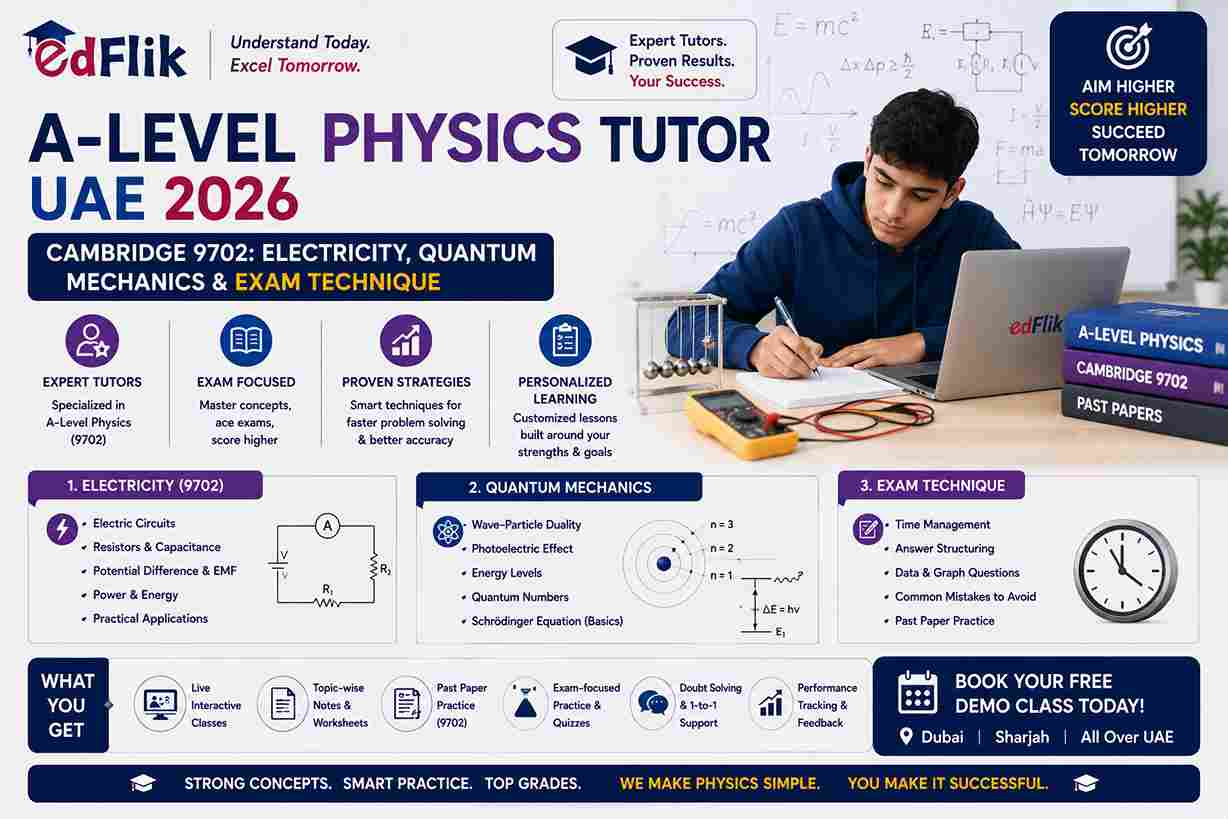
A-Level Physics Tutor in the UAE: Mastering Cambridge 9702 from AS to A2
Cambridge A-Level Physics (9702) is widely regarded as one of the most demanding subjects on the A-Level timetable. Students across the UAE — studying at international schools in Dubai, Abu Dhabi, Sharjah, Ras Al Khaimah, and beyond — frequently find that the transition from IGCSE Physics to A-Level represents a step change in difficulty that catches them unprepared. The mathematical demands increase sharply, the conceptual depth moves into territory that is genuinely counterintuitive, and the examination questions require a precision of expression that few students develop without targeted practice. This guide explains the structure of Cambridge 9702, the topics that students find hardest, and how a specialist A-Level Physics tutor can make the difference.
Why A-Level Physics Is a Genuine Step Change from IGCSE
At IGCSE level, Physics is largely qualitative — students describe phenomena, recall definitions, and perform relatively straightforward calculations. At A-Level, the demands shift fundamentally:-
· Mathematical depth: A-Level Physics requires confident use of calculus concepts (rates of change, integration, differential equations), vector analysis, trigonometry, and logarithmic relationships. Students who are not comfortable with A-Level Mathematics alongside Physics are at a significant disadvantage.
· Conceptual precision: A-Level Physics rewards precise explanation — using correct terminology, distinguishing between related but distinct concepts (such as velocity and speed, or electric field strength and electric potential), and explaining the physics behind phenomena rather than just describing them.
· Extended problem-solving: A-Level Physics questions require students to work through multi-step calculations, often combining two or three areas of physics in a single question, without being told which approach to use.
· Data analysis: Paper 5 (the planning and analysis paper) requires students to analyse experimental data, identify relationships between variables, process and graph data correctly, and evaluate experimental methods — skills that are entirely different from content recall.
Cambridge 9702 Paper Structure
Cambridge A-Level Physics 9702 is examined through five papers:
· Paper 1 (AS): 40 multiple-choice questions testing AS content — mechanics, waves, electricity, and introductory quantum physics.
· Paper 2 (AS): Structured questions requiring written responses across AS topics. This paper tests understanding, application, and mathematical problem-solving at AS level.
· Paper 3 (AS Practical): A laboratory-based examination (or school-reported practical assessment) testing experimental skills including measurement, data collection, graphing, and evaluation of experimental procedures.
· Paper 4 (A2): Structured questions on the A2 content, which extends into gravitational and electric fields, capacitors, magnetic fields, electromagnetic induction, nuclear physics, medical imaging, and astrophysics.
· Paper 5 (A2 Planning and Analysis): Students are given an experimental scenario and must plan an experiment, identify variables, predict expected outcomes, process provided data, and analyse sources of error.
The Hardest Topics in Cambridge A-Level Physics
The topics that cause the most difficulty for students in UAE international schools, based on examiner reports and common tutoring requests, are:
· Gravitational and electric fields (Paper 4): The parallelism between gravitational and electric field equations is conceptually elegant but often confusing — students mix up the equations, forget sign conventions, or misapply the inverse-square law.
· Quantum physics: Wave-particle duality, the photoelectric effect, and energy levels in atoms require students to reason in ways that are fundamentally different from classical physics. The mathematics is not particularly complex, but the conceptual reasoning demands careful study.
· Circular motion and simple harmonic motion: These topics require confident mathematical treatment of sinusoidal functions and the ability to relate kinematics to force analysis.
· Capacitors: The charging and discharging of capacitors involves exponential decay, RC time constants, and the graphical treatment of logarithmic relationships — all of which require both mathematical and conceptual fluency.
· Electromagnetic induction: Faraday's law, Lenz's law, and the application of Fleming's rules to generators and transformers consistently appear in examination questions and require precise, step-by-step reasoning.
Calculation Technique: Where Marks Are Won and Lost
In A-Level Physics, the way a student sets out a calculation is as important as reaching the correct numerical answer. The Cambridge mark scheme awards marks at each step of a multi-mark calculation, which means:
· Always state the formula you are using before substituting values.
· Show each step of the algebra or arithmetic, even if it seems obvious.
· Include units at each stage of the calculation, and check dimensional consistency.
· Quote the final answer to an appropriate number of significant figures — usually two or three, consistent with the data given.
· If you reach an incorrect answer, you can still earn marks for correct method — but only if the method is clearly shown.
A Physics tutor will work through past paper calculations with students systematically, identifying exactly where marks are being lost — whether from formula recall, algebraic errors, unit conversion mistakes, or presentation issues — and correcting these specifically.
Paper 5: Planning and Data Analysis
Paper 5 is the A2 Physics paper that most students find hardest to prepare for, because it is unlike anything they have encountered before. Students are given an unfamiliar experimental scenario and must:
· Identify the independent and dependent variables and those that must be controlled.
· Describe a valid experimental procedure, including equipment and safety precautions.
· Predict the expected relationship between variables and state how to test for it graphically.
· Process provided data — often including taking logarithms, calculating gradients, and determining quantities from graphs.
· Evaluate the experimental method, identify sources of uncertainty, and suggest improvements.
This paper rewards a very specific skill set that is entirely distinct from the content knowledge tested in Papers 1, 2, and 4. Focused tutoring on Paper 5 technique — working through past Paper 5 questions and understanding the specific language and structure the mark scheme rewards — is one of the highest-return investments an A-Level Physics student can make.
How UAE Students Struggle with Data Analysis
Students in UAE international schools often have strong content knowledge but weaker data-analysis skills. The practical examination traditions in many school systems focus on following procedures rather than developing genuine experimental reasoning. Paper 5 requires students to think like experimental physicists — generating hypotheses, identifying sources of error, and interpreting imperfect data. An A-Level Physics tutor who understands Paper 5 specifically can bridge this gap significantly.
EdFlik's A-Level Physics Tutoring in the UAE
EdFlik's A-Level Physics tutors are experienced teachers with deep knowledge of Cambridge 9702 at both AS and A2 levels. All sessions are live, one-to-one, and online — available to students across the UAE. Pricing starts from AED 45, and a free trial class is available. Visit edflik.com to book.
Frequently Asked Questions
Should I study A-Level Mathematics alongside A-Level Physics?
Strong mathematical skills are essential for success in Cambridge A-Level Physics 9702. The syllabus explicitly requires use of calculus, trigonometry, exponential functions, and logarithmic relationships. Many students in UAE international schools study A-Level Mathematics and Physics alongside each other, which provides the mathematical foundation the Physics course demands. Students who are taking A-Level Physics without A-Level Mathematics (or an equivalent) will need to ensure they are comfortable with these mathematical techniques, and tutoring can help bridge specific mathematical gaps as they arise in the Physics syllabus.
How long does it typically take to improve significantly in A-Level Physics with tutoring?
Most students who begin regular A-Level Physics tutoring (one session per week, minimum) show measurable improvement within six to eight weeks — particularly in Paper 2 structured question technique and calculation methodology. Improvement in Paper 4 (the more conceptually demanding A2 content) typically takes longer because the concepts need time to settle. Paper 5 skills can be developed relatively quickly — often in four to six focused sessions — because the technique is very specific and learnable. The students who improve most quickly are those who attempt past paper questions between tutoring sessions and come to each session with specific questions about what they found difficult.
Are the AS Level and A Level Physics syllabuses examined separately or together?
In the Cambridge 9702 system, AS Level is examined at the end of the first year through Papers 1, 2, and 3. Students can opt to take the AS Level as a standalone qualification, or continue to the full A Level by completing Papers 4 and 5 at the end of the second year. Some UAE international schools enter students for the AS examination at the end of Year 12 and the full A Level at the end of Year 13; others only enter students for the full A Level at the end of Year 13. It is important to confirm your child's school's approach to know which papers are being targeted at each stage of tutoring.
My child is finding Paper 4 (A2) much harder than Paper 2 (AS). Is this normal?
Yes, this is entirely normal. Paper 4 covers the A2 content — gravitational and electric fields, capacitors, electromagnetic induction, nuclear physics, and astrophysics — which represents a significant step up from the AS material. The conceptual demands are higher, the mathematical treatment is more sophisticated, and the topics are genuinely more abstract. Many students who performed well at AS level find Paper 4 challenging, and this is precisely where targeted A-Level Physics tutoring has the greatest impact. Focused work on the hardest Paper 4 topics — particularly fields, capacitors, and electromagnetic induction — combined with systematic past paper practice, typically produces the most significant mark improvements.