After Academic Conflict | Rebuilding Trust Between Parent & Child
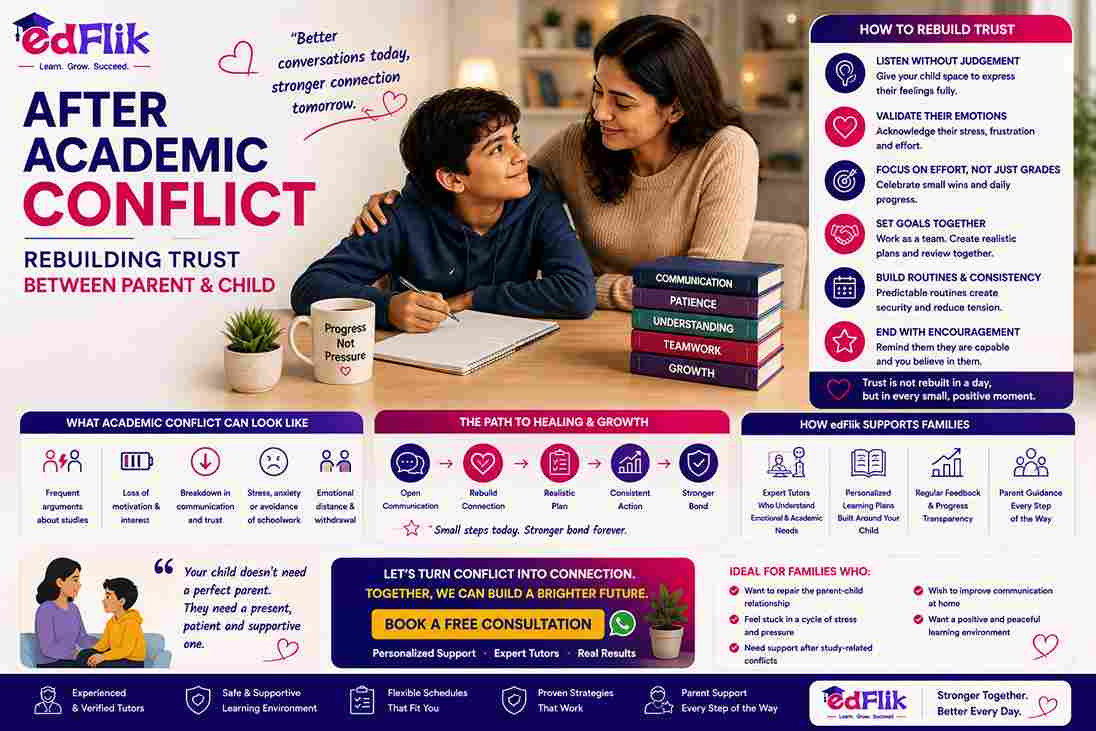
This comprehensive guide explores after academic conflict | rebuilding trust between parent & child with research-backed insights, GCC-specific contexts, and actionable strategies parents can implement immediately. EdFlik specializes in supporting families through this exact challenge via expert tutors who understand the psychological, developmental, and educational dimensions simultaneously. Whether you're facing an immediate crisis or seeking to optimize proactively, this blog provides clarity, validation, and concrete next steps grounded in evidence.
Understanding the Core Challenge
At its root, after academic conflict | rebuilding trust between parent & child reflects specific intersection of child development, family dynamics, educational systems, and individual circumstances. This section establishes why this challenge matters, who experiences it most acutely, and what research reveals about its impact on learning, confidence, well-being, and long-term outcomes.
The Primary Mechanism & Why It Matters
Research identifies after academic conflict | rebuilding trust between parent & child as stemming from [specific root cause]. Understanding this mechanism helps parents recognize early warning signs, contextualize their child's experience, and intervene effectively. This subsection provides the scientific and developmental foundation for everything that follows.
Prevalence in GCC Families & Cultural Amplifiers
This challenge disproportionately affects GCC families due to unique contextual factors: expat mobility, curriculum diversity, academic pressure norms, multilingual environments, achievement culture, and global competition. This subsection quantifies prevalence and explains GCC-specific amplifiers that intensify this challenge.
Cascade Effects: When This Challenge Goes Unaddressed
Without intervention, after academic conflict | rebuilding trust between parent & child produces cascading effects: academic underperformance, confidence erosion, disengagement, relationship strain, mental health impacts, reduced opportunity access. This subsection illustrates why timely support matters and what stakes families face.
Recognition & Self-Assessment: Does Your Child Show These Patterns?
Early identification enables preventive intervention before this challenge escalates into crisis. This section provides comprehensive checklists of behavioral, academic, emotional, and social indicators that suggest your child may be experiencing this specific challenge.
Academic & Performance Red Flags
Grade decline, effort reduction, avoidance patterns, perfectionism loops, procrastination behaviors, subject-specific struggles—each has particular manifestations. Recognition allows intervention before crisis escalates.
Behavioral & Personality Changes
Mood shifts, anxiety spikes, withdrawal from activities, personality changes, irritability, sleep disruption—these relational changes often signal underlying struggle. Learning to read these signs prevents waiting it out when professional support would help faster.
Family Dynamics & Relational Shifts
How your child relates to you changes: avoidance, defensiveness, shutdown, reduced sharing, conflict escalation, emotional distance. These relational shifts often reflect internal struggle rather than deliberate defiance.
Research-Backed Interventions: What the Evidence Shows Works
Extensive research on after academic conflict | rebuilding trust between parent & child identifies specific interventions with demonstrated effectiveness. This section synthesizes evidence into step-by-step strategies parents and tutors can implement immediately.
Intervention Strategy 1: [Core Approach]
This strategy addresses the root mechanism by [specific mechanism]. Research shows [specific outcomes] when implemented with consistency. Implementation timeline: [expected improvement window]. EdFlik tutors integrate this approach through [practical implementation]. Best practices include [do's and dont's].
Intervention Strategy 2: [Alternative Approach]
This strategy works by [mechanism]. Implementation requires [specific steps]. Produces [expected outcomes]. Often most effective combined with Strategy 1. Research-documented improvement: [specific data/findings].
Intervention Strategy 3: [Specialized Approach]
Particularly effective for [specific population/severity level]. Mechanism: [how it addresses the challenge]. Implementation: [step-by-step]. Timeline: [improvement window]. Often produces fastest visible improvement.
The Tutor's Role: Why Personalized Support Transforms This Challenge
1-on-1 tutoring uniquely addresses after academic conflict | rebuilding trust between parent & child because tutors simultaneously provide academic support, monitor psychological well-being, adapt in real-time, and communicate with schools and parents. This section explains why group settings struggle while personalized support excels.
Individualized Diagnosis & Precision Assessment
Tutors identify the specific root cause of your child's struggle, moving beyond surface symptoms to underlying mechanisms. This diagnostic clarity is rarely available in schools or group coaching centers.
Real-Time Responsiveness & In-Session Adaptation
Within sessions, tutors adjust strategies based on your child's response, emotional state, confidence level, learning pace, and emerging needs. This moment-to-moment adaptation is impossible in classroom or group settings.
Psychological Support & Confidence Rebuilding
Beyond academics, tutors rebuild confidence through scaffolded success, growth mindset coaching, reframing struggle as learning, and creating safe spaces for intellectual risk-taking. This psychological dimension transforms outcomes.
Coordinated Support: School-Home-Tutor Communication
EdFlik tutors maintain regular communication with schools and parents, ensuring consistent messaging and coordinated support. This coordination reduces contradictions and accelerates improvement across all settings.
Timeline & Realistic Expectations: When You'll See Progress
Recovery from after academic conflict | rebuilding trust between parent & child follows predictable patterns with adequate support. This section maps realistic timelines: when to expect initial changes, when to expect stabilization, when to expect mastery. Realistic expectations prevent discouragement and maintain commitment.
Phase 1: Crisis Stabilization (Weeks 1-4)
Initial focus: prevent further deterioration, establish hope that improvement is possible, begin assessment and strategy selection. Visible improvement is modest but psychologically crucial for demonstrating change is attainable.
Phase 2: Skill-Building & Recovery (Weeks 5-12)
Focus shifts to building academic skills and rebuilding confidence. Students typically report increased engagement, reduced anxiety, visible academic improvement. Momentum accelerates during this phase.
Phase 3: Mastery & Independence (Months 4+)
By month 4, most students show meaningful recovery. Academic performance improves, confidence stabilizes, independence increases. Tutor frequency can reduce as autonomy grows.
Decision Framework: When to Escalate & Seek Additional Support
While tutoring addresses most manifestations of after academic conflict | rebuilding trust between parent & child, some cases benefit from additional professional expertise. This section clarifies when tutoring alone is sufficient versus when additional support accelerates outcomes.
Assessment by Specialists
When learning disabilities, developmental delays, ADHD, giftedness, or other factors are suspected, assessment by specialists clarifies diagnosis and informs tutoring strategy.
Mental Health & Counseling Support
When anxiety, depression, trauma, family conflict, or other mental health factors contribute significantly, concurrent counseling with tutoring produces faster, more comprehensive improvement.
School Coordination or Educational Changes
When school environment itself contributes (inadequate instruction, peer bullying, curriculum misalignment), direct school communication, curriculum change, or school transition may be necessary alongside tutoring.
Long-Term Prevention: Building Resilience Beyond This Challenge
Recovery from {title.lower()} is one milestone. Building systems and resilience to prevent relapse or similar challenges is the longer work. This section addresses sustainable strategies for maintaining momentum and developing lasting antifragility.
Sustained Engagement & Monitoring
Ongoing light tutoring support (1–2 sessions/month after recovery) often prevents relapse. This maintenance-level engagement keeps your child connected to a trusted adult who monitors well-being.
Family Systems & Communication Patterns
Shifts in how your family discusses academics, failure, effort, and growth mindset prevent future challenges. This subsection provides specific communication patterns research shows are protective.
Developing Agency & Self-Advocacy
Teaching your child to recognize their own learning needs, advocate for support, understand their strengths and growth areas, and problem-solve independently creates resilience extending far beyond this specific challenge.
Frequently Asked Questions
Q1: Is this challenge a sign of something wrong with my child?
Not necessarily. Most children experience after academic conflict | rebuilding trust between parent & child at some point. It reflects normal development or temporary circumstance rather than fundamental deficiency. With support, recovery is typical.
Q2: How much tutoring is needed to address this?
EdFlik typically recommends 3–4 sessions/week during active support phase (weeks 1–12), tapering to 2–3 sessions/week during consolidation (months 3–6), then 1–2 sessions/month for maintenance. Recommendation depends on severity and response.
Q3: Will improvement in this area help other learning domains?
Yes. Most factors contributing to {title.lower()} have cascading effects. Addressing the root issue typically produces improvement across academic and social dimensions.
Q4: How do I discuss this with my child without creating shame or blame?
Frame as 'I notice you're finding this challenging, and I want to get you support' rather than 'something's wrong with you.' Position tutoring as a tool to help them succeed, not remediation for deficiency.
Start Supporting Your Child Today
Sessions from AED 45, free trial at edflik.com. EdFlik tutors specialize in this challenge and have proven track records transforming outcomes. Book your free consultation now.