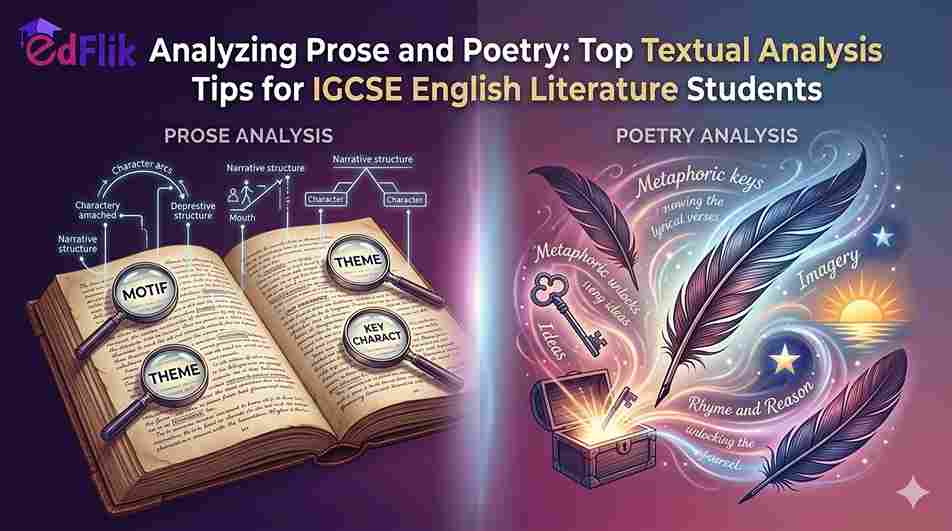
Analyzing Prose and Poetry: Top Textual Analysis Tips for IGCSE English Literature Students
Last Updated: September 2026 | By EdFlik Education Team
For students studying Cambridge IGCSE or Pearson Edexcel IGCSE English Literature (Course 0475 / 0992 or Edexcel Specification), exams can feel daunting. Unlike subjects where answers can be memorized from a textbook, IGCSE Literature tests your ability to think critically, decode unseen texts, and analyze how writers manipulate language, structure, and form to create meaning.
Whether you are studying classic prose novels like To Kill a Mockingbird and Things Fall Apart, or exploring an anthology of poetry ranging from William Blake to modern diverse voices, scoring a top grade requires moving past plot summary into rigorous textual analysis.
In this comprehensive guide, our expert IGCSE English Literature tutors break down the essential techniques, essay structures, and analytical frameworks you need to master prose and poetry for your upcoming exams.
Part 1: Decoding Prose — Character, Setting, and Narrative Voice
Prose texts (novels and short stories) give writers ample room to build immersive worlds, but they also give students a lot of text to sift through. When analyzing a passage of prose in an exam, you must look beyond what is happening to examine how the narrative is constructed.
1. Analyze Narrative Point of View
Who is telling the story, and why does it matter?
- First-Person Narrator ("I"): Creates intimacy and immediacy, but can be unreliable. Ask yourself: Is the narrator hiding something, or is their perspective skewed by bias or trauma?
- Third-Person Omniscient: An all-knowing narrator who can see into the minds of multiple characters, offering a god-like perspective.
- Third-Person Limited: Focuses closely on the thoughts and feelings of a single character, shaping reader sympathy.
2. Characterization and Motivation
Examiners look for sophisticated discussions of characters as constructed literary devices rather than real people.
- Look at how characters are introduced: Are they defined by their speech (idiolect), their actions, their environment, or how other characters react to them?
- Track character arcs and structural shifts (e.g., how a protagonist's power dynamic changes from the opening chapter to the climax).
3. Setting and Atmosphere
Setting is rarely just a backdrop in literature; it often mirrors a character's internal psychological state or reflects wider societal corruption (pathetic fallacy, dystopian motifs, gothic gloom). When analyzing setting, look for sensory imagery—words that appeal to sight, sound, smell, and touch.
Part 2: Decoding Poetry — Form, Structure, and Sound
Poetry is compressed language. Because poets use far fewer words than novelists, every single word, punctuation mark, and line break carries immense weight.
1. Form and Stricter Structures
- Fixed Forms: Does the poem follow a rigid structure like a sonnet (14 lines, traditional themes of love or conflict) or a villanelle? If a poet departs from a traditional form (e.g., breaking rhyme or meter), ask yourself why—usually, it signals emotional breakdown, chaos, or rebellion.
- Stanza Structure: Look at stanza lengths (quatrains, tercets, or free-form). Are they uniform, suggesting order, or erratic, reflecting instability?
2. Enjambment vs. Caesura
- Enjambment: When a sentence or clause runs over from one line to the next without terminal punctuation. It creates momentum, breathless urgency, or a sense of unstoppable flow.
- Caesura: A deliberate pause in the middle of a line of poetry (marked by punctuation like a full stop, comma, or dash). It creates a jarring, fractured effect, forcing the reader to stop and reflect.
3. Sound Devices
Poetry is meant to be heard. Analyze the sonic qualities of the verse:
- Alliteration and Sibilance: Repetition of consonant sounds (e.g., harsh 'plosive' $b, p, t, d$ sounds create aggression or tension; soft 'sibilant' $s, sh$ sounds create whispering, sinister, or soothing tones).
- Assonance and Rhyme: Repetition of vowel sounds or end rhymes that bind the poem together or emphasize key thematic words.
Part 3: The PEEL Method for Writing High-Scoring Literature Essays
Knowing how to analyze a text is only half the battle; communicating that analysis clearly in an essay format is what earns an $A^*$. The gold standard for structuring analytical paragraphs is the PEEL method:
- P – Point: Make a clear analytical assertion that directly answers the essay prompt. (Avoid plot summary!).
- E – Evidence: Embed short, precise quotations from the text directly into your sentence. Never use long block quotes.
- E – Explanation (The Core): Analyze specific keywords and literary devices within your quote. Ask yourself: What connotations do these words carry? How does this technique affect the reader?
- L – Link: Connect your paragraph back to the overarching theme of the text, the writer's wider intention, or the prompt's core question.
Part 4: Top 4 Strategies to Secure an A* in IGCSE Literature
- Memorize Embedded Quotations: You don't need to memorize whole stanzas or paragraphs, but memorizing short, punchy 3-to-5-word phrases allows you to embed textual evidence seamlessly into your writing.
- Focus on Writer's Intent: Avoid writing phrases like "The author made me feel sad." Instead, use sophisticated verbs: "The writer crafts a poignant atmosphere," "The poet subverts traditional expectations," or "The playwright exposes the hypocrisy of..."
- Explore Multiple Interpretations: Top-band responses acknowledge ambiguity. Use phrases like "On one hand, this metaphor suggests... however, it could also be interpreted as..." to show critical depth.
- Practice Unseen Poetry and Prose: Don't just rely on studied texts. Regularly practice analyzing unfamiliar poems or prose extracts under timed conditions to sharpen your close-reading skills.
Struggling to decode poetry, structure your literature essays, or prepare for your IGCSE English exams? EdFlik offers expert, 1-to-1 online tutoring customized specifically for Cambridge and Edexcel IGCSE syllabi, helping you build analytical confidence and achieve top grades.Book a Free Demo Class Today!
Frequently Asked Questions (FAQs)
Q1: How do I memorize enough quotes for my IGCSE Literature exams?
Ans: Focus on thematic quote banks rather than memorizing entire chapters. Select 15 to 20 versatile, multi-functional quotes per text that apply to major themes like power, guilt, isolation, or relationships.
Q2: What is the difference between IGCSE Literature Paper 1 and Paper 3/4?
Ans: Paper 1 typically tests set texts (poetry and prose) through essay and passage-based questions, whereas coursework or alternative papers often focus on deeper extended analysis or unseen texts. Check your specific exam board syllabus (Cambridge 0475 or Edexcel) for exact paper breakdowns.
Q3: How important is terminology in English Literature essays?
Ans: Terminology (such as metaphor, juxtaposition, enjambment, oxymoron) is important, but only when used to support an analytical point. Dropping technical terms without explaining their effect will not earn high marks.
Q4: How can EdFlik help my child improve their IGCSE English Literature grade?
Ans: EdFlik connects students with experienced, certified 1-to-1 online tutors specializing in IGCSE English Literature. Our tutors guide students through close textual analysis, essay structuring, and past paper practice to unlock their full potential.