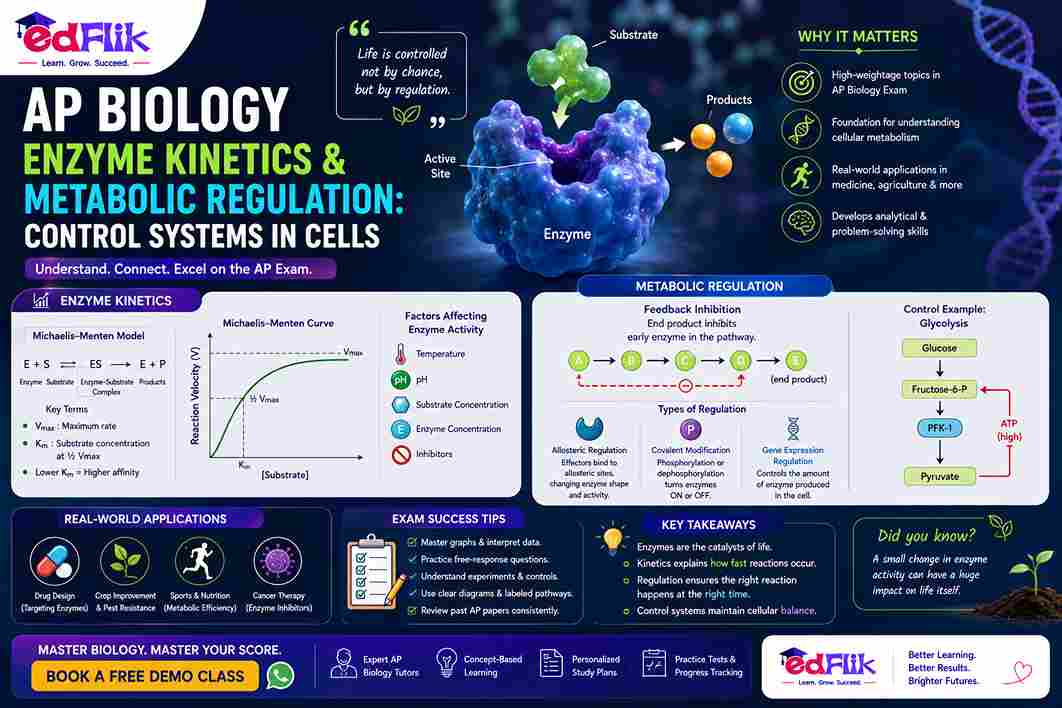
AP Biology: The Complete Tutoring Guide for Dubai Students

The Challenge: Why AP Biology's Breadth Overwhelms Unprepared Students
AP Biology covers an enormous scope: cell biology, genetics, evolution, ecology, physiology, biochemistry. It's not just deep — it's *broad*. A student can be strong in genetics but struggle with ecology, or vice versa.
Add the two exam components (multiple choice + free response questions) and the demands multiply. Students must not only know the content, but apply it to scenarios they've never seen before.
Most students underestimate AP Biology early, then panic during final exam prep when they realize how much ground they need to cover.
EdFlik's AP Biology tutors guide students through this breadth systematically, ensuring no unit is skipped or glossed over.
What Makes an Effective AP Biology Tutor
1. Comprehensive Unit Coverage
AP Biology has 13 units:
1. Chemistry of life (atoms, bonding, macromolecules)
2. Cell structure & transport
3. Cellular energetics (photosynthesis, respiration)
4. Cell communication & division
5. Heredity
6. Gene expression & regulation
7. Natural selection
8. Ecology (populations, communities, ecosystems)
9. Photosynthesis details
10. Respiration & fermentation
11. Immune response
12. Nervous & endocrine systems
13. Animal behavior
A tutor who covers all 13 units systematically beats one who focuses only on students' "favorite" units.
2. FRQ (Free Response Question) Expertise
The AP Biology exam includes 6 free response questions (FRQs). Each worth significant points. Each requires more than just knowledge — it requires application, analysis, and clear communication.
A good tutor teaches FRQ strategy:
· How to read an FRQ carefully (what is actually being asked?)
· How to structure an answer (topic sentence, evidence, explanation)
· How to allocate time across 6 questions in 90 minutes
· Common FRQ types (experimental design, data analysis, mechanism explanation)
By exam day, your child has written 15+ FRQs and feels confident.
3. Multiple Choice Technique
The AP Biology multiple-choice section has 45 questions in 90 minutes (1.5 min per question). Speed and accuracy are both critical.
A good tutor teaches:
· How to eliminate obviously wrong answers first
· How to identify the "best" answer among plausible options
· Time management (which questions to tackle first, which to skip and return to)
· Common trap answer patterns
Book Your Free Trial Now
Master AP Biology.
Book a free trial class with an AP Biology specialist. WhatsApp **+91 88788 96600** or www.edflik.com
Most students see content mastery improve within 4–6 weeks.
5 Tutoring Mistakes Dubai Parents Make (And How to Avoid Them)
Mistake 1: Overemphasizing Just One Unit
Parent: "My child is strong at cell biology, so we'll focus there."
Reality: Ecology is worth as much on the exam as cell biology. Ignoring weak units costs points. A good tutor ensures balanced coverage.
Mistake 2: Skipping FRQ Practice Until Late
Many students focus entirely on multiple-choice until March. Then FRQ practice begins and they realize FRQs are harder than expected. Start FRQ practice early (January).
Mistake 3: Confusing IB Biology with AP Biology
They're related but different. AP Biology emphasizes mechanisms and applications more. EdFlik tutors specialize in AP, not generic biology.
Mistake 4: Not Understanding the Exam Format
Some students are surprised on exam day by the mix of questions or time pressure. A tutor who does practice exams early (January) exposes these gaps early.
Mistake 5: Ignoring Data Analysis Questions
AP Biology includes figures, graphs, and data sets. Students must interpret them quickly and accurately. Tutors who skip this skill cost your child points.
Why EdFlik AP Biology Tutors Get Results
AP-Experienced Teachers
Our tutors have taught AP Biology for 5+ years. They know the exact topics the College Board emphasizes. They have access to years of released AP exams and understand the question patterns.
Systematic Unit Coverage
We cover all 13 units methodically, checking understanding at each step. By the end, no unit is weak or missing.
FRQ Strategy & Practice
We teach FRQ structure:
1. Introduction sentence stating the concept
2. Evidence & explanation
3. Real-world application or extended reasoning
By exam day, your child has written 15+ FRQs and understands the formula.
Multiple Choice Speed Training
We practice timed sets of 45 MC questions, coaching speed and accuracy simultaneously. Students improve their pace and accuracy over weeks.
Data Analysis Skill Building
We teach students to read graphs quickly, identify trends, and draw conclusions from data. By exam day, data-based questions feel straightforward.
Monthly Progress Tracking
Every month you'll see:
· Units covered
· Unit-level mastery (which units strong, which need work)
· Practice test scores
· Weak question types for next focus
AP Biology Curriculum
13 Units (All Covered):
1. Chemistry of life (atoms, bonds, water, macromolecules)
2. Cell structure (prokaryotic, eukaryotic, organelles)
3. Cellular transport (diffusion, osmosis, active transport)
4. Photosynthesis (light-dependent, light-independent reactions)
5. Cellular respiration (glycolysis, Krebs cycle, electron transport)
6. Cell communication (cell signaling, signal transduction)
7. Cell division (mitosis, meiosis, binary fission)
8. Heredity (Mendelian genetics, pedigrees)
9. Gene expression (transcription, translation, regulation)
10. Mutation & evolution
11. Natural selection & evolution
12. Ecology (populations, communities, biomes, ecosystems)
13. Animal behavior
Exam Sections:
· Multiple choice: 45 questions, 90 minutes
· Free response: 6 questions, 90 minutes
How It Works: 6 Steps to AP Biology Success
Step 1: Contact EdFlik
WhatsApp +91 88788 96600 or www.edflik.com. Tell us you're taking AP Biology and your weak units.
Step 2: Tutor Matching
Within 24 hours, we match an AP Biology specialist.
Step 3: Free Trial
Your child attends 1–2 free classes to judge the tutor's teaching style.
Step 4: Systematic Unit Coverage
2–3 sessions per week (2–3 hours total). We cover units sequentially, with practice questions and quizzes for each.
Step 5: Practice Exam Focus (January–March)
By January, we transition to full-length practice exams (multiple choice + FRQs). Monthly practice exams track progress.
Step 6: Final Review & Exam Readiness
April–May focuses on weak units and last-minute FRQ refinement.
What Students Say
*"AP Biology is so broad I was overwhelmed. My tutor broke it down unit-by-unit and suddenly it was manageable."*
— Aisha Al-Kaabi, Dubai
*"FRQs were my weak point until my tutor taught me the structure. Then every FRQ felt like it followed a pattern I understood."*
— Hassan Al-Mazrouei, Sharjah
*"My tutor did practice exams with me monthly so I could see my progress. That kept me motivated."*
— Priya Patel, Ajman
FAQs:-
Q: How much tutoring is needed?
A: 2–3 sessions per week (2–3 hours total) is standard for maintaining pace with the curriculum.
Q: Is AP Biology harder than IGCSE/A-Level Biology?
A: AP Biology is broader than A-Level but less deep in some areas. It requires strong fundamentals and good test-taking strategy.
Q: When should tutoring start?
A: September of your AP year is ideal. This allows 8 months for systematic coverage and practice exams.
Q: What if my child is weak in a specific unit?
A: We can do focused sessions on weak units while maintaining pace on stronger ones.
Q: How much does AP Biology tutoring cost?
A: Starting at 50 AED per hour. Most families invest 200–300 AED per week.
Q: Can my child score a 5 on the AP exam?
A: With consistent tutoring starting in September and 2+ years of preparation, a 5 is achievable. Grade depends on starting point and effort.