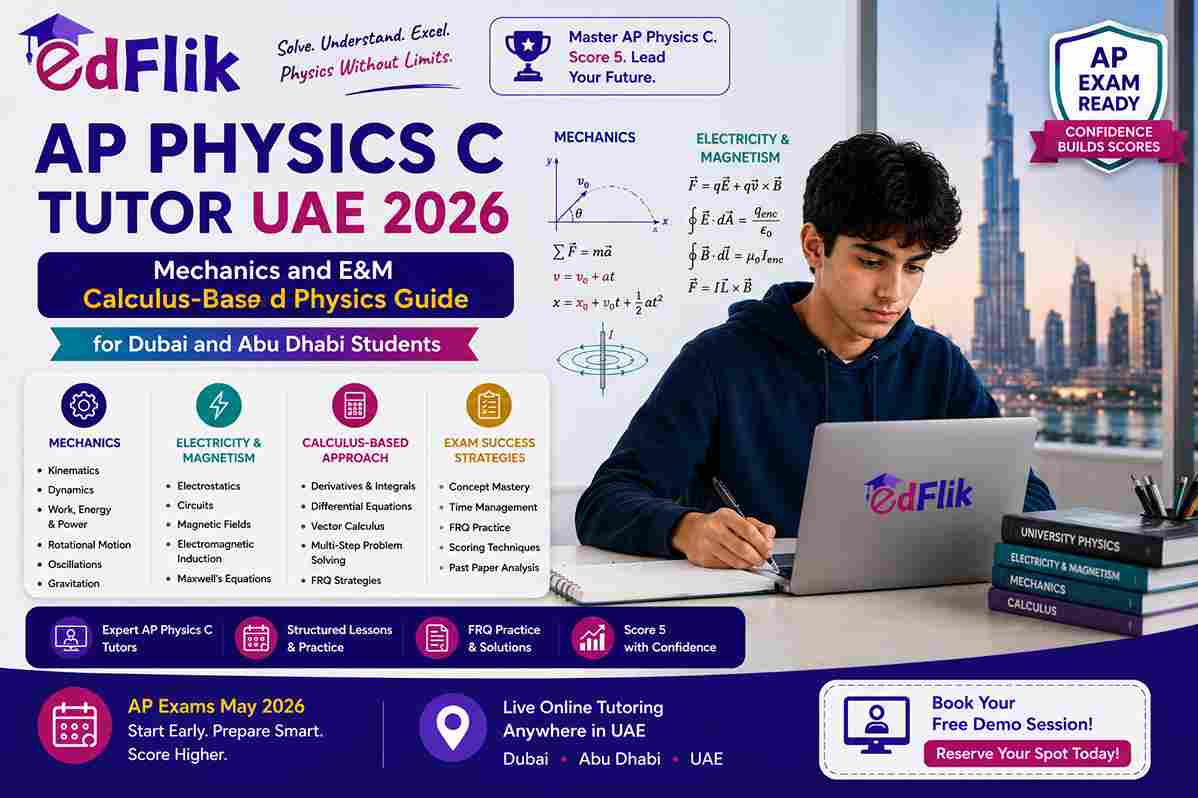
AP Physics C Tutor UAE 2026 — Mechanics and E&M Calculus-Based Physics Guide for Dubai and Abu Dhabi
AP Physics C is the most demanding AP science — rated the hardest AP of all 38 courses by difficulty. Yet it earns the most university credit (two full semesters of calculus-based physics) and is the expected credential for UAE students applying to Engineering programmes at MIT, Caltech, Princeton, and other competitive US universities. This guide explains what Mechanics and E&M each test, the calculus integration that distinguishes C from Physics 1 and 2, and the FRQ technique that produces 5 scores.
AP Physics C — Two Separate Exams
|
Exam |
Duration |
Content
Coverage |
University
Credit |
|
AP Physics C:
Mechanics |
90 minutes
total (45 MCQ + 45 FRQ) |
Kinematics,
Newton's Laws, Work/Energy, Systems of Particles, Rotation, Oscillations,
Gravitation |
Typically 1
semester university Physics |
|
AP Physics C:
E&M |
90 minutes
total (45 MCQ + 45 FRQ) |
Electrostatics,
Conductors, Capacitors, Resistivity, Circuits (RC), Magnetic Fields,
Electromagnetic Induction |
Typically 1
semester university Physics |
|
AP Physics C:
Mechanics and E&M are two completely separate exams, typically taken on
the same day. UAE students can take one or both. Both require calculus.
Students who take both and score 5 on each may earn credit for two full
semesters of university physics — equivalent to a full year of introductory
Physics. |
How Calculus Changes Physics C vs Physics 1
|
Concept |
Physics 1
(Algebra) |
Physics C
(Calculus-Based) |
|
Acceleration
from velocity |
a = Δv/Δt
(average) |
a(t) = dv/dt
(instantaneous derivative) |
|
Displacement
from velocity |
d = vt
(constant v only) |
x(t) = ∫v(t)
dt (works for any v) |
|
Work by
variable force |
Cannot handle
— assumes constant F |
W = ∫F(x) dx
(integral along path) |
|
Moment of
inertia |
Given formula
or simple systems |
I = ∫r² dm
(must derive for continuous mass) |
|
Electric
potential |
V = kq/r
(point charges only) |
V = -∫E·dl
(works for any field) |
|
Gauss's Law |
Conceptual
understanding |
Φ = ∮E·dA =
Q/ε₀ (surface integral applied to find E) |
|
RC circuit
charging |
Qualitative
graph only |
V(t) = V₀(1 −
e^{−t/RC}), derived from differential equation |
Hardest Topics in AP Physics C Mechanics
Rotational Dynamics — Torque, Moment of Inertia, Angular Momentum
Rotational dynamics is the topic where the most Mechanics marks are lost. The key connections: τ = Iα (torque equals moment of inertia times angular acceleration, the rotational analogue of F = ma); L = Iω (angular momentum); conservation of angular momentum when net external torque is zero. The FRQ consistently presents rolling-without-slipping problems where translational and rotational kinetic energy must both be included.
Oscillatory Motion — SHM with Calculus
Simple harmonic motion requires knowing that F = -kx implies x(t) = A cos(ωt + φ), where ω = √(k/m). The period T = 2π/ω = 2π√(m/k). Deriving potential and kinetic energy expressions from the position function using calculus is required for FRQ maximum marks.
Hardest Topics in AP Physics C E&M
Gauss's Law — Applying to Non-Trivial Geometries
Gauss's Law (∮E·dA = Q_enc/ε₀) is straightforward for spherical symmetry. The harder cases — cylindrical symmetry (infinite line charge, coaxial cable) and planar symmetry (infinite sheet, parallel plates) — require correct Gaussian surface selection and symmetry argument. UAE students who memorise results without understanding the Gaussian surface selection cannot handle novel geometries on the FRQ.
RC Circuits — Transient Analysis
RC circuit charging and discharging require solving a first-order differential equation: Q/C + IR = V, which gives Q(t) = CV(1 − e^{−t/RC}) for charging. Students must be able to: derive the equation from Kirchhoff's Laws, recognize the time constant τ = RC, and apply the solution to find current, charge, or voltage at any time. This is one of the most consistently FRQ-tested E&M topics.
AP Physics C FRQ Strategy
Both Mechanics and E&M exams have 3 FRQs worth 15 points each, for 45 minutes. Each FRQ has multiple parts (a), (b), (c), (d), each testing a specific concept. Key strategies:
• Show all work including calculus steps — writing just the final answer earns 0; showing the setup of the integral, evaluating it, and stating the result earns all marks even with arithmetic errors
• Draw free-body diagrams or field diagrams — most Mechanics FRQs award 2-3 marks for correct diagrams
• State physical principles before applying them — "By Newton's Second Law, ΣF = ma..." before writing equations
• Dimensional analysis as a check — if units are wrong, the formula is wrong
|
EdFlik AP
Physics C tutors are calculus-based Physics specialists. Sessions cover
Mechanics and E&M separately with College Board FRQ practice. From AED 80
per session. Free diagnostic trial. Book at www.edflik.com or WhatsApp +91
88788 96600. |
Frequently Asked Questions
Q: What is the difference between AP Physics 1 and AP Physics C?
Physics 1 is algebra-based; Physics C is calculus-based and significantly harder. Physics C earns more university credit and is expected for Engineering applicants at competitive US universities.
Q: Do I need AP Calculus before taking AP Physics C?
Yes. Derivatives and integrals are used throughout both Mechanics and E&M. Students should complete or concurrently take AP Calculus AB or BC.
Q: Is AP Physics C Mechanics or E&M harder?
E&M is consistently rated harder (8/10 vs 7.5/10). E&M requires Gauss's Law, Faraday's Law, and RC differential equations — more mathematically abstract than Mechanics.
Q: What are the hardest AP Physics C topics?
Mechanics: rotational dynamics with complex objects, SHM with calculus, gravitational fields. E&M: Gauss's Law applied to cylinders and planes, RC transient analysis, electromagnetic induction.
Q: How much does AP Physics C tutoring cost in Dubai?
EdFlik: AED 80 per session for AP Physics C — specialist calculus-based physics, College Board FRQ practice. Free diagnostic trial.