Approaching IB MYP Science Criterion B and C: Designing Effective Investigations
Last Updated: September 2026 | By EdFlik Education Team
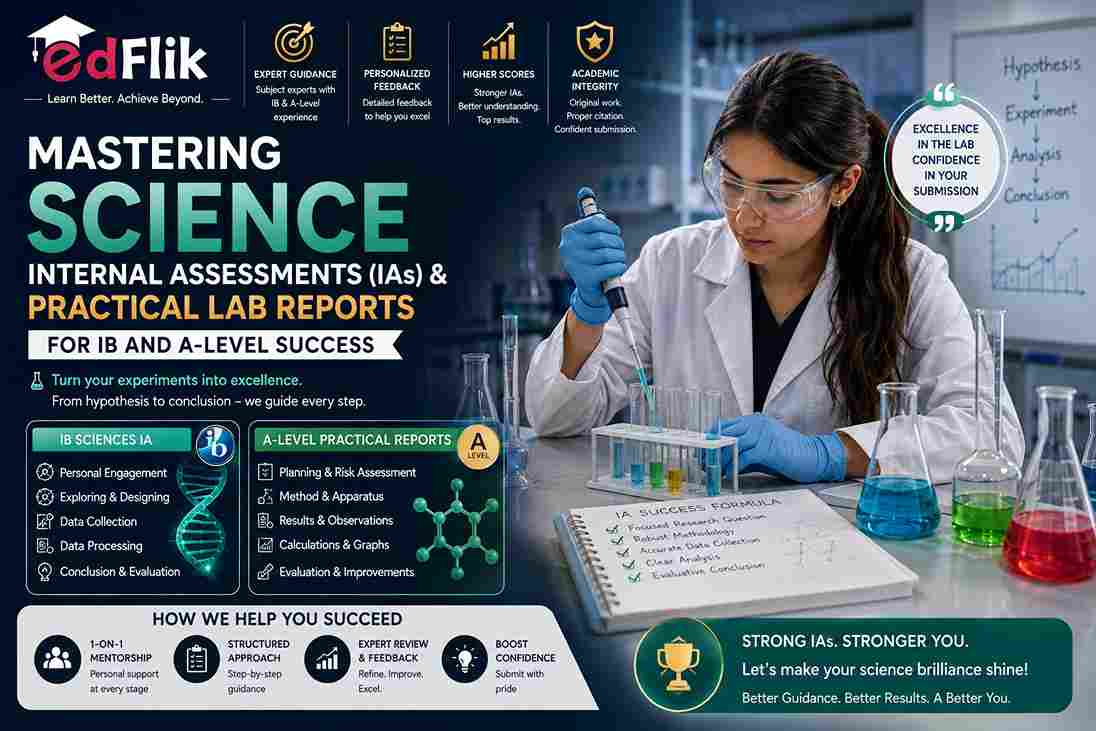
For students progressing through the International Baccalaureate (IB) Middle Years Programme (MYP) Sciences (Biology, Chemistry, Physics, and Integrated Science), internal assessment shifts far away from rote memorization. While Criterion A (Knowing and Understanding) tests your factual recall, the true heart of scientific inquiry in the MYP lies in Criterion B (Inquiring and Designing) and Criterion C (Processing and Evaluating).
Whether you are completing a unit in Years 1-3 or tackling your culminating eAssessment in MYP Year 5, Criterion B and C practical investigations determine whether you can think, act, and communicate like a real scientist. Many students lose valuable marks not because they don't understand the science, but because they fail to structure their experimental variables, data tables, and evaluations according to strict IB rubrics.
In this comprehensive, in-depth guide, our expert IB MYP Science tutors break down the exact expectations for Criteria B and C, common pitfalls, and step-by-step strategies to secure top achievement levels.
Part 1: Mastering MYP Science Criterion B — Inquiring and Designing
Criterion B evaluates your ability to design a scientific investigation to test a research question or hypothesis. Across the MYP rubric bands, top-tier marks are awarded for precision, safety, and thorough methodological planning.
1. Formulating a Focused Research Question and Hypothesis
Every good investigation begins with a crystal-clear focus. Your research question must explicitly state the relationship between your variables.
- Independent Variable (IV): What you intentionally change (with at least 5 distinct, well-spaced quantitative values).
- Dependent Variable (DV): What you measure, including exact units and the measuring apparatus (e.g., volume of oxygen gas produced in $\text{cm}^3$ using a gas syringe).
- Hypothesis Formulation: Never write a simple "I think X will happen because of Y." Use a scientific rationale: "If the temperature of the catalase enzyme increases from $20^\circ\text{C}$ to $60^\circ\text{C}$, then the initial rate of reaction will increase up to an optimum at $40^\circ\text{C}$ and then drop sharply, because thermal agitation past the optimum causes denaturation of the enzyme’s active site."
2. Identifying and Controlling Variables (Crucial for Top Marks)
Vague statements like "I will keep the room the same" will cost you marks. You must identify:
- Controlled Variables: List at least 3 to 4 specific environmental or biological factors that could inadvertently affect your dependent variable. For each control, state why it matters and how you will actively control it (e.g., "pH will be kept constant at 7 using a phosphate buffer solution, because changes in hydrogen ion concentration alter enzyme ionization states").
- Uncontrolled Variables: Acknowledging variables that were physically impossible to control (and explaining how they might impact your results) demonstrates high-level critical thinking.
3. Materials, Apparatus, and Safety
- Equipment Precision: Always list the precise measurement instruments you will use (e.g., a electronic balance measuring to $\pm 0.01\text{ g}$ rather than just a "scale").
- Risk Assessment: You must explicitly address safety, ethical, and environmental considerations. Mention specific safety gear (goggles, lab coats, gloves) and hazardous handling precautions (e.g., handling concentrated acids or living organisms safely).
Part 2: Mastering MYP Science Criterion C — Processing and Evaluating
Once you complete your experiment (or are given raw data in an eAssessment scenario), Criterion C measures how accurately you process data, present it visually, and critically evaluate the methodology.
1. Raw and Processed Data Tables
Your data presentation must look professional:
- Table Formatting: Every table must have a clear, descriptive title. Column headers must include both the variable name and its correct SI units in parentheses (e.g., Time ($t$ / $\text{s}$)).
- Decimal Consistency: All raw data recorded from an instrument must maintain consistent decimal places reflecting the instrument's precision (e.g., if a thermometer measures to $0.5^\circ\text{C}$, record values as $21.0, 22.5, 23.0$).
- Data Processing: Show at least one sample calculation for any processed data (e.g., calculating mean values, percentage change, or rates of reaction).
2. Graphing Conventions
If plotting graphs manually or digitally:
- The independent variable goes on the horizontal ($x$) axis, and the dependent variable goes on the vertical ($y$) axis.
- Axes must be fully labeled with quantities and units.
- Use a sensible, linear scale that occupies more than 50% of the grid area.
- Draw lines of best fit (either smooth curves or straight trend lines depending on the data) rather than connecting dots point-to-point like a dot-to-dot puzzle.
3. Evaluating and Interpreting Results
This is where many students lose top marks by keeping their evaluation too superficial. A complete evaluation requires:
- Scientific Explanation: Interpret your trends using scientific theory. Why did the data behave this way?
- Evaluating the Hypothesis: Did your results support or refute your initial hypothesis? Use specific numerical data to justify your conclusion.
- Identifying Anomalies: Spot anomalies in your data set and suggest realistic experimental errors that caused them.
4. Discussing Validity and Improvements
Do not write generic improvements like "I will be more careful next time." Focus on systematic errors and methodological flaws:
- Weak Improvement: "Be more precise with timing."
- Strong Improvement: "Use a data logger and light gate instead of a manual stopwatch to eliminate human reaction time error when measuring times under 2 seconds."
- Suggest logical extensions or modifications to the experiment to test a related hypothesis further.
Part 3: Top 4 Strategies to Achieve Level 7/8 in MYP Sciences
- Treat Rubrics as a Checklist: Before submitting any Criterion B or C lab report, print out the IB grade descriptors for your grade band and verify that every requirement (from units to safety and trend evaluation) is explicitly addressed.
- Master Scientific Terminology: Use precise scientific vocabulary (e.g., systematic error, random error, precision, accuracy, proportional relationship, plateau) rather than everyday conversational phrasing.
- Practice eAssessment Style Prompts: If you are in MYP Year 5, practice past eAssessment papers where you are given pre-recorded data sets to process and evaluate under timed conditions.
- Keep Your Lab Log Organized: Maintain a clean, structured lab journal. Document your reasoning, modifications made during preliminary trials, and reflections throughout the investigative process.
Struggling with MYP Science experimental design, data processing, or preparing for your eAssessments? EdFlik offers expert, 1-to-1 online tutoring customized specifically for the IB Middle Years Programme, helping you build analytical confidence and achieve top grades.Book a Free Demo Class Today!
Frequently Asked Questions (FAQs)
Q1: What is the difference between MYP Criterion B and Criterion C?
Ans: Criterion B (Inquiring and Designing) focuses on planning the experiment, defining variables, selecting equipment, and outlining a safe methodology before conducting the test. Criterion C (Processing and Evaluating) focuses on what happens after the experiment—organizing data into tables, plotting graphs, interpreting trends, and critically evaluating the validity of the procedure.
Q2: How many data points or increments should my independent variable have?
Ans: For a robust scientific investigation in the IB MYP, you should select at least five distinct quantitative values for your independent variable, and repeat each condition at least three times to calculate a reliable mean and identify anomalies.
Q3: How important are units in MYP Science data tables and graphs?
Ans: Extremely important. Omitting units in table headers or axis labels results in immediate mark deductions across both Criterion B and Criterion C rubrics.
Q4: How can EdFlik help my child excel in IB MYP Sciences?
Ans: EdFlik connects students with experienced, certified 1-to-1 online tutors specializing in the IB MYP curriculum. Our tutors guide students through designing inquiry labs, mastering data processing techniques, and refining lab report writing skills.