
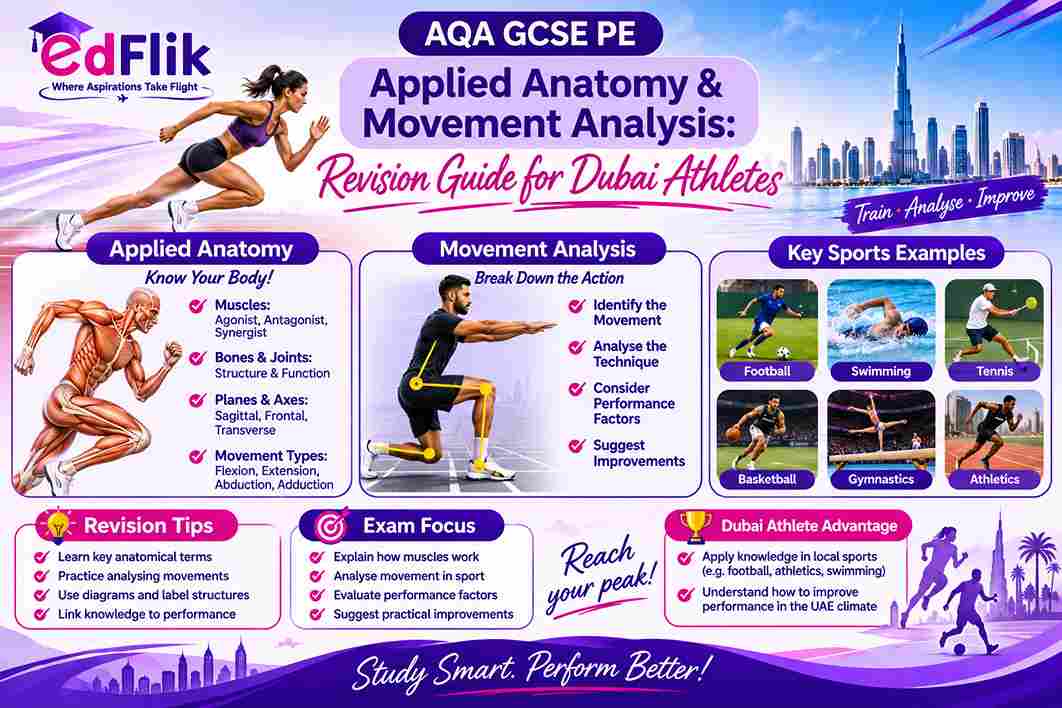
AQA GCSE PE Applied Anatomy & Movement Analysis: Revision Guide for Dubai Athletes
By EdFlik Team | November 25, 2026
For Key Stage 4 student-athletes across Dubai—from Jumeirah, Arabian Ranches, and Dubai Hills Estate to Al Barsha, Mirdif, and Dubai Sports City—enrolled in AQA GCSE Physical Education (8582), Paper 1: The Human Body and Movement in Physical Activity and Sport (worth 30% of the total GCSE grade, 78 marks in 1 hour 15 minutes) is won or lost in Applied Anatomy and Physiology and Movement Analysis. Whether a student competes in DASSA (Dubai Affiliated School Sport Association) football, rugby, swimming, netball, athletics, or basketball, translating practical sporting instinct into exact AQA mark-scheme terminology is the single biggest challenge in Year 10 and Year 11.
Many talented student-athletes in Dubai's British international schools excel in the 30% Non-Exam Assessment (NEA) practical performance, yet lose vital theory marks on Paper 1 because they name muscles vaguely ("arm muscle" instead of biceps brachii or triceps brachii), confuse antagonistic muscle pairs during the upward versus downward phase of a movement, mix up planes and axes of rotation, or forget why a second-class lever has high mechanical advantage while a third-class lever operates at a mechanical disadvantage.
Securing a Grade 8 or 9 ($A^*$) in AQA GCSE PE (8582)—an ideal springboard toward A-Level Physical Education, IB Sports, Exercise and Health Science (SEHS), or BTEC Sport & Exercise Science—requires linking every bone, synovial joint, muscle contraction, lever system, and plane/axis directly to a concrete sporting action.
This comprehensive masterclass guide covers AQA GCSE PE Applied Anatomy & Movement Analysis, including the musculoskeletal system, antagonistic pairs and contraction types, first-, second-, and third-class levers with mechanical advantage, planes and axes of movement, a full 6-mark exam-style worked answer, common mark-scheme traps, and 100% copy-paste JSON-LD schema markup.
Key Takeaways
- Name Specific Bones, Synovial Joints, and Antagonistic Muscle Pairs: AQA mark schemes never accept "thigh muscle" or "calf muscle"; always name the exact agonist (prime mover) and antagonist—such as quadriceps and hamstrings at the knee, gastrocnemius and tibialis anterior at the ankle, or biceps brachii and triceps brachii at the elbow.
- Memorize the "FLE — 123" Lever Shortcut & Mechanical Advantage Formula: The component in the middle determines the lever class (Fulcrum = 1st class, Load = 2nd class, Effort = 3rd class), and $\text{Mechanical Advantage} = \frac{\text{Effort Arm}}{\text{Load Arm}}$—explaining why second-class levers lift heavy loads easily while third-class levers generate high speed and wide range of movement.
- Pair Every Plane with Its Exact Perpendicular Axis: Sagittal plane movements (flexion/extension) rotate around the transverse (frontal) axis; frontal plane movements (abduction/adduction) rotate around the sagittal axis; and transverse plane movements (rotation) rotate around the longitudinal axis.
- Separate Eccentric and Concentric Contractions in Two-Phase Skills: When a Dubai footballer bends their knee back to prepare a kick (flexion), the hamstrings act as the agonist; during the downward phase of a squat, the quadriceps are still the agonist working eccentrically to control gravity—never say the hamstrings pull you down!
Part 1: Applied Anatomy — Synovial Joints, Antagonistic Pairs & Muscle Contractions
In AQA GCSE PE Paper 1 (Topic 3.1.1), examiners focus on hinge joints (elbow, knee, ankle) and ball-and-socket joints (shoulder, hip), testing how muscles pull on bones via tendons while ligaments stabilize bone-to-bone connections.
Core Antagonistic Muscle Pairs & Joint Actions
| Synovial Joint (Type) | Articulating Bones | Movement & Agonist (Prime Mover) | Antagonist (Relaxes) | Sporting Example (Dubai School Sport) |
Elbow (Hinge) | Humerus, radius, ulna | • Flexion: Biceps brachii • Extension: Triceps brachii | • Triceps brachii • Biceps brachii | • Upward phase of a bicep curl / pulling in swimming. • Extending the elbow in a netball chest pass or basketball shot. |
Knee (Hinge) | Femur, tibia (patella protects front) | • Flexion: Hamstrings • Extension: Quadriceps | • Quadriceps • Hamstrings | • Bending the knee back before kicking a football. • Straightening the knee to strike a football or push off swimming blocks. |
Ankle (Hinge) | Tibia, fibula, talus | • Plantar flexion: Gastrocnemius • Dorsiflexion: Tibialis anterior | • Tibialis anterior • Gastrocnemius | • Pointing toes during a sprint push-off or gymnastics leap. • Pulling toes upward toward the shin during the heel-strike of running or hurdle clearance. |
Shoulder (Ball-and-Socket) | Humerus, scapula (clavicle nearby) | • Flexion / Extension: Anterior / posterior deltoid • Abduction / Adduction: Deltoid / Latissimus dorsi (and pectoralis major) | • Opposite deltoid / latissimus dorsi | • Lifting arm forward in front crawl recovery (flexion) or swinging arm backward in bowling (extension). |
Hip (Ball-and-Socket) | Pelvis, femur | • Flexion: Hip flexors (iliopsoas) • Extension: Gluteus maximus | • Gluteus maximus • Hip flexors | • Driving the knee upward during a 100 m sprint. • Driving the leg backward during sprint propulsion. |
Isotonic vs. Isometric Muscle Contractions:
- Isotonic Concentric Contraction: The muscle shortens under tension while generating force (e.g., the biceps brachii contracting concentrically during the upward phase of a pull-up).
- Isotonic Eccentric Contraction: The muscle lengthens under tension to control movement against gravity (e.g., the quadriceps contracting eccentrically as a basketball player bends their knees to land safely from a rebound).
- Isometric Contraction: The muscle develops tension without changing length, keeping a joint stationary (e.g., holding a plank position, a rugby scrum engagement, or a gymnast's crucifix hold on rings).
Part 2: Movement Analysis — First-, Second-, and Third-Class Levers (Topic 3.1.2)
Every lever system in the human body consists of four components: a Fulcrum ($\triangle$ — joint), a Load ($\square$ — weight of body part or external resistance), an Effort ($\uparrow$ — muscular force at insertion), and a Lever Arm (bone).
First-, second-, and third-class lever systems and fulcrum-load-effort positions.
As illustrated in the lever classification diagram above, changing which component sits in the middle creates three distinct lever classes—including third-class levers (such as the forearm during a bicep curl, where the effort applied by the biceps acts between the fulcrum at the elbow and the load in the hand)
AQA Lever Systems & Mechanical Advantage Table
| Lever Class & Middle Component | Sporting / Anatomical Example | Effort Arm vs. Load Arm | Mechanical Advantage / Disadvantage & Sporting Benefit |
First-Class Lever (Fulcrum in the middle) | • Neck (atlas/axis joint): Heading a football. • Elbow extension: Overhead triceps extension / javelin release (triceps pulls olecranon behind elbow fulcrum). | Effort arm and load arm can be similar or vary depending on attachment. | Can generate either speed/range of movement or force, depending on whether the fulcrum sits closer to the load or the effort. |
Second-Class Lever (Load in the middle) | • Ankle joint during plantar flexion: Rising onto tiptoes to dive off swimming blocks or jump for a basketball rebound (ball of foot = fulcrum, body weight = load, gastrocnemius pulling heel = effort). | Effort arm is longer than the load arm. | High Mechanical Advantage ($\text{MA} \gt 1$): Allows a relatively small muscular effort to lift a heavy load (entire body weight), though with slower movement speed and limited range. |
Third-Class Lever (Effort in the middle) | • Most limb joints in the body: Elbow flexion (biceps curl), knee extension (kicking a football), hip flexion (sprinting). | Load arm is longer than the effort arm. | Mechanical Disadvantage ($\text{MA} \lt 1$): Requires greater muscular force to move a load, but produces high speed of movement and a wide range of motion at the end of the limb (ideal for striking, throwing, and sprinting). |
Formula to Memorize for AQA Paper 1:$$\text{Mechanical Advantage} = \frac{\text{Effort Arm}}{\text{Load Arm}}$$
- Effort Arm: Perpendicular distance from the fulcrum to the effort.
- Load Arm: Perpendicular distance from the fulcrum to the load.
Part 3: Planes and Axes of Movement (Topic 3.1.2)
AQA examiners frequently test planes (imaginary flat surfaces dividing the body) and axes (imaginary straight lines around which rotation occurs) using gymnastics, diving, athletics, and racquet-sport examples.
The three anatomical planes and axes of rotation.
As shown in the anatomical reference diagram above, the Sagittal plane divides the body into left and right halves, the Frontal plane divides front and back, and the Transverse plane divides top and bottom—with each plane paired with an axis passing perpendicularly through it
Planes & Axes Quick-Match Table
| Plane of Movement | Axis of Rotation | Permitted Joint Actions | Classic AQA Exam Sporting Examples |
Sagittal Plane (Left & right halves) | Transverse (Frontal) Axis (Runs left-to-right through hips) | Flexion and Extension (plus plantar flexion / dorsiflexion). | • Somersault in gymnastics or springboard diving. • Running/sprinting leg action; bicep curl; vertical jump. |
Frontal Plane (Front & back halves) | Sagittal Axis (Runs front-to-back through navel) | Abduction and Adduction. | • Cartwheel in gymnastics. • Star jumps; outward/inward leg sweep in breaststroke kick. |
Transverse Plane (Upper & lower halves) | Longitudinal Axis (Runs head-to-toe vertically) | Rotation (and horizontal flexion/extension). | • Full twist / 360° spin in ice skating, trampolining, or diving. • Discus throw spin; golf swing torso rotation. |
Part 4: Full 6-Mark Exam-Style Worked Question (AO1 + AO2 + AO3)
Question: A Year 11 student in Dubai is performing a standing vertical jump during a basketball game to block an opponent's shot. Analyse the movement at the ankle joint during the upward take-off phase, making reference to the joint type, articulating bones, joint action, antagonistic muscle pair, contraction type, and lever system involved. [6 marks]
Step-by-Step Top-Band AQA Answer (6/6 Marks):
- Joint Type & Articulating Bones (AO1 — 1 mark): The ankle is a hinge joint formed by the tibia, fibula, and talus.
- Joint Action (AO2 — 1 mark): During the upward push-off phase of the jump, plantar flexion occurs at the ankle as the heel lifts off the court and the toes point downward.
- Antagonistic Muscle Pair & Contraction Type (AO2 — 2 marks): The gastrocnemius acts as the agonist (prime mover), contracting concentrically (shortening under tension) to pull on the calcaneus via the Achilles tendon, while the tibialis anterior acts as the antagonist, relaxing to allow smooth movement.
- Lever System & Mechanical Advantage (AO1 + AO3 — 2 marks): This action operates as a second-class lever, because the load (the athlete's body weight acting down through the ankle) sits in the middle between the fulcrum (the ball of the foot/toes on the court) and the effort (the gastrocnemius pulling upward at the heel). Because the effort arm is longer than the load arm, this lever has a high mechanical advantage, enabling the athlete to generate enough force to lift their entire body weight rapidly off the ground.
Part 5: Top 4 Exam Traps That Cost Dubai AQA GCSE PE Students Marks
- Drawing Lever Diagrams with the Wrong Symbols or Labels: AQA expects standard lever diagrams—a triangle ($\triangle$) for the fulcrum, a square ($\square$) for the load, and an arrow ($\uparrow / \downarrow$) for the effort, all clearly labeled.
- Swapping Agonist and Antagonist on Eccentric Lowering Phases: During the downward phase of a press-up (elbow flexion), gravity pulls the body down while the triceps brachii remains the agonist contracting eccentrically to slow the descent—not the biceps!
- Confusing the Transverse Plane with the Transverse Axis: Remember that the transverse plane pairs with the longitudinal axis (spins/twists), whereas the sagittal plane pairs with the transverse axis (somersaults/running).
- Writing Generic Statements in 6- or 9-Mark Extended Questions: Always structure extended Paper 1 answers using AO1 (define/name anatomical terms), AO2 (apply directly to the named sport skill in the prompt), and AO3 (explain why that mechanism improves speed, force, or performance).
For expert 1-on-1 online tutoring support to master AQA GCSE PE Paper 1 anatomy, movement analysis, cardio-respiratory physiology, and Grade 8/9 ($A^*$) exam technique in Dubai, book a class on EdFlik.
Frequently Asked Questions (FAQs)
Q1: How can I easily remember the difference between first-, second-, and third-class levers in AQA GCSE PE?
Ans: Use the memory aid "F-L-E = 1-2-3": whichever component sits in the middle tells you the class of lever—Fulcrum in the middle = 1st-class, Load in the middle = 2nd-class, and Effort in the middle = 3rd-class.
Q2: Why do third-class levers have a mechanical disadvantage yet appear in most human joints?
Ans: Because the effort (muscle insertion) is positioned closer to the fulcrum (joint) than the load at the end of the limb, the load arm is longer than the effort arm ($\text{MA} \lt 1$). While this requires higher muscular force, it allows a small muscle contraction to move the hand or foot through a large range of motion at high speed—vital for throwing, kicking, and sprinting.
Q3: Which planes and axes apply to a cartwheel versus a somersault in AQA GCSE PE?
Ans: A cartwheel takes place in the frontal plane around the sagittal axis (involving abduction and adduction), whereas a somersault takes place in the sagittal plane around the transverse (frontal) axis (involving flexion and extension).