Cambridge IGCSE Chemistry (0620) in Abu Dhabi: Stoichiometry, Moles & Limiting Reactants
By EdFlik Team | November 27, 2026
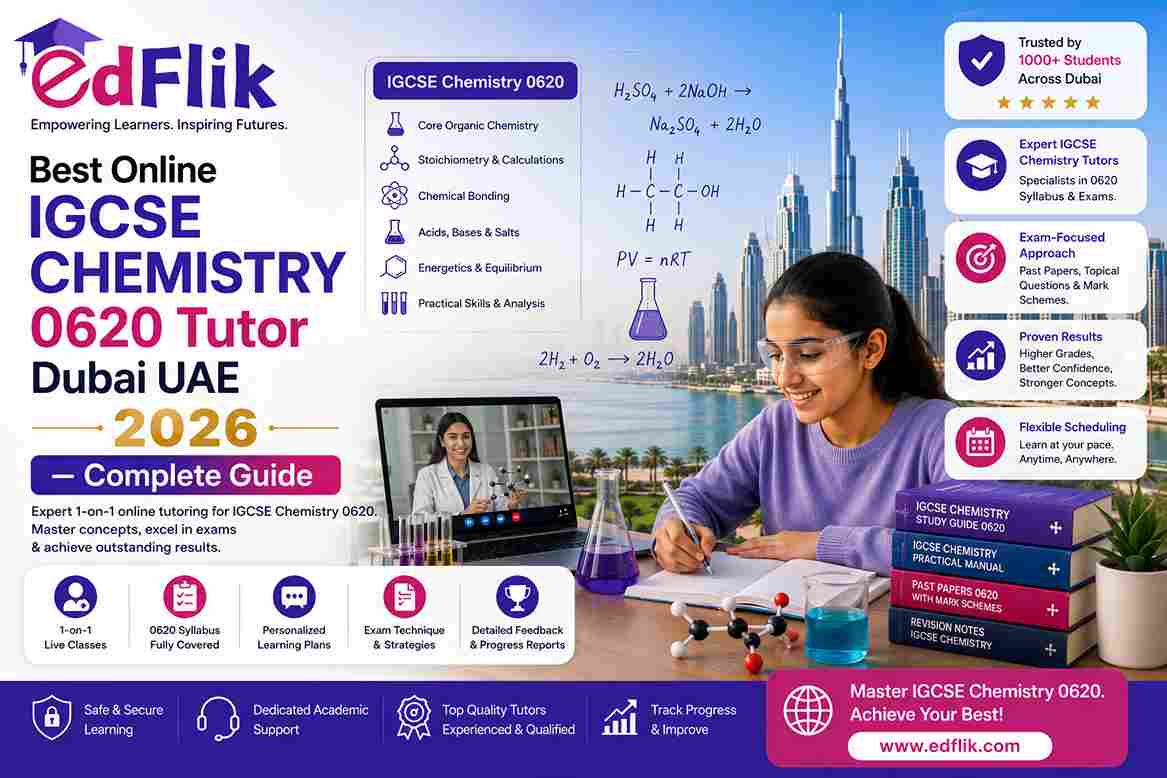
For Key Stage 4 students across Abu Dhabi—from Al Reem Island, Saadiyat Island, and Al Raha Beach to Khalifa City, Al Mushrif, and Mohammed Bin Zayed City—studying Cambridge IGCSE Chemistry (0620) builds quantitative reasoning and chemical literacy that directly support future study in Chemistry, Chemical Engineering, Medicine, Pharmacy, Materials Science, and Environmental Engineering. Assessed across Paper 2 (Multiple Choice — 45 minutes, 30% weighting), Paper 4 (Theory Extended — 1 hour 15 minutes, 50% weighting), and Paper 6 (Alternative to Practical — 1 hour, 20% weighting), stoichiometry, the mole concept, and limiting reactants sit at the heart of the entire 0620 syllabus.
In a major industrial and energy hub like Abu Dhabi—where desalination plants, petrochemicals, clean-energy projects, water-quality testing, and industrial materials depend on exact chemical proportions—understanding how substances react in fixed molar ratios is far more than an exam skill. Yet many capable Abu Dhabi students lose valuable method and accuracy marks on Extended Paper 4 and Paper 2 calculations because they forget to balance the chemical equation first, confuse moles with mass or volume, misconvert $\text{cm}^3$ to $\text{dm}^3$ in solution concentration and gas-volume calculations, or calculate product yield from the excess reactant instead of the limiting reactant.
Securing a Grade A or A* in Cambridge IGCSE Chemistry (0620) requires treating every calculation as a disciplined mole-bridge workflow, verifying molar ratios from balanced symbol equations, and keeping full precision until the final significant-figure step.
This masterclass guide breaks down Moles, Avogadro's Constant & Molar Conversions, Stoichiometry & Limiting Reactants, Step-by-Step Worked Exam Calculations, common mark-scheme traps, FAQs, SEO meta tags, and 100% copy-paste JSON-LD schema markup.
Key Takeaways
- Always Convert to Moles ($\text{mol}$) First Before Using Mole Ratios: Balanced chemical equations give ratios in moles, not grams or cubic centimeters—convert given mass ($\text{g}$), gas volume ($\text{dm}^3$), or solution volume & concentration ($\text{dm}^3$ and $\text{mol/dm}^3$) into moles first, multiply/divide by the stoichiometric mole ratio, and convert back to the requested unit.
- Identify the Limiting Reactant by Comparing Actual Moles to Stoichiometric Need: The limiting reactant is the reactant that runs out completely first and determines the maximum amount of product formed; any other reactant present in greater amount than needed is in excess, leaving unreacted material at the end.
- Watch Unit Conversions Closely ($\text{cm}^3 \leftrightarrow \text{dm}^3$ and Molar Gas Volume): Divide $\text{cm}^3$ by $1000$ to get $\text{dm}^3$ in concentration ($n = c \times V$ in $\text{dm}^3$) and gas volume calculations at room temperature and pressure (r.t.p., where $1\text{ mol}$ of any gas occupies $24\text{ dm}^3$ or $24\,000\text{ cm}^3$ under Cambridge 0620 conventions).
- Show Every Step Clearly for Extended Paper 4 Method Marks: Even if a final number has a rounding or arithmetic slip, Cambridge examiners award method marks (M marks) for writing correct molar mass ($M_r$), mole calculations, mole ratios, and percentage yield/purity expressions.
Part 1: The Mole Concept & Essential Stoichiometry Conversions
One mole ($\text{mol}$) is the amount of substance containing Avogadro's constant ($L \approx 6.02 \times 10^{23}$) elementary entities (atoms, molecules, ions, or formula units). Because different particles have different atomic or molecular masses, one mole of one substance has a different mass from one mole of another—yet contains the same number of particles.
As illustrated in the mole-relationship diagram above, moving cleanly between amount in moles ($n$), number of particles ($N$), and Avogadro's constant ($N_{\text{A}}$ / $L$) keeps particle and mole conversions organized.
Core IGCSE Chemistry (0620) Stoichiometry Formulas
| Quantity / Calculation | Formula | Units & Key Exam Reminder |
| Moles from Mass & Molar Mass | $\text{moles } (n) = \dfrac{\text{mass } (m)}{\text{molar mass } (M \text{ or } M_r)}$ | Mass in grams ($\text{g}$); $M_r$ has no units (sum of relative atomic masses $A_r$ from the Periodic Table). |
| Moles of Gas at r.t.p. | $\text{moles } (n) = \dfrac{\text{volume } (V)}{24\text{ dm}^3}$ (or $\dfrac{V\text{ in cm}^3}{24\,000}$) | Applies to gases at room temperature and pressure ($24\text{ dm}^3\text{ mol}^{-1}$). |
| Moles in Solution (Concentration) | $\text{moles } (n) = \text{concentration } (c) \times \text{volume } (V\text{ in dm}^3)$ | Convert $\text{cm}^3 \div 1000 = \text{dm}^3$; concentration is in $\text{mol/dm}^3$ ($\text{mol dm}^{-3}$). |
| Percentage Yield | $\text{Percentage Yield} = \left(\dfrac{\text{actual yield}}{\text{theoretical maximum yield}}\right) \times 100\%$ | Both yields must be in the same unit (usually $\text{g}$ or $\text{mol}$); actual yield $\le$ theoretical yield. |
| Percentage Purity | $\text{Percentage Purity} = \left(\dfrac{\text{mass of pure substance}}{\text{total mass of impure sample}}\right) \times 100\%$ | Calculate moles of pure product first, then find mass of pure reactant needed. |
Part 2: Limiting vs. Excess Reactants
When two or more reactants are mixed in amounts that are not in the exact stoichiometric ratio shown by the balanced equation, one reactant is consumed completely first—stopping the reaction even if other reactants remain.
As shown in the molecular reaction diagram above, when excess molecules remain after the reaction finishes, the limiting reactant dictates the total number of product molecules formed, while the excess reactant remains partially unreacted.
               THE 4-STEP STOICHIOMETRY & LIMITING REACTANT ENGINE
                                      |
  1. Balance Equation   ---> Write balanced symbol equations with state symbols
                             and note stoichiometric coefficients (mole ratios).
  2. Convert to Moles   ---> Convert every given mass, gas volume, or solution
                             volume x concentration into MOLES (mol).
  3. Find Limiting      ---> Compare available moles of each reactant against
     Reactant                the balanced equation ratio to spot which runs
                             out first (that one is the LIMITING REACTANT).
  4. Calculate Target   ---> Use ONLY the limiting reactant's moles + mole ratio
     Quantity                to find moles of product, then convert to mass (g)
                             or gas volume (dm^3) at the end.
Part 3: Step-by-Step Worked Exam Calculations
Worked Problem 1: Limiting Reactant & Mass of Product Formed
Question: Magnesium ribbon reacts with hydrochloric acid according to the balanced equation:
$$\text{Mg(s)} + 2\text{HCl(aq)} \longrightarrow \text{MgCl}_2\text{(aq)} + \text{H}_2\text{(g)}$$
Suppose $2.4\text{ g}$ of $\text{Mg}$ ($A_r(\text{Mg}) = 24$) is added to $0.15\text{ mol}$ of $\text{HCl}$.
- Identify the limiting reactant.
- Calculate the maximum mass of $\text{MgCl}_2$ ($M_r(\text{MgCl}_2) = 24 + 2 \times 35.5 = 95$) formed.
Step-by-Step Solution:
- Moles of $\text{Mg}$ available:$$n(\text{Mg}) = \frac{2.4\text{ g}}{24\text{ g mol}^{-1}} = 0.10\text{ mol}$$
- Check stoichiometric requirement for $\text{HCl}$:From the balanced equation, $1\text{ mol of Mg}$ requires $2\text{ mol of HCl}$.So $0.10\text{ mol of Mg}$ requires:$$0.10 \times 2 = 0.20\text{ mol of HCl}$$Since only $0.15\text{ mol of HCl}$ is present ($0.15\text{ mol} < 0.20\text{ mol}$ needed), $\text{HCl}$ is the limiting reactant (and $\text{Mg}$ is in excess by $0.10 - \frac{0.15}{2} = 0.025\text{ mol}$).
- Calculate maximum mass of $\text{MgCl}_2$ from limiting reactant ($\text{HCl}$):From the equation, $2\text{ mol of HCl}$ produces $1\text{ mol of MgCl}_2$.$$n(\text{MgCl}_2) = \frac{0.15\text{ mol}}{2} = 0.075\text{ mol}$$$$\text{Mass of MgCl}_2 = 0.075\text{ mol} \times 95\text{ g mol}^{-1} = 7.125\text{ g} \approx 7.13\text{ g (3 s.f.)}$$
Worked Problem 2: Volume of Gas Produced at r.t.p.
Question: Calculate the volume of carbon dioxide gas ($\text{CO}_2$, in $\text{dm}^3$ at r.t.p.) produced when $5.0\text{ g}$ of calcium carbonate ($\text{CaCO}_3$, $M_r = 100$) reacts completely with excess hydrochloric acid:
$$\text{CaCO}_3\text{(s)} + 2\text{HCl(aq)} \longrightarrow \text{CaCl}_2\text{(aq)} + \text{H}_2\text{O(l)} + \text{CO}_2\text{(g)}$$
Step-by-Step Solution:
- Moles of $\text{CaCO}_3$:$$n(\text{CaCO}_3) = \frac{5.0\text{ g}}{100\text{ g mol}^{-1}} = 0.050\text{ mol}$$
- Moles of $\text{CO}_2$ ($1 : 1$ ratio):$$n(\text{CO}_2) = 0.050\text{ mol}$$
- Volume of $\text{CO}_2$ at r.t.p. ($24\text{ dm}^3\text{ mol}^{-1}$):$$V(\text{CO}_2) = 0.050\text{ mol} \times 24\text{ dm}^3\text{ mol}^{-1} = 1.2\text{ dm}^3 \text{ (or } 1200\text{ cm}^3\text{)}$$
Part 4: Top 4 Exam Traps That Cost Abu Dhabi IGCSE Chemistry Students Marks
- Using Mass Directly Instead of Converting to Moles Before Applying Mole Ratios: Never assume $10\text{ g}$ of reactant A produces $10\text{ g}$ of product B—always convert to moles first using $n = m / M_r$.
- Forgetting to Divide $\text{cm}^3$ by $1000$ in Concentration Calculations: When given $25.0\text{ cm}^3$ of $0.200\text{ mol/dm}^3$ solution, write $V = \frac{25.0}{1000} = 0.0250\text{ dm}^3$ so $n = 0.200 \times 0.0250 = 0.00500\text{ mol}$.
- Picking the Limiting Reactant by Comparing Raw Grams Instead of Moles: A smaller mass in grams does not automatically mean a reactant is limiting—compare moles relative to stoichiometric coefficients in the balanced equation.
- Inverting Percentage Yield: Always divide actual yield by theoretical maximum yield and multiply by $100\%$—dividing the larger number by the smaller number produces an impossible yield above $100\%$.
For 1-on-1 online tutoring to master Cambridge IGCSE Chemistry (0620) moles, stoichiometry, limiting reactants, titration calculations, and Paper 2/4/6 exam technique in Abu Dhabi, book a session on EdFlik.
Frequently Asked Questions (FAQs)
Q1: How do I find the limiting reactant quickly in a two-reactant stoichiometry question?
Ans: Convert both given reactant amounts into moles, divide each reactant's moles by its coefficient in the balanced equation, and the reactant with the smaller ratio value is the limiting reactant.
Q2: Why do we use $24\text{ dm}^3\text{ mol}^{-1}$ in IGCSE Chemistry gas calculations?
Ans: Under Cambridge IGCSE Chemistry (0620) conventions at room temperature and pressure (r.t.p.), one mole of any gas occupies $24\text{ dm}^3$ ($24\,000\text{ cm}^3$), allowing direct conversion between moles of gas and gas volume.
Q3: How can Abu Dhabi students improve speed and accuracy on stoichiometry questions?
Ans: Write down a clean 4-line mole map (Given $\to$ Moles $\to$ Ratio $\to$ Target unit) for every calculation, double-check $M_r$ additions from the Periodic Table, and keep intermediate decimals unrounded until the final line.