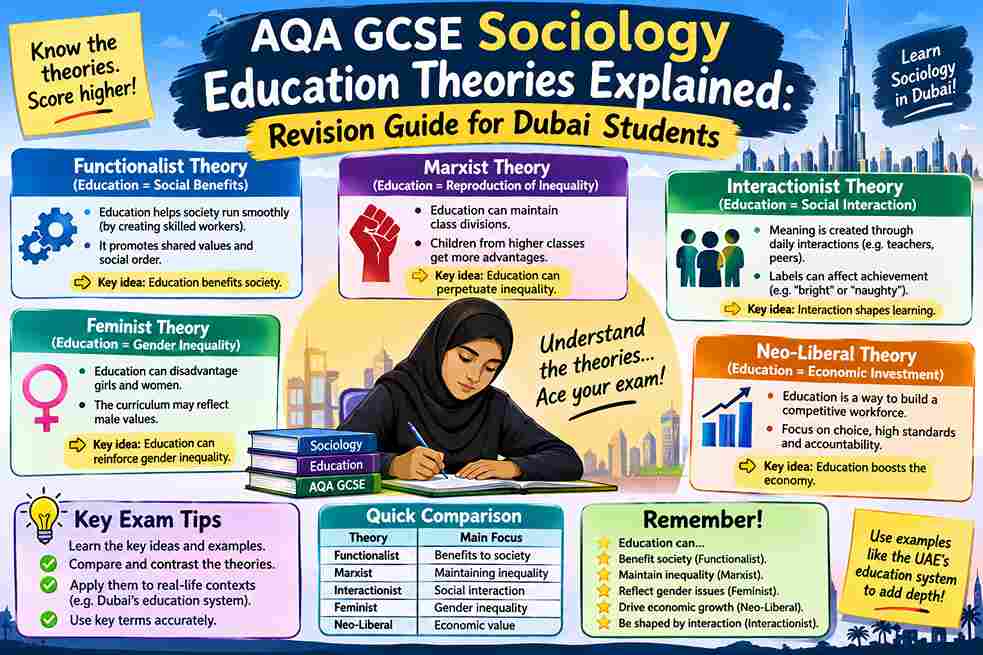
AQA GCSE Sociology Education Theories Explained: Revision Guide for Dubai Students
By EdFlik Team | November 20, 2026
For Key Stage 4 students across Dubai—from Jumeirah and Al Barsha to Dubai Silicon Oasis, Mirdif, and Dubai Marina—studying AQA GCSE Sociology (8192), the Education topic is both one of the most relatable and one of the most heavily examined sections of Paper 1 (The Sociology of Families and Education). Even when students encounter questions on school types, differential educational achievement, or labeling inside classrooms, AQA examiners repeatedly test whether candidates can connect real-world school practices to core sociological theories and evaluate their strengths and limitations.
Unlike subjects that reward memorizing isolated facts, AQA GCSE Sociology rewards clear AO1 (knowledge and understanding), precise AO2 (application) to specific scenarios or educational settings, and balanced AO3 (analysis and evaluation)—including critiques of each perspective and awareness of how globalized or diverse school environments shape educational experiences. For students in Dubai's international school community, thinking critically about how schooling shapes social mobility, cultural capital, student identity, and opportunity makes abstract sociological concepts far easier to grasp and apply in extended 12-mark essay questions.
Securing a Grade 8 or 9 ($A^*$) in AQA GCSE Sociology—a strong stepping stone toward A-Level Sociology, IB Diploma Psychology or Global Politics, or Law, Humanities, and Social Sciences—requires mastering the core education theories, knowing key sociological thinkers and concepts, and structuring structured evaluation paragraphs rather than listing one-sided points.
This comprehensive revision guide breaks down the major sociological theories of education for AQA GCSE Sociology, compares how they explain schooling and achievement, walks through high-scoring essay and evaluation habits, highlights common exam traps, and includes 100% copy-paste JSON-LD schema markup.
Key Takeaways
- Functionalism Sees School as Meritocratic and Socializing: Functionalists view education as promoting social solidarity, teaching specialist skills for the division of labor, and acting as a meritocracy where individuals succeed based on effort and talent.
- Marxism Sees School as Reproducing Class Inequality: Marxists argue that education legitimizes inequality under capitalism—promoting the myth of meritocracy, encouraging passive acceptance of hierarchy, and preparing students for different tiers of the workforce.
- Feminism Highlights Gendered Experiences and Progress: Feminists examine both historical barriers faced by girls and contemporary patterns in boys' and girls' achievement, subject choices, and hidden-curriculum expectations.
- Interactionism Focuses on Classroom Labels and Identity: Interactionists zoom in on everyday classroom interactions—such as teacher labeling, the self-fulfilling prophecy, and setting/streaming—to show how identities and outcomes form inside schools.
Part 1: Core Sociological Theories of Education in AQA GCSE Sociology
In AQA GCSE Sociology, every major theory answers two fundamental questions: What is the role of education in society? and Why do different groups achieve different outcomes in school?
                 AQA GCSE SOCIOLOGY: EDUCATION THEORIES MAP
                                      |
  +-----------------------------------+-----------------------------------+
  |                                                                       |
STRUCTURAL / MACRO PERSPECTIVES                              INTERACTIONIST / MICRO PERSPECTIVE
• Functionalism (Consensus & Meritocracy)                    • Labeling & Self-Fulfilling Prophecy
• Marxism (Conflict & Class Reproduction)                    • Teacher Expectations & Pupil Subcultures
• Feminism (Gender & Patriarchy / Equality)
1. Functionalism (Consensus & Meritocracy)
Functionalists (building on thinkers such as Émile Durkheim and Talcott Parsons) view society as an organic system where institutions like education perform essential functions to keep society stable and ordered:
- Social Solidarity & Shared Values: Schools bind diverse individuals together through shared norms, rules, and civic values—preparing young people to cooperate in wider society.
- Specialist Skills & Economic Role: Modern economies require specialized knowledge and technical skills; schools equip students with competencies needed for diverse occupations.
- Meritocracy & Role Allocation: Functionalists argue that modern schooling is largely meritocratic—meaning status and rewards are earned through individual ability and hard work rather than family background—and helps match people to roles suited to their talents.
- Key Evaluations (AO3): Critics argue that education is not purely meritocratic because family income, home resources, and school selection still strongly influence outcomes; Marxists contend that "shared values" often reflect ruling-class interests rather than neutral consensus.
2. Marxism (Conflict & Class Reproduction)
Marxists (drawing on Karl Marx and neo-Marxist educational sociologists such as Samuel Bowles and Herbert Gintis with the correspondence principle, and Pierre Bourdieu with cultural capital) view education under capitalism as a mechanism that reproduces social class inequality:
- Correspondence Principle: School structures—such as hierarchy, timetables, authority, and external rewards like grades—mirror the hierarchy and routines of the capitalist workplace, conditioning students for their future position in the labor market.
- The Myth of Meritocracy: Marxists argue that claiming schools reward pure merit convinces disadvantaged students that their lower attainment is their own fault, masking structural advantages tied to wealth and family background.
- Cultural Capital: Middle- and upper-class families are more likely to pass on linguistic styles, knowledge, familiarity with high-status culture, and educational confidence that align with school expectations.
- Key Evaluations (AO3): Functionalists argue Marxists exaggerate passive conditioning and overlook genuine social mobility; interactionists point out that students actively negotiate, resist, or reshape meanings in classrooms rather than simply absorbing ruling-class ideology.
As shown in the stratification diagram above, sociological debates over inequality often contrast economic class structures against broader status and power dimensions—a distinction that helps students compare Marxist class analysis with Weberian and cultural explanations of opportunity [image_agent_tag_17188066375139887394]
3. Feminism (Gender, Opportunity, and Representation)
Feminist sociologists examine how gender shapes schooling—looking at historical inequalities, changing achievement gaps, subject stereotyping, and hidden-curriculum messages:
- Liberal Feminism: Focuses on equal opportunities, legal/policy reforms, and removing barriers so girls and boys have fair access to all subjects and pathways (including STEM).
- Radical Feminism: Highlights patriarchal power dynamics, gender stereotyping, and issues such as sexual harassment or unequal representation in leadership.
- Marxist / Socialist Feminism: Connects gender inequality in education to both capitalism and domestic/economic structures.
- Key Evaluations (AO3): Critics note that feminist approaches sometimes treat gender in isolation from social class and ethnicity, and modern attainment data shows girls outperforming boys on several measures while distinct gender gaps persist in specific subject choices and leadership roles.
4. Interactionism (Labeling, Setting, and Subcultures)
Unlike macro theories that focus on broad social structures, interactionism looks closely at day-to-day face-to-face interactions between teachers and students:
- Teacher Labeling: Teachers may form early impressions of students based on behavior, speech, attainment, or perceived effort—attaching labels such as "high-ability," "motivated," or "disruptive."
- Self-Fulfilling Prophecy: When a student internalizes a teacher's label and acts in ways that confirm it, the prediction becomes reality (positive labels can boost confidence and attainment; negative labels can lower expectations and performance).
- Setting / Streaming and Subcultures: Grouping students by perceived ability can reinforce labels over time and contribute to pro-school or anti-school subcultures.
- Key Evaluations (AO3): Interactionism can feel overly focused on individual classrooms while neglecting wider structural forces—such as national curriculum design, funding, and family socioeconomic background—that shape what happens before a student even enters the classroom.
Part 2: Quick Comparison Matrix for AQA GCSE Revision
Use this comparison table when planning 4-mark, 6-mark, and 12-mark AQA GCSE Sociology responses:
| Perspective | Core View of Education | Key Concepts / Terms | Main Strength (AO3) | Main Limitation (AO3) |
| Functionalism | Builds social cohesion, teaches skills, promotes meritocracy. | Social solidarity, meritocracy, specialist skills, role allocation. | Explains how shared norms and skill training support social stability. | Overstates meritocracy; ignores how family wealth shapes opportunity. |
| Marxism | Reproduces class inequality and legitimizes privilege. | Correspondence principle, myth of meritocracy, cultural capital. | Highlights how material advantage and cultural familiarity affect attainment. | Tends to be deterministic; underestimates student agency and mobility. |
| Feminism | Examines gender equality, subject choices, and hidden curriculum. | Gender socialization, subject stereotyping, equal opportunity. | Draws attention to gendered patterns in expectations and pathways. | Can overlook class or ethnic differences within gender groups. |
| Interactionism | Shapes identities and outcomes via classroom interactions. | Labeling, self-fulfilling prophecy, setting/streaming, subcultures. | Shows how everyday classroom dynamics affect confidence and results. | Focuses on micro interactions; can miss wider structural causes. |
Part 3: How to Structure High-Scoring AQA Essay & Evaluation Paragraphs
In AQA GCSE Sociology, AO3 (evaluation) is not just adding "However, some sociologists disagree" at the end of an answer. Strong evaluation weighs evidence, examines why a theory may be limited or one-sided, and contrasts competing viewpoints directly.
                 AQA 12-MARK ESSAY & EVALUATION FLOW
                                     |
  Step 1: Define & State Argument  ---> Clearly define key sociological terms and outline how
                                         the focal theory answers the question (AO1/AO2).
  Step 2: Develop Applied Point(s)   ---> Explain the mechanism clearly and apply it to school
                                         practices, assessment, or achievement (AO2).
  Step 3: Offer Targeted Critique    ---> Challenge assumptions, point out counter-evidence or
                                         limitations, and compare another theory (AO3).
  Step 4: Reach a Balanced Judgment  ---> Weigh both sides in context before concluding which
                                         explanation is strongest for the specific scenario.
Practical Paragraph Formula (Point $\to$ Explain $\to$ Apply $\to$ Evaluate):
- Point: Name the concept or theory clearly (e.g., Marxists argue that schools promote the myth of meritocracy...).
- Explain: Define what the concept means in sociology.
- Apply: Connect it to schooling, exams, setting, or student outcomes.
- Evaluate: Explain a limitation of that argument or contrast it with an alternative perspective (such as functionalism or interactionism).
Linking educational achievement to broader ideas of social mobility—such as whether students can move upward across generations or how structural barriers limit movement—helps students write sharp, analytical evaluations in AQA extended responses [image_agent_tag_17188066375139888065]
Part 4: Applying Theory to Dubai's Diverse International School Context
Dubai's school landscape is remarkably diverse—bringing together students from many nationalities, languages, and family backgrounds across private and international schools. While AQA GCSE Sociology exams assess the AQA specification and sociological concepts rather than local regulations, thinking through how theories apply in a cosmopolitan environment like Dubai is a great way to test your AO2 application skills:
- Functionalism in Diverse Classrooms: You can examine how shared school rules, extracurricular activities, and common academic standards help students from varied backgrounds build shared norms and prepare for future careers.
- Marxism & Cultural Capital: You can analyze how access to extra resources, academic support, or familiarity with formal academic expectations can give some students an advantage—while testing whether hard work alone guarantees equal outcomes.
- Interactionism in Everyday Lessons: You can reflect on how teacher encouragement, expectations, and classroom grouping affect a student's confidence—especially when studying in a second language or adapting to a new school system.
Always remember: in the actual AQA exam, ground your answer firmly in AQA sociology concepts, theorists/perspectives, and sociological evidence, using real-world examples to illustrate—never replace—sociological analysis.
Part 5: Top 4 Exam Traps That Cost AQA GCSE Sociology Students Marks
- Describing School Policies Without Using Sociological Concepts: Writing a general description of homework, exams, or school rules without naming sociological concepts (like meritocracy, cultural capital, labeling, or self-fulfilling prophecy) limits AO1 and AO2 marks.
- Treating Theories as Monolithic or Uncriticized: Presenting Functionalism or Marxism as absolute truth without evaluating its blind spots restricts top-band AO3 marks. Every theory has strengths and limitations.
- Confusing "Correlation" with "Simple Cause": In questions on achievement by class, gender, or ethnicity, avoid claiming a single factor explains everything on its own; explore how home factors, school processes, and wider society interact.
- Running Out of Time on the 12-Mark Question: Allocate your time deliberately so you have enough minutes to plan a clear two-sided argument with explicit evaluation before the bell.
For expert 1-on-1 online tutoring support to master AQA GCSE Sociology theories, 4- and 12-mark essay structure, and exam technique in Dubai, book a class on EdFlik.
Frequently Asked Questions (FAQs)
Q1: What are the main theories of education I need to revise for AQA GCSE Sociology?
Ans: Focus primarily on Functionalism (Durkheim, Parsons—social solidarity, specialist skills, meritocracy), Marxism (Bowles and Gintis, Bourdieu—correspondence principle, myth of meritocracy, cultural capital), Feminism (gender socialization, equal opportunity, subject choices), and Interactionism (labeling, self-fulfilling prophecy, setting/streaming, subcultures), along with key evaluations of each.
Q2: How do I get top marks for evaluation (AO3) in AQA GCSE Sociology?
Ans: Go beyond simply stating that another sociologist disagrees. Explain why a theory has limitations, use contrasting perspectives to highlight what a theory misses, and link your evaluation directly back to the question's focus on schooling or achievement.
Q3: Why is the Education topic so important in AQA GCSE Sociology Paper 1?
Ans: Education is one of the core mandatory topics in Paper 1 (The Sociology of Families and Education), carrying substantial weight across short-answer items, source/item application questions, and extended 12-mark essays. Mastering the core theories gives you a reliable analytical toolkit across the entire topic.