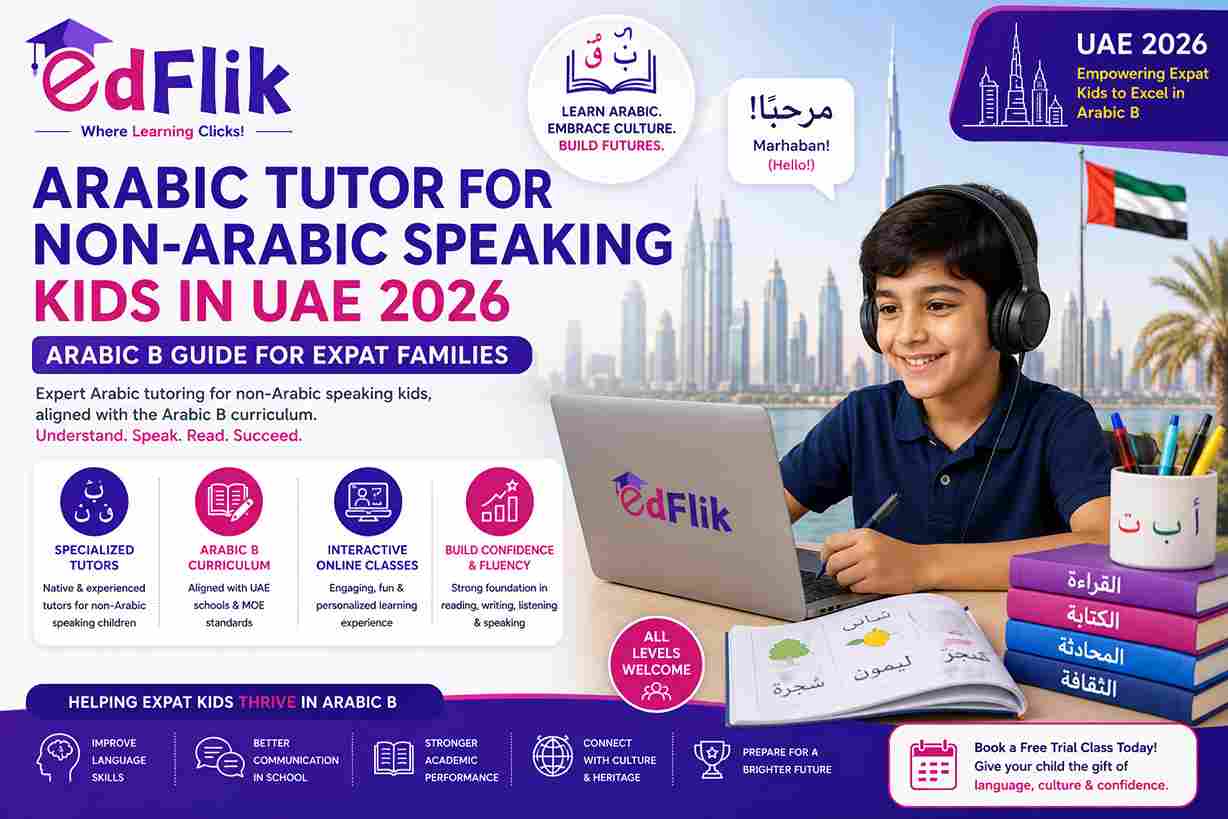
Arabic Tutor UAE 2026 — Complete Guide for Expat Students and UAE National Families
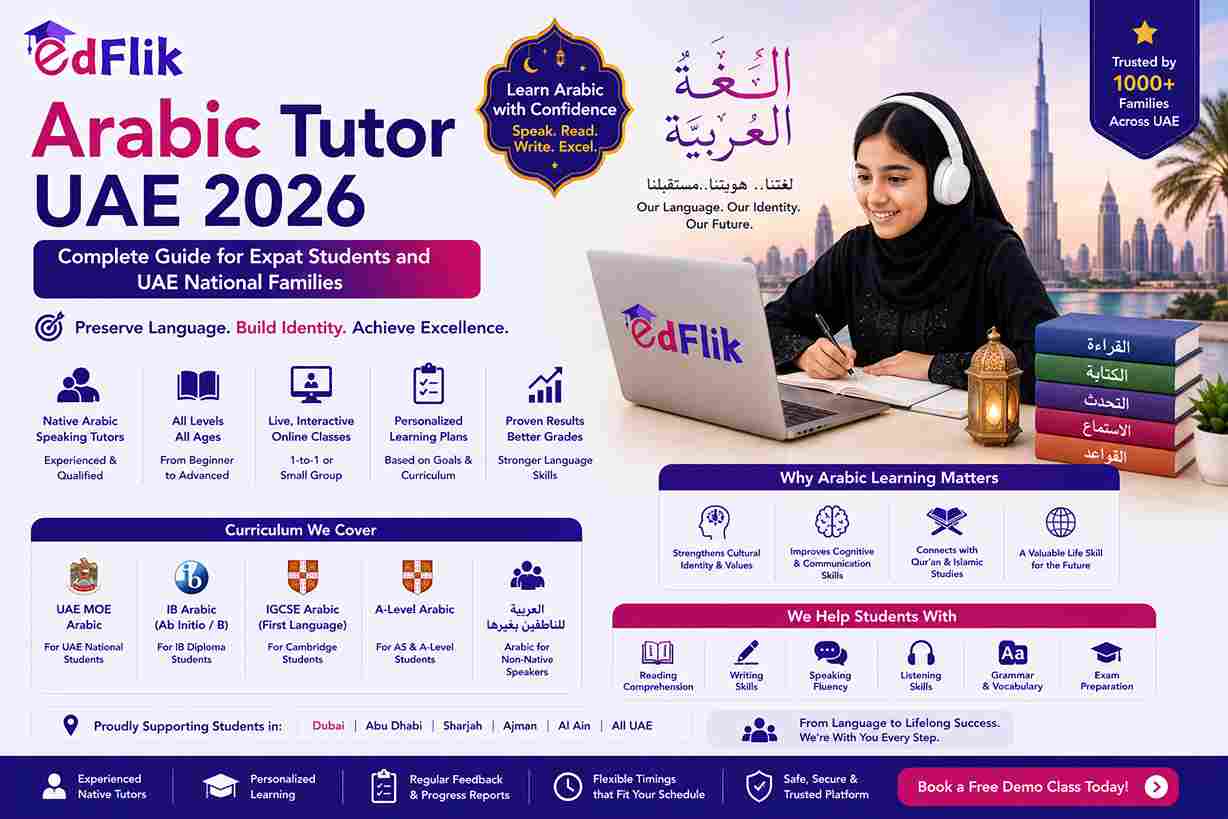
Arabic is the one subject in UAE private schools that every family — UAE national and expatriate alike — consistently needs specialist tutoring support for. It is compulsory at every UAE private school regardless of curriculum. It has a genuinely complex script and grammar system. And the version taught in schools (Modern Standard Arabic, فصحى) is different from both spoken Emirati dialect and the colloquial Arabic most expatriate families encounter in daily life. This guide covers what Arabic tutoring in UAE involves, who needs it, and what an effective Arabic tutor provides.
Two Completely Different Arabic Tutoring Needs in UAE
|
Student Type |
What They
Need |
Key Challenge |
EdFlik Rate |
|
Expatriate
child at UAE school — Arabic Second Language (non-native) |
Building
Arabic literacy from foundation: script recognition, writing, basic grammar,
conversational phrases, school Arabic vocabulary |
The Arabic
script is completely unfamiliar; right-to-left reading; 28 letters with
multiple forms; no cognates with English or most South Asian languages |
From AED
55/session |
|
UAE national
student — Arabic First Language (native speaker) |
Formal Modern
Standard Arabic grammar (nahw and sarf); literary Arabic for comprehension
questions; formal writing techniques; Arabic poetry analysis at senior levels |
Spoken Emirati
dialect differs significantly from formal written Arabic; MSA grammar rules
(case endings, dual forms, broken plurals) are complex and require explicit
study |
From AED
60/session |
|
IB or IGCSE
Arabic exam preparation (any level) |
Exam-specific
technique: IGCSE Arabic comprehension format, IB Arabic B oral, IB Arabic A
Individual Oral — board-specific skills beyond general Arabic competence |
Each board has
specific question formats and mark-scheme requirements; a student with
general Arabic competence still needs board-specific tutoring for exam
performance |
From AED
65/session |
Arabic for Expat Children — The Script Foundation First
The most important Arabic tutoring decision for expatriate UAE families is when to start. Arabic script is a genuinely new writing system for children whose home literacy is in English, Hindi, Urdu (which shares Arabic script but with different sounds), Malayalam, or other non-Arabic-script languages. The Arabic script has:
• 28 letters — each of which has up to 4 different written forms depending on its position in a word (isolated, initial, medial, final)
• Right-to-left reading and writing direction — the opposite direction from English, which some children find confusing initially when switching between the two
• Short vowels not written in most school and examination text — students must infer pronunciation and meaning from context, root knowledge, and grammar rules
• No capital letters, no spaces between letters within words — Arabic words are written as connected letter strings, unlike the separated letters of English print
For a child joining a UAE school in FS1 or KS1, systematic phonics-style Arabic script teaching — learning to recognise, read, and write each letter in all its forms before encountering it in reading — is the foundation that everything else builds on.
Arabic First Language for UAE Nationals — Modern Standard vs Dialect
UAE national students at Arabic First Language level face a different challenge: the Arabic they speak at home (Emirati Arabic dialect) is significantly different from the Modern Standard Arabic (MSA, الفصحى) they are assessed on in school. Emirati dialect has different vocabulary, different verb forms, and different pronunciation from MSA. When a UAE national student writes an Arabic essay, they must write in MSA — not in the dialect they grew up speaking.
The three most consistently challenging aspects of MSA for UAE national students:
• Case endings (i'raab): MSA uses case endings on nouns (nominative, accusative, genitive) and adjectives that Emirati dialect does not use in speech. Writing a formally correct Arabic sentence requires knowing which case ending to apply to each noun.
• Broken plural patterns: Arabic has no simple 's' plural — most nouns form their plural through an irregular 'broken' pattern (e.g. كتاب → كتب; طالب → طلاب) that must be memorised individually.
• Verb conjugation tables: Arabic verbs conjugate for person, number, and gender. MSA verb tables are more regular than English but have 13 forms per tense that must be used correctly in formal written Arabic.
IGCSE and IB Arabic — Board-Specific Examination Technique
Arabic tutoring for examination preparation must be specifically aligned to the board and level:
• IGCSE Arabic First Language (0508): Two papers — Paper 1 (reading comprehension in Arabic; questions in Arabic) and Paper 2 (directed writing and essay in Arabic). Comprehension questions require specific inference and summary skills in Arabic academic register.
• IGCSE Arabic Second Language (0544): Listening, reading, speaking, and writing components at ASL level — accessible to non-native learners with several years of school Arabic experience.
• IB Arabic B (SL and HL): Language acquisition framework for non-native learners. Individual Oral (15-minute recorded discussion) is assessed using IB Language B criteria — different from IGCSE Arabic comprehension technique.
• IB Arabic A (Language A): First language track, assessed alongside English A at schools with bilingual programmes. Arabic A IO requires literary analysis of Arabic texts in the IB Language A framework.
|
EdFlik
provides Arabic tutoring for both Arabic First Language (UAE national
students — MSA grammar, nahw, formal writing) and Arabic Second Language
(expatriate students — script foundation through exam preparation). All
Arabic tutors are native Arabic speakers with UAE curriculum experience. From
AED 55 per session. Free diagnostic in Arabic or English. Book at
www.edflik.com or WhatsApp +91 88788 96600. |
Frequently Asked Questions
Q: Why is Arabic tutoring in such high demand in UAE?
Arabic is compulsory at all UAE private schools regardless of curriculum. Every student — UAE national or expatriate — must study and be assessed in Arabic. For non-Arabic-speaking expat families, it is the subject with the largest language gap. For UAE nationals, formal MSA differs significantly from spoken Emirati dialect.
Q: What Arabic does a child need to learn in UAE private schools?
Two tracks: Arabic First Language (AFL) for native speakers — MSA grammar, literature, formal writing at high academic level; and Arabic Additional/Second Language (AAL/ASL) for non-native learners — building from literacy foundations. The track determines the entire tutoring approach.
Q: How does IGCSE Arabic differ from IB Arabic?
IGCSE Arabic has three versions (First Language, Second Language, Foreign Language). IB has Arabic A (Language A — first language) and Arabic B (Language B — language acquisition). Different assessment frameworks, different text types, different mark-scheme requirements — board-specific tutoring is essential.
Q: What Arabic topics do expat students struggle with most?
Arabic script recognition and writing, short vowel marks (tashkeel) not written in most text, formal Arabic grammar (case endings, broken plurals, verb conjugation), and reading speed. All addressable with systematic, explicit Arabic literacy tutoring.
Q: At what age should expat children in UAE start Arabic tutoring?
As early as school entry (FS1/FS2, ages 3-4) is most effective. Children joining in KS1 (ages 5-7) should start immediately. Children joining in KS2 or KS3 need immediate tutoring to prevent the gap from widening quickly.