Bar Model Method: Singapore Primary Maths for UAE Parents
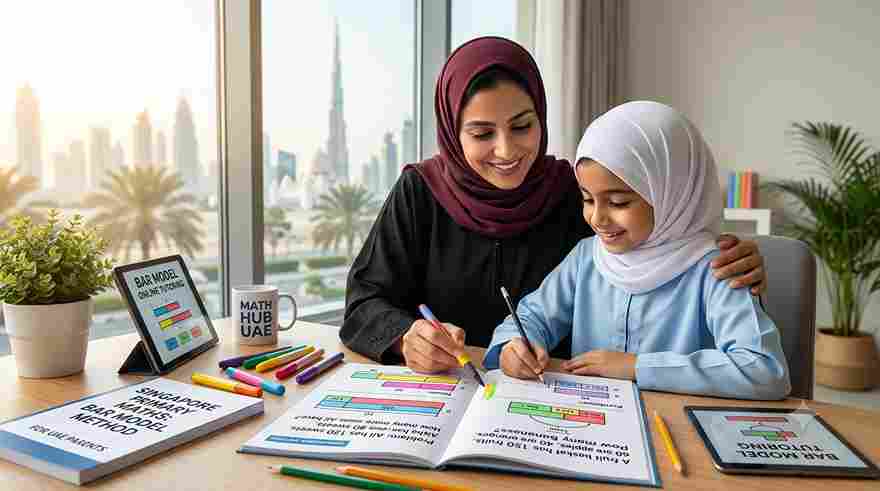
If your child has come home with a maths word problem and a drawing of rectangles, you are not alone in wondering what is going on. The bar model method is one of the most talked-about visual tools in primary maths, and it can look unfamiliar to parents who learned maths in a different way. The good news is that the idea behind it is simple, and most families can start helping within a few minutes. This guide explains what the method is, how children use it with word problems, and how you can support it at home or in an online class.
Maths teaching approaches differ between schools and courses. Before you change how your child practises, check the current guidance from your child's school, and ask the tutor which methods they use.
What a bar model is
A bar model is a drawing that represents the numbers in a word problem. Each quantity becomes a bar, and the length of the bar shows how big that quantity is compared with the others. The drawing does not need to be exact. Its job is to show relationships: which amounts are the same, which is larger, and what is missing.
The value of the model is that it turns words into a picture before any calculation starts. A child who reads "Ahmed has three times as many stickers as Sara" can draw one bar for Sara and three equal bars for Ahmed. Once the picture is clear, the question is often much easier to answer.
The main types of bar model
Children usually meet a few common patterns, and they build from simple to complex as they grow more confident.
- Part-whole models: Two smaller bars join to make one whole bar. These help with addition and subtraction questions, such as finding a missing part when the total is known.
- Comparison models: Two bars sit one above the other, with one longer than the other. These suit "how many more" and "how many fewer" questions.
- Change models: A bar shows a starting amount, then an extra section shows what has been added or taken away. These help children picture a story that changes over time.
As problems become more layered, children may combine these types. The principle stays the same: draw what the words describe, then use the picture to decide the next step.
How children use bar models with word problems
Most students benefit from a simple routine. The steps below are a useful pattern to practise, though your child's teacher or tutor may describe them slightly differently:
1. Read the problem twice, slowly, and say the important facts out loud.
2. Decide what the question is asking for, and mark it with a question mark on the drawing.
3. Draw the bars, starting with the quantity that is easiest to describe.
4. Label each bar with a number, a name or a letter that matches the story.
5. Use the picture to choose the calculation, then check that the answer makes sense against the drawing.
The check at the end is the part many children skip. If the model shows a bar that should be longer, the answer may need another look. Encouraging that habit helps children become independent thinkers rather than people who only look for the right operation.
Where parents can help at home
You do not need to be an expert in the method to help. Some simple questions can guide your child:
- "What does the longest bar stand for?"
- "Which part of the picture tells us the question?"
- "Does your answer fit the drawing?"
Try to ask questions rather than correcting the drawing straight away. When a parent explains the answer, the child often stops thinking. When a parent asks what the child notices, the child keeps working. Keep sessions short, perhaps ten to fifteen minutes, and finish with a problem the child can solve confidently. That small success matters.
Be patient with drawings that look untidy. The purpose is thinking, not art. A rough sketch that shows the right relationships is far more useful than a neat picture with the wrong parts.
Common mistakes to watch for
Children often make the same few errors when they first use bar models, and recognising them early saves a lot of frustration. A bar may be drawn at the wrong length, so the picture no longer matches the story. A child may label a bar with the total when it should be a part. Others skip the question mark, and so lose track of what they are solving for. When you spot these, ask your child to read the story again and compare it with the drawing, rather than fixing the picture for them.
Another common issue is drawing too quickly. Children who rush to the calculation often find the model is only decoration. A simple pause, where the child says what each bar stands for before writing any numbers, prevents most of these errors.
Using the method in an online class
Online lessons can work well for bar models, because the tutor can draw on a shared screen while your child follows along. A good tutor will ask your child to draw their own bars rather than copy the tutor's picture, since drawing is part of the learning. They will also notice when a child has read a problem quickly and missed a key word such as "fewer" or "altogether".
Ask the tutor how they introduce the method, and whether they move from simple part-whole models to comparison and change models as the child becomes more confident. Ask how they check that the drawing matches the question, and how they tell you about progress. You are looking for a clear approach with plenty of practice, not a quick trick.
A checklist before you start
- Ask your child's school which maths approach they use, and whether they expect bar models in class.
- Practise with two or three problems a week rather than long sessions every day.
- Keep a small notebook of problems your child found tricky, and revisit them after a few days.
- Celebrate effort and clear thinking, not only a correct final answer.
- Ask a tutor to show you how a problem was modelled, so you can recognise the pattern at home.
How EdFlik can help
EdFlik runs live, one-to-one online classes for children and teens aged 3 to 18. Classes last about one hour, and pricing starts from AED 45 per class. A tutor can work through word problems with your child, ask them to draw their own models and explain their reasoning out loud.
We confirm whether a tutor teaches a particular course or method before we promise it. So please ask us whether a tutor works with bar models before you book. If the answer is yes, your next step is a free trial class. Visit www.edflik.com to book, or write to support@edflik.com with your child's age and the areas where they need support. A free trial lets you and your child see how the lessons feel.
Conclusion
The bar model method is a simple idea with a lot of power. It helps children turn words into a picture, and the picture into a plan. With short, regular practice and gentle questions from home, most children grow more confident with word problems over time. Check your child's school guidance, practise little and often, and try a free trial class if you want a tutor to build the routine with your child.
Frequently Asked Questions
What is the bar model method?
The bar model method is a visual way to solve maths word problems. Each quantity in the problem becomes a bar, and the lengths show how the amounts relate to each other. Children draw the picture first, then use it to choose the calculation and to check the answer.
Which primary years use bar models?
Bar models are most common in primary maths, especially when children are working through addition, subtraction, multiplication, division and word problems. The exact year groups depend on the school and the curriculum. Ask your child's teacher which approach they use and when models are introduced.
How can a parent help with bar models at home?
Ask questions rather than giving answers. Try "What does the longest bar stand for?" or "Does your answer fit the drawing?" Keep sessions short, let your child draw their own model and celebrate clear thinking, even when the drawing is rough.
Is the bar model used outside Singapore?
Visual models are used in many maths courses around the world, though the exact approach varies. Ask your child's school whether they use bar models, and check the current guidance from the curriculum your child follows.
Can an online tutor teach bar models?
Many online tutors can teach bar models, and a shared screen makes drawing easy to follow. Ask whether the tutor works with bar models and how they check that your child draws their own. A free trial class shows the approach in action.
More on Study Skills & Parenting
- Decoding the Singapore Math Method: Why It Works and How to Help Your Child at Home
- Deciphering White Rose Maths: Navigating the Concrete Pictorial Abstract (CPA) Approach in UAE British Primary Schools
- How to Improve Maths Grade UAE | EdFlik Guide
- Maths Homework Help for Kids in the UAE: Practical Tips for Parents
- All Study Skills & Parenting articles