Decoding the Singapore Math Method: Why It Works and How to Help Your Child at Home
Last Updated: September 2026 | By EdFlik Education Team
If you have ever looked at a modern elementary school math textbook, you may have noticed a shift away from endless memorization toward diagrams, word problems, and conceptual questions. Chances are, you are looking at the influence of Singapore Math.
Consistently topping global education rankings like TIMSS and PISA, Singapore’s national math curriculum has captured the attention of educators and parents worldwide. But what makes this method so effective, and how can parents who didn't grow up learning this way help their children at home?
In this comprehensive guide, we decode the Singapore Math method and provide practical tips to support your child's mathematical journey.
What is Singapore Math?
Developed in the 1980s by Singapore’s Ministry of Education, Singapore Math is designed to teach students to understand mathematical concepts deeply rather than simply memorize algorithms or procedures.
Instead of covering a massive breadth of topics superficially every year, Singapore Math focuses on a smaller number of core concepts per grade, teaching them in depth until students achieve complete mastery.
The philosophy rests on three major pillars:
- Problem Solving as the Center: The ultimate goal of learning math is not just computation, but the ability to apply mathematical thinking to solve real-world problems.
- The Concrete-Pictorial-Abstract (C-P-A) Approach: A progressive learning model developed by psychologist Jerome Bruner that bridges physical objects with abstract numbers.
- Number Sense and Mental Math: Emphasizing flexibility with numbers so students can calculate efficiently in their heads.
The Secret Sauce: The Concrete-Pictorial-Abstract (C-P-A) Approach
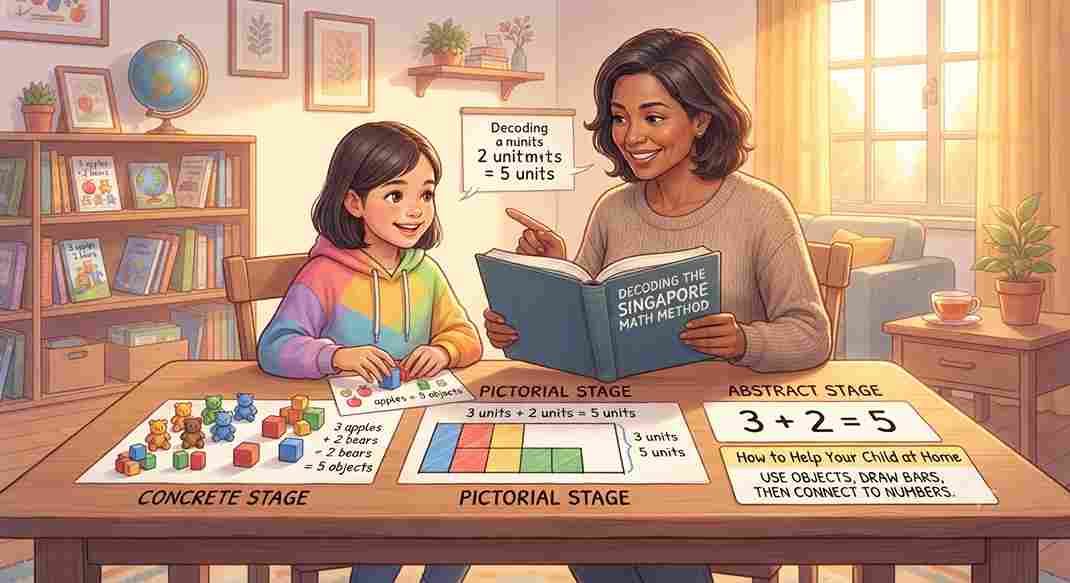
The core superpower of Singapore Math is how it introduces new concepts. Children rarely jump straight from a word problem to an equation. Instead, they move through three distinct stages:
1. The Concrete Stage (Doing)
Children learn by manipulating physical objects. When learning addition, fractions, or multiplication, they use counters, base-ten blocks, fraction bars, or everyday household items. Math is experienced physically.
2. The Pictorial Stage (Seeing)
Once children understand the physical concept, they transition to drawing pictures, tallies, or diagrams. This is where the famous Bar Model Method comes in. Students draw rectangular bars to represent quantities and relationships in word problems, transforming confusing sentences into clear visual maps.
3. The Abstract Stage (Symbolic)
Finally, students replace the objects and drawings with standard mathematical symbols, numbers, and signs ($+$, $-$, $\times$, $\div$, $=3$). Because they built a strong foundation in the first two stages, abstract equations actually make sense to them rather than feeling like arbitrary rules.
Why Singapore Math Works So Well
- It Builds Real Conceptual Depth: Students understand why $3/4 \div 1/2$ works, rather than just blindly remembering to "keep-change-flip."
- It Erases Math Anxiety: Because concepts are broken down visually using models, children who struggle with abstract word problems gain a reliable tool (bar modeling) to untangle any scenario.
- It Fosters Critical Thinking: Standard worksheets test routine calculations; Singapore Math tests whether a student can adapt concepts to unfamiliar, multi-step problems.
How to Help Your Child with Singapore Math at Home
If your child's school uses Singapore Math (or a curriculum heavily inspired by it), you might feel intimidated helping with homework. Here are four practical ways to support them:
1. Embrace the Bar Model
When your child encounters a difficult word problem, resist the urge to immediately write out an algebraic equation. Instead, ask them: "Can we draw this out using bars?" Draw a rectangle for the known quantity and proportional bars for the unknowns. Visualizing the parts and the whole changes everything.
2. Ask "How" and "Why," Not Just "What"
When reviewing homework, don't just check if the final answer is right. Ask questions like:
- “How did you figure that out?”
- “Can you solve this a different way?”This encourages metacognition and deepens conceptual retention.
3. Use Everyday Objects for Concrete Practice
You don't need expensive math manipulatives. Use everyday items around the house:
- Counting and grouping snacks (grapes or crackers) for multiplication and division.
- Cutting pizza, pie, or paper strips into equal parts to explore fractions.
- Measuring ingredients while cooking to understand decimals and units of measurement.
4. Celebrate Mistakes as Learning Moments
Singapore Math problems are designed to challenge thinking. If your child gets stuck, praise their effort, review the model together, and treat the error as a natural stepping stone to mastery.
Want to give your child an edge in mathematics? EdFlik offers personalized, 1-to-1 online tutoring tailored to Singapore Math, US Common Core, IB, and other global curricula.Book a Free Demo Class Today!
Frequently Asked Questions (FAQs)
Q1: Is Singapore Math harder than traditional math?
Ans: It isn’t necessarily harder, but it is different. It requires students to think critically and explain their reasoning rather than rely on rote memorization. Once children get used to the visual methods, they often find math much more logical and intuitive.
Q2: What is the Bar Model Method?
Ans: The bar model method is a visual problem-solving tool used in Singapore Math. Students draw rectangular bars to represent known and unknown quantities in a word problem, making it easy to see addition, subtraction, multiplication, or fraction relationships at a glance.
Q3: Can Singapore Math help students preparing for competitive exams?
Ans: Absolutely. Because Singapore Math trains students in flexible problem-solving, advanced word problem analysis, and mental math, it builds a stellar foundation for competitive tests like the SAT, AMC, and international math olympiads.
Q4: How can EdFlik help my child master Singapore Math?
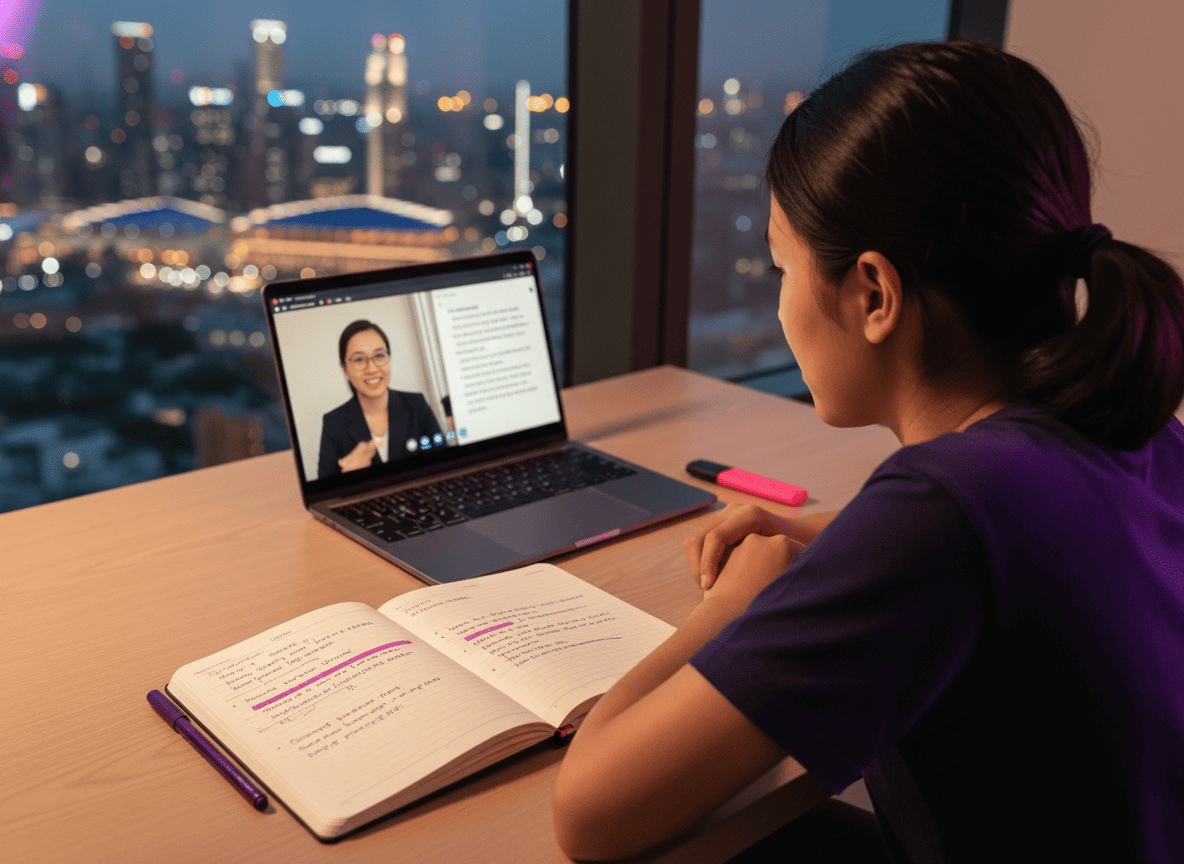
Ans: EdFlik provides expert, 1-to-1 online tutors who specialize in the Singapore Math curriculum. Our tutors break down complex word models, strengthen number sense, and adapt lessons to your child's unique learning pace.