Building a Winning STEM Portfolio: Extracurriculars That Top UK and US Universities Look For
Last Updated: October 2026 | By EdFlik Education Team
For high-achieving students across international schools in the United Arab Emirates and globally who aspire to study Science, Technology, Engineering, or Mathematics (STEM) at world-class institutions—such as Oxford, Cambridge, MIT, Stanford, Imperial College London, or Ivy League universities—the academic transcript is only half the battle.
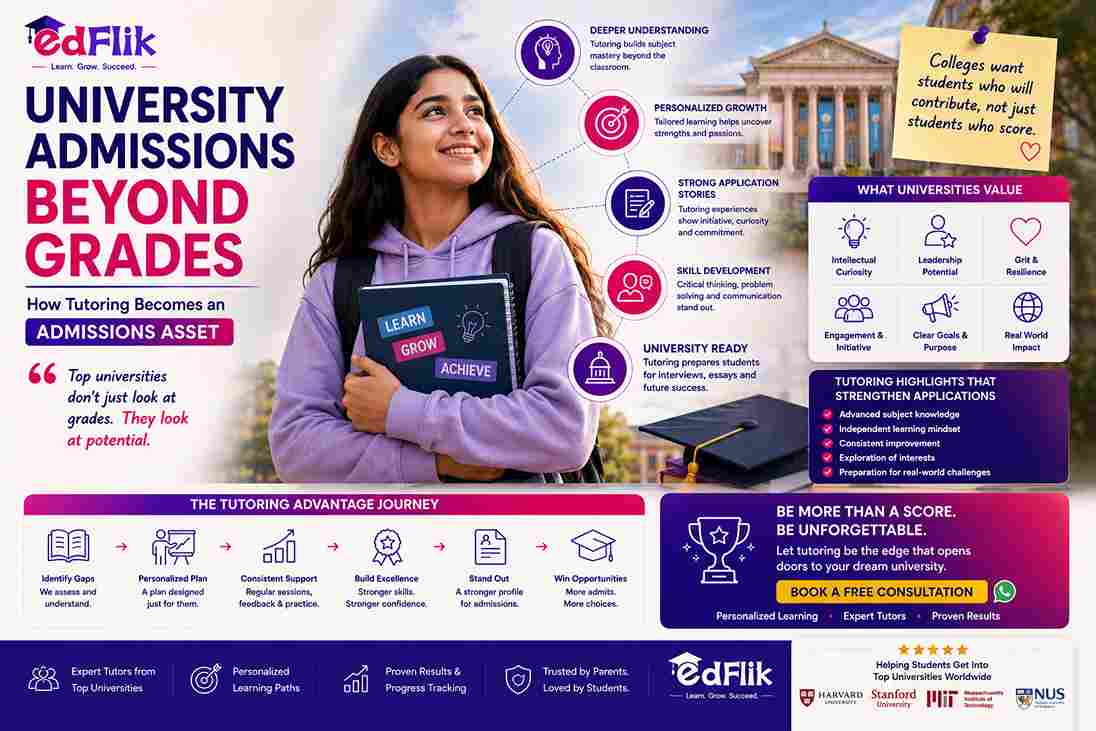
In an era where thousands of applicants apply with near-perfect GPA scores, straight $A^*$ grades, or maximum IB points, top-tier university admissions officers no longer view high grades as a differentiator. Instead, they look for a compelling, self-directed STEM Portfolio. Admissions committees want to see authentic intellectual curiosity, independent initiative, and tangible evidence that you are already engaging with science and engineering beyond the compulsory school curriculum.
In this comprehensive masterclass guide, our expert university admissions and curriculum consultants break down what elite UK and US universities look for in a STEM applicant, identify high-impact extracurricular activities, and share a strategic roadmap to build a standout portfolio.
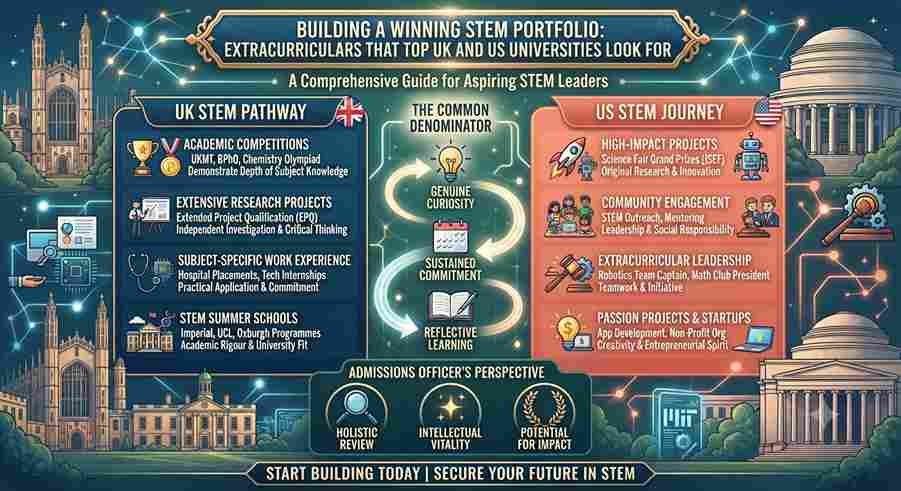
Part 1: The Core Philosophy — UK vs. US Admissions Expectations
Before assembling your portfolio, you must understand the fundamental divergence in how British and American universities evaluate STEM applicants:
1. The UK System (UCAS Personal Statement & Oxbridge Focus)
- The Philosophy: Depth of academic focus and subject mastery.
- What Admissions Tutors Look For: When applying for Engineering, Natural Sciences, or Computer Science through UCAS (especially to Oxford or Cambridge), your personal statement must be 80% academic. Tutors want to see evidence of independent super-curricular reading, advanced problem-solving competitions (such as the BPhO or SMC), and extended scientific inquiry. General leadership or sports clubs carry very little weight unless they directly connect to your intellectual stamina.
2. The US System (Common App & Holistic Evaluation)
- The Philosophy: Breadth, leadership, community impact, and multifaceted character.
- What Admissions Tutors Look For: US holistic admissions committees evaluate you as a complete person. While stellar STEM achievements are mandatory, they want to see how you apply your technical skills to solve real-world problems. They look for "spikes"—a defining area of deep expertise—complemented by collaborative leadership, mentorship, and community engagement.
Part 2: 4 Pillars of a High-Impact STEM Portfolio
To build a competitive profile for both UK and US admissions, your extracurricular and super-curricular activities should span four essential pillars:
Pillar 1: Independent Research and Innovation (The Capstone Project)
Nothing signals genuine passion for STEM quite like executing an independent project that goes beyond standard school labs.
- What to Do: Conduct an independent research paper, build a functional software application, design an engineering prototype, or enter prestigious science fairs (such as Regeneron ISEF, local national science symposiums, or virtual research mentorship programs).
- Example: Instead of just taking AP Computer Science, build an open-source machine learning model that analyzes local traffic patterns or optimizes renewable energy distribution in your community.
Pillar 2: Competitive Mathematics and Olympiads
Top universities revere rigorous problem-solving benchmarks. Excelling in national and international competitions provides objective validation of your mathematical agility.
- What to Target:
- For UK/International: British Physics Olympiad (BPhO), UK Senior Mathematical Challenge (SMC), Chemistry Olympiad (RSC), or Bebras Computing Challenge.
- For US/Global: American Mathematics Competitions (AMC 10/12), AIME, USACO (USA Computing Olympiad), or Physics/Chemistry Olympiads.
Pillar 3: Authentic Leadership and STEM Advocacy
Universities want to know how you contribute to your school or local community through your technical expertise.
- What to Do: Found or lead your school’s Coding Club, Robotics Team, or Math Circle. Organize a regional STEM hackathon, mentor younger students in middle school science, or volunteer to teach digital literacy in underserved communities. Leadership is demonstrated through initiative and measurable impact, not merely holding a formal club title.
Pillar 4: Advanced Super-Curricular Exploration
Demonstrate that you consume science and mathematics voraciously outside of assigned homework.
- What to Do: Engage with university-level online courses (Coursera, edX, MIT OpenCourseWare) in specialized fields like quantum computing, organic chemistry, or artificial intelligence. Read seminal popular science and mathematics literature (e.g., books by Richard Feynman, Stephen Hawking, or Marcus du Sautoy) and write critical reflection essays or blog posts analyzing them.
Part 3: A Timeline Strategy — When to Build Your Portfolio
Building a winning STEM portfolio cannot be rushed into the autumn of your Grade 12 year. It requires a multi-year trajectory:
Grades 9 & 10 (Exploration and Foundation)
- Build a rock-solid foundation in core math and science courses.
- Participate in school science fairs, coding clubs, and introductory math competitions (e.g., Kangaroo Math or intermediate Olympiads).
- Begin exploring areas of genuine interest (e.g., robotics, biotech, astrophysics) through books, documentaries, and online enrichment modules.
Grade 11 (Deepening and Leadership)
- Take on leadership roles in STEM clubs or initiate your own independent research project.
- Register for rigorous national Olympiads (AMC, BPhO, UKMT) and aim for certificates of distinction or qualification for higher rounds.
- Secure a summer internship, university research attachment, or engineering shadow program.
Grade 12 (Synthesis and Application)
- Weave your research projects, competition achievements, and intellectual motivations into your UCAS Personal Statement (UK) or Common App essays and STEM supplement (US).
- Request detailed letters of recommendation from STEM teachers who can speak directly to your curiosity and lab/classroom leadership.
Part 4: Top 4 Portfolio Pitfalls to Avoid
- Certificate Collecting Without Depth: Accumulating dozens of superficial online course certificates from 2-hour webinars without demonstrating actual mastery, application, or independent projects. Admissions officers see right through "resume padding."
- Neglecting Core Academics: Spending so much time on robotics competitions or independent coding projects that your school GPA or AP/IB predicted grades drop. Your academic transcript remains the foundational gatekeeper.
- Lacking a Narrative ("The Jack of All Trades"): Having a disjointed list of activities—such as captain of the debate team, member of the art club, and a beginner physics coder—without a cohesive narrative showing your deep commitment to scientific inquiry.
- Impersonal Group Projects: Claiming sole credit for a massive corporate or university research project where you merely washed glassware or observed. Authenticity and personal contribution are paramount.
Preparing for competitive UK or US university admissions in STEM? EdFlik connects international school students globally with expert, 1-to-1 online mentors specializing in Olympiad preparation, university application coaching, and STEM portfolio development, helping you secure offers from world-class institutions.Book a Free Demo Class Today!
Frequently Asked Questions (FAQs)
Q1: Do I need to win an international Olympiad to get into MIT or Oxford for STEM?
Ans: No. While winning international medals certainly helps, elite universities accept thousands of students who have never competed globally. What matters most is demonstrating consistent, self-driven intellectual engagement through local competitions, independent research, and deep passion projects.
Q2: How important are AP/IB scores compared to extracurriculars for US STEM admissions?
Ans: They are equally critical. US universities use academic metrics (GPA, AP/IB scores, SAT/ACT) as a threshold to prove you can handle rigorous university coursework. Once you clear that academic threshold, your extracurricular portfolio, essays, and recommendations determine whether you stand out among tens of thousands of qualified applicants.
Q3: How can I find research opportunities while still in high school?
Ans: Start locally. Reach out to professors or researchers at universities in your region, pitch your interest in their published work, and inquire about virtual research assistantships. Additionally, structured summer research programs hosted by universities are fantastic avenues to explore.
Q4: How does EdFlik support students building their STEM profiles?
Ans: EdFlik connects international school students worldwide with vetted, expert 1-to-1 online mentors specializing in STEM curriculum enhancement, Olympiad training, university admissions consulting, and personal statement crafting. Our personalized coaching helps students discover their academic passion and build a compelling, authentic portfolio.