How UAE Students Apply to UK Universities: A Complete 2026 Guide
The UK remains the most popular overseas university destination for UAE secondary school graduates — driven by the prevalence of British-curriculum schools in Dubai, Abu Dhabi, and Sharjah, and by the strong reputation of UK universities for the degrees most commonly pursued by UAE students: Medicine, Engineering, Business, Law, and Computer Science. Understanding how UCAS works, what UK universities expect from international applicants, and how to build a competitive application from the UAE is essential knowledge for Year 11 and Year 12 students and their parents.
How UCAS Works for UAE International Students
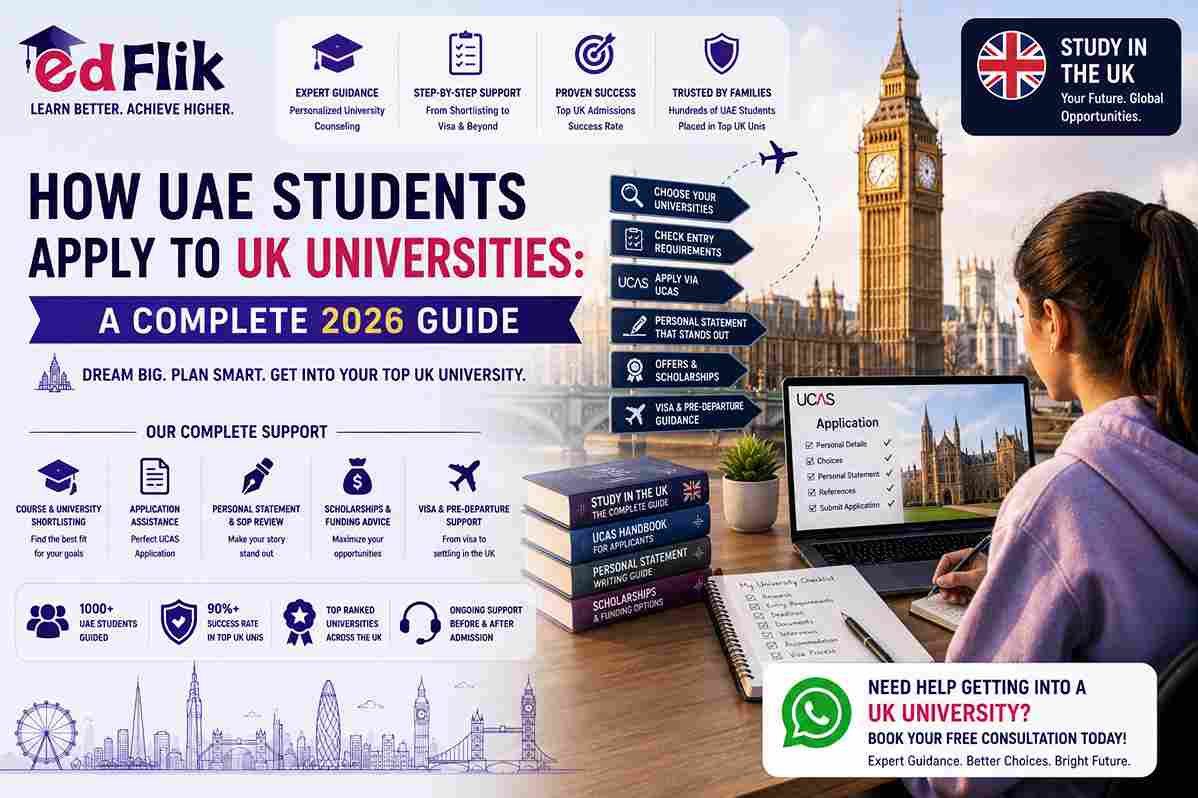
UCAS (Universities and Colleges Admissions Service) is the centralised application system for undergraduate programmes at UK universities. All applications — domestic and international — go through UCAS. UAE students apply through the same system, on the same deadlines, as UK domestic applicants.
Each UCAS application includes:
· Up to five course choices at different universities (five choices for most subjects; three for Medicine, Dentistry, and Veterinary Science, with no limit on other choices)
· Predicted grades from the student's school
· A reference letter written by the student's teacher or school
· A personal statement of up to 4,000 characters
There is no interview at most UK universities for most courses — the offer is made on the basis of the application and predicted grades alone. Medicine, Oxbridge, and some competitive humanities and law courses include interviews or additional assessments (UCAT, LNAT, TSA, MAT) that UAE students must prepare for separately.
Which UK Universities and Courses Accept UAE Students?
Virtually all UK universities accept international applications via UCAS. For UAE students, the universities most commonly targeted — based on typical qualification profiles — include:
· Russell Group universities — UCL, King's College London, Imperial College, Edinburgh, Warwick, Bristol, Durham — for students with strong IB Diploma or A-Level profiles (typically 36–42 IB points or AAA–AAA* at A-Level for competitive courses)
· Queen Mary, City University, Brunel, and similar universities — for students with solid but not top-tier predicted grades, or for specific courses such as Dentistry, Physiotherapy, or Pharmacy
· Oxbridge — Oxford and Cambridge — for exceptional candidates; the October 15 deadline applies; some courses require admissions tests taken in October/November
The Role of Predicted Grades in UAE University Applications
Because UCAS applications are submitted in December to January of the final year of study — typically several months before the IB May examinations or the A-Level June examinations — UK universities make offers based on predicted grades provided by the student's school, not actual results. This places enormous weight on the predicted grade the school's teachers are willing to write.
For UAE students following IB or A-Level programmes, the predicted grade reflects the teacher's honest assessment of the grade the student is likely to achieve. Schools typically predict based on internal mock examination performance, classwork quality, and past paper practice results. A student whose mock results are borderline for their target university's offer conditions is significantly disadvantaged compared to one whose mock performance clearly evidences the predicted grade.
This is one of the most practical reasons why tutoring in the Year 12 mock examination period — typically October to December — directly improves a student's university application outcome, not just their examination result. A student who improves from a grade 5 to a grade 6 in a November mock enables their teacher to predict a grade 6 — which may be the grade that unlocks an offer from their target university.
The UCAS Personal Statement: What UAE Students Need to Know
The personal statement is 4,000 characters — approximately 650 words — and must make a compelling, specific case for why this student wants to study this particular subject at university level. It is submitted once and shared with all five of the student's chosen universities.
Common weaknesses in personal statements from UAE applicants include:
· Generic openers ('I have always been interested in Medicine since I was young') that do not differentiate the candidate
· Lists of activities without connecting them to the degree: describing a robotics club without explaining what it taught about engineering thinking
· International experience that is described but not leveraged: growing up in Dubai as a multilingual student with exposure to diverse cultures is distinctive — but only if connected to genuine academic interest or professional aspiration
· No evidence of reading or engagement beyond the school curriculum — UK universities want to see that the student thinks about the subject outside of class
How Strong IGCSE and A-Level/IB Grades Support UK Applications
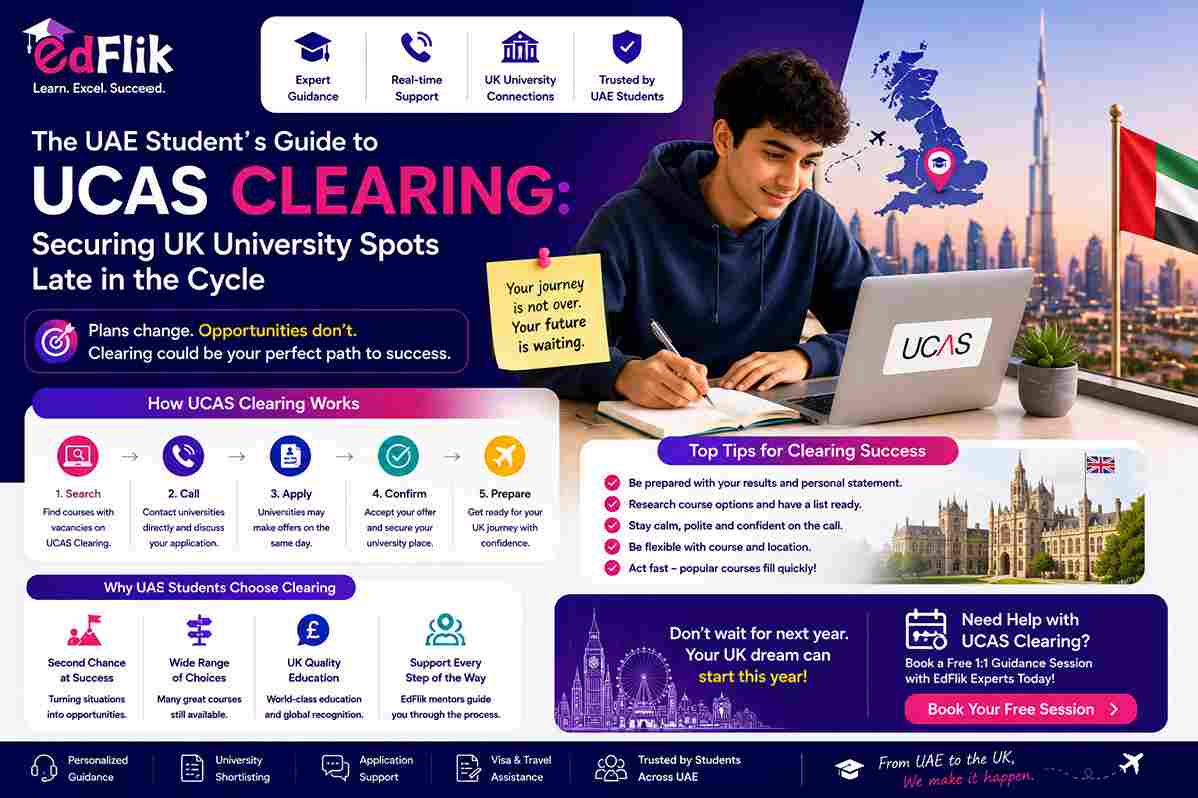
UK university offers are conditional on final examination grades — not predicted ones. A student who receives an offer conditional on AAB at A-Level must achieve those grades in their June examinations to take up their place. Students who accept offers and then miss the conditions by one or two grades can apply through UCAS Clearing to find an available place — but Clearing places for competitive courses are limited.
EdFlik provides one-to-one tutoring for UAE students at all stages of their IGCSE, A-Level, and IB programmes — building the subject-level performance that enables strong predictions, strong actuals, and strong UCAS applications. Sessions from AED 45. Free trial at edflik.com.
Frequently Asked Questions
What is the UCAS application deadline for UAE students applying to UK universities?
The main UCAS application deadline for UAE students applying to UK universities in 2026 is 29 January 2026 for most courses. However, for Oxford, Cambridge, and most Medicine, Dentistry, and Veterinary Science courses, the earlier UCAS deadline of 15 October 2025 applies. Applications submitted after the January deadline can still be submitted through UCAS until 30 June, but late applications are considered only if universities have remaining places — for competitive courses, this means a significantly reduced chance of acceptance. UAE students applying from IB or A-Level programmes should confirm the specific deadline for each of their five chosen courses.
What qualifications do UAE students need to apply to UK universities?
UK universities accept a range of international qualifications from UAE students. The IB Diploma Programme is directly accepted by all UK universities as equivalent to A-Levels — IB point requirements are published alongside A-Level grade requirements. Cambridge International A-Levels (the most commonly followed qualification at UAE British-curriculum schools) are fully accepted. Edexcel International A-Levels are also accepted by most UK universities. US curriculum students presenting AP examination scores alongside SAT or ACT results can apply but should verify that specific universities accept this combination for their chosen course, as some competitive programmes specify IB or A-Level equivalence.
How important are predicted grades in a UCAS application from the UAE?
Predicted grades are highly important. UK universities make offers based on predicted grades because the actual examination results are not yet available at the time of application. Most applications from UAE sixth-form students are submitted in January of the final year of study, with results released in August. An offer from a competitive university (e.g. Imperial offering AAA for Engineering) is conditional on achieving those grades. A student whose predicted grades are lower than the university's typical offer range will often not receive an offer, regardless of other application strengths. Students whose predicted grades are borderline for their target university should invest in tutoring support to give teachers sufficient evidence to predict at the higher grade level.
What should a UAE student include in their UCAS personal statement?
The UCAS personal statement (limited to 4,000 characters or 47 lines) should demonstrate: genuine academic interest in the chosen course supported by specific examples of reading, projects, or experiences beyond the school curriculum; relevant extracurricular activities or work experience that relate to the degree field; skills developed that are applicable to university study; and a clear sense of why this degree at this level is the right next step. UAE students have distinctive experiences — international exposure, multilingualism, and in some cases entrepreneurial or business context through family connections — that can be used effectively if linked directly to course relevance. Generic personal statements that list activities without connecting them to academic purpose are the most common weakness.
Book a Free Trial Class to Support Your UK University Application
EdFlik provides IGCSE, A-Level, and IB tutoring for UAE students targeting UK universities. Sessions from AED 45. Free trial at edflik.com.