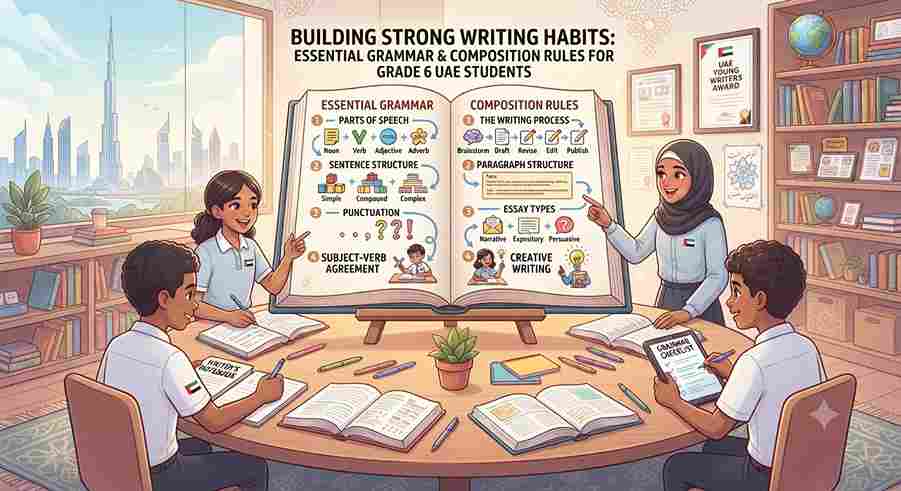
Building Strong Writing Habits: Essential Grammar and Composition Rules for Grade 6 UAE Students
Last Updated: September 2026 | By EdFlik Education Team
For students stepping into Grade 6 (Primary 7 / Year 7) across international schools in the UAE and around the world, the academic expectations for writing change significantly. Gone are the days of simple, single-paragraph descriptive stories. Grade 6 marks the critical transition where students are expected to craft structured multi-paragraph essays, persuasive arguments, and analytical book reviews.
However, many students hit a roadblock during this transition. They have wonderful creative ideas in their heads, but struggle to translate them onto paper with proper grammar, punctuation, and structural flow.
If you want to help your child build bulletproof writing habits and master middle school composition, here is a complete, expert-backed guide.
The Grade 6 Writing Shift: Why Grammar and Structure Matter Now
In lower elementary grades, teachers celebrate basic storytelling and imagination. In Grade 6, however, writing is evaluated on clarity, coherence, and technical precision.
Without a solid grasp of foundational grammar (like pronoun-antecedent agreement, complex sentence structures, and correct punctuation), even the most creative story can become confusing to read. Establishing strong writing habits in Grade 6 prevents bad habits from cementing and sets students up for success in advanced English courses, IGCSE, and IB curricula later on.
1. Mastering Sentence Structure: Moving Beyond Simple Sentences
Many young writers rely exclusively on simple sentences ("The dog ran. He caught the ball. It was fun."). By Grade 6, students must learn to vary their sentence lengths and structures.
- Compound Sentences: Teach your child to use coordinating conjunctions (FANBOYS: For, And, Nor, But, Or, Yet, So) joined by a comma to connect two independent clauses.
- Complex Sentences: Introduce subordinating conjunctions (AAAWWUBBIS: Although, After, As, When, While, Until, Before, Because, If, Since) to show cause, effect, or time relationships ("Because the rain poured heavily, the football match was postponed").
- Actionable Tip: Have your child review a paragraph they wrote and color-code their sentences. If every sentence is the same length, challenge them to combine or expand them for better rhythm.
2. Conquering Punctuation Pitfalls
Punctuation marks are the road signs of writing; they tell the reader when to pause, stop, or emphasize a point. Grade 6 students frequently struggle with three major areas:
- Apostrophes for Possession vs. Contraction: Students often confuse possessive nouns (the dog's toy) with contractions (it's for it is). Remind them that apostrophes for possession show ownership, not pluralization (one cat's toy vs. two cats' toys).
- Comma Splices: Two complete sentences cannot be glued together with just a comma ("I went to the store, I bought apples"). Teach students to fix comma splices using a period, a semicolon, or a comma plus a conjunction.
- Dialogue Punctuation: Writing narrative essays requires correctly punctuating spoken words. Remind students that quotation marks enclose what is spoken, and punctuation marks (commas, periods, question marks) always go inside the quotation marks.
3. The Anatomy of a Paragraph: MEAL Plan
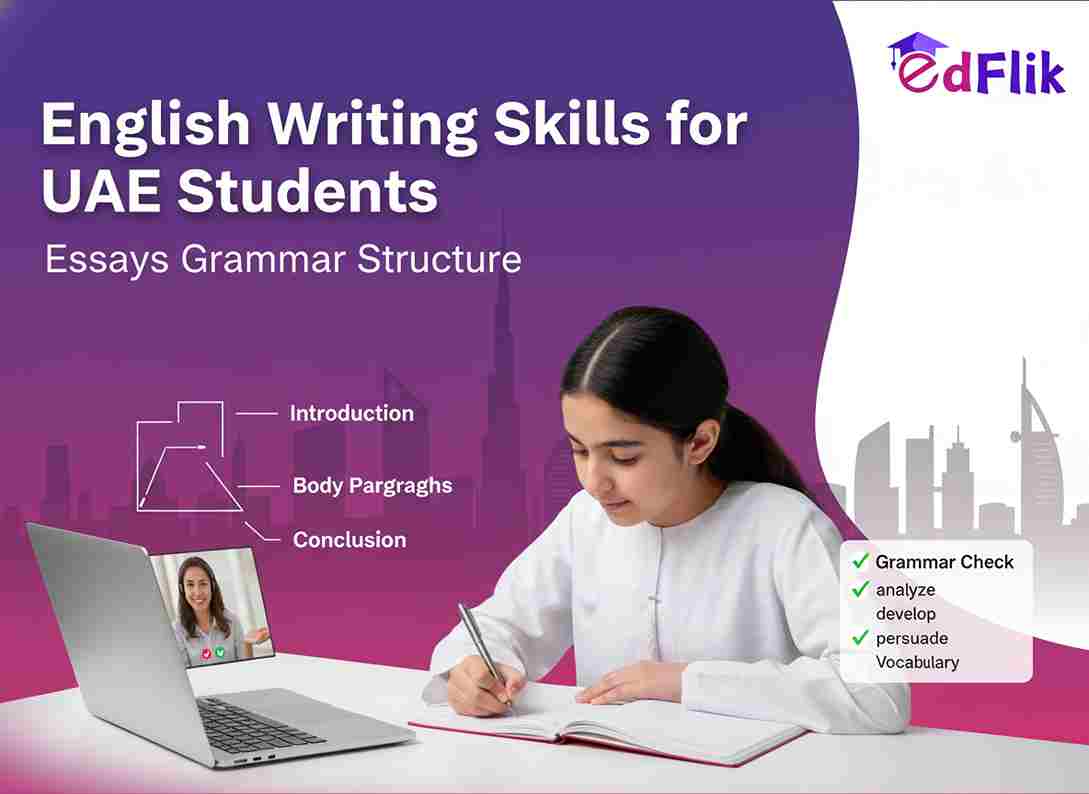
When transitioning to essay writing, students often write disorganized paragraphs where thoughts jump randomly from one idea to another. Introduce them to the MEAL paragraph structure:
- M - Main Idea (Topic Sentence): State the central argument or point of the paragraph clearly.
- E - Evidence: Provide a quote, statistic, or specific example from a text or real-world observation.
- A - Analysis: Explain why the evidence matters and how it supports your main idea. This is where higher-order thinking happens!
- L - Link: Conclude the paragraph by summarizing the main point or smoothly transitioning to the next paragraph.
4. Building a Robust Vocabulary
Writing becomes vibrant when students stop relying on "dead words" like good, bad, nice, sad, or very.
- Actionable Tip: Instead of telling a student their writing is "boring," encourage them to use precise verbs and descriptive modifiers. For example, instead of "The runner ran very fast," encourage "The sprinter sprinted swiftly across the track." Keep a "Vocabulary Vault" notebook where students record exciting new words discovered during reading.
5. The Power of the Editing Process
The biggest enemy of good writing is the belief that the first draft must be the final draft. Professional authors rewrite their work multiple times—and students must learn to do the same.
- CUPS Strategy: Train your child to edit their work in passes using the CUPS checklist:
- C - Capitalization (Are proper nouns, titles, and sentence starts capitalized?)
- U - Understanding (Does the sentence make sense? Is it a fragment?)
- P - Punctuation (Are periods, commas, and apostrophes in the right places?)
- S - Spelling (Are tricky words spelled correctly?)
Struggling to help your Grade 6 student build confidence in writing and grammar? EdFlik offers expert, 1-to-1 online tutoring customized for middle school English composition and grammar fundamentals.Book a Free Demo Class Today!
Frequently Asked Questions (FAQs)
Q1: Why is Grade 6 such a crucial year for writing development?
Ans: Grade 6 bridges elementary school creative writing and middle school academic writing. Students shift from writing short personal narratives to constructing multi-paragraph essays, citing evidence, and mastering formal grammar rules.
Q2: How can I encourage my child to read more to improve their writing?
Ans: Model reading at home and let your child choose books that genuinely interest them—whether graphic novels, adventure series, or non-fiction science magazines. Reading exposes children instinctively to correct sentence structures and diverse vocabulary.
Q3: What is a run-on sentence and how do I fix it?
Ans: A run-on sentence occurs when two or more independent clauses are joined without proper punctuation or conjunctions. It can be fixed by splitting them into separate sentences, adding a semicolon, or using a comma and a coordinating conjunction (FANBOYS).
Q4: How can EdFlik help my child improve their English writing skills?
Ans: EdFlik provides experienced, certified 1-to-1 online tutors who specialize in English grammar, creative writing, and essay composition. Our tutors provide personalized feedback, teach structured writing frameworks, and build your child's confidence word by word.