IGCSE Narrative Writing UAE 2026 — How to Write an A* Story for Cambridge 0500
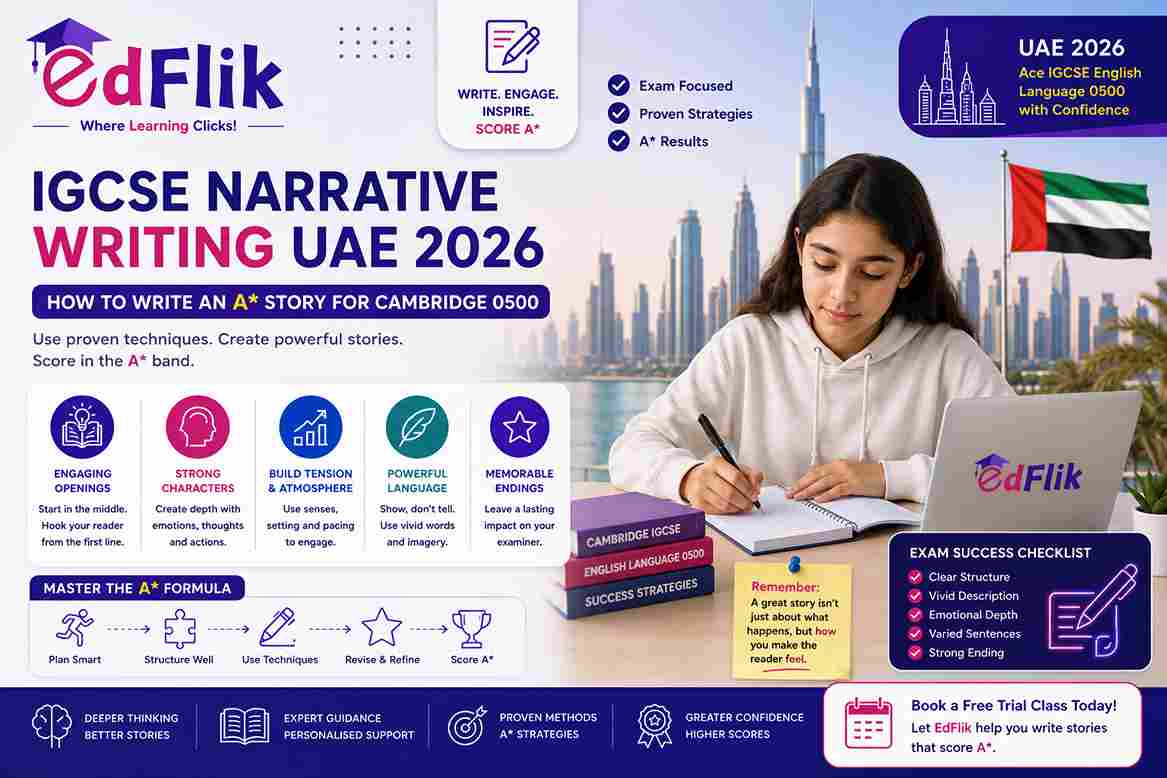
Narrative writing is the composition choice of most UAE IGCSE English Language students in Cambridge 0500 Paper 2 — and the one where the gap between a B and an A* is most clearly about technique, not talent. Students who score A* in IGCSE narrative writing are not necessarily more creative or better storytellers than students who score B. They are students who have learned to make deliberate decisions about structure, sentence variety, sensory detail, and endings — and who execute those decisions consistently under examination conditions. This guide teaches exactly those decisions.
What Cambridge Examiners Actually Reward — The Marking Criteria
|
Marking Area |
What the
Examiner Looks For |
What Earns B |
What Earns A* |
|
Content and structure |
Does the narrative have a clear situation, development, and
outcome? Is there genuine character development and setting depth? |
A coherent story with a beginning, middle, and end; characters
described; some sense of setting |
A narrative with a distinct opening situation; character internal
experience developed alongside external events; an ending that creates
resonance rather than simply stopping |
|
Style and accuracy |
Are vocabulary and sentence structures used deliberately and
effectively? Is the writing accurate? |
Mostly accurate grammar and spelling; some varied vocabulary;
some sentence variety |
Deliberate sentence variety for specific effect; precise
vocabulary choices where the word earns its place; a controlled authorial
voice visible throughout |
|
Overall impression |
Holistic quality — does this writing leave an impression? |
A competent, clear narrative that tells a story effectively |
A piece of writing that creates a distinctive experience — one
the examiner remembers as an individual piece, not just a correct answer |
The 5-Step Narrative Framework for UAE IGCSE Students
Step 1 — Plan Before You Write (5 Minutes Maximum)
Planning saves time and produces better writing. In 5 minutes, decide: the central character and their situation (one sentence); the opening moment (what scene, what detail, what atmosphere?); the turning point (what changes or is revealed?); the ending type (choose from the 5 types below). Do not plan the whole plot — IGCSE narrative composition is 400 to 600 words. You need one situation explored in depth, not a sequence of events.
Step 2 — The Opening (60 to 80 Words): Start in the Action
The opening is the examiner's first impression — and the strongest signal of whether this will be a B or an A* piece. Avoid: 'It was a dark and stormy night'; 'One day'; 'I woke up to find'; 'It all started when.' These are the openings Cambridge examiner reports specifically identify as marking a lack of craft.
Instead: start in the middle of a moment. The character is doing something. The setting is specific. The atmosphere is established through detail, not statement.
Example — prompt: 'Write a story about a journey that did not go as planned.' Weak opening: 'I was going on a journey to visit my grandmother when something unexpected happened.' Strong opening: 'The last bus had already left. I watched its red tail-lights dissolve into the rain, taking with them the one plan I had managed to hold together all day.'
Step 3 — Development (200 to 250 Words): Go Deep, Not Wide
The most common IGCSE narrative error: covering too many events. A narrative composition is not a synopsis — it is a piece of writing that earns marks for the quality of attention it pays to experience. For 200 to 250 words of development, choose one or two significant moments and explore them with:
• Sensory detail: what can the character see, hear, smell, touch? Specific sensory details create the reader's experience rather than reporting it.
• Internal perspective: what is the character thinking and feeling? Not 'she was scared' but 'the familiar thought kept circling back: she should have left earlier.'
• Pacing through sentence length: long complex sentences for background and setting; short punchy sentences for action, tension, and emphasis.
Step 4 — The Turning Point or Climax (60 to 80 Words): Slow Down Time
The most intense moment of a narrative should use the shortest sentences. Fragmented sentence structure mimics the experience of a tense or surprising moment. 'She saw it. Just for a second. Then nothing.' The turning point should not be resolved immediately — the reader should feel the weight of the moment before the resolution arrives.
Step 5 — The Ending (60 to 80 Words): Choose Your Ending Type
|
Ending Type |
Description |
Example
Effect |
|
Circular ending |
Returns to an image, phrase, or moment from the opening |
Creates a sense of completeness; shows the character has changed
by how the same image is now seen differently |
|
Image ending |
Closes on a single powerful visual rather than explanation |
Creates a lasting impression; lets the image carry the meaning
without stating it |
|
Ambiguous ending |
Leaves something unresolved; the reader decides what happens |
Creates engagement beyond the final word; signals a writer
thinking about the reader's experience |
|
Reflective ending |
The character processes what has happened and reaches an
understanding |
Adds meaning and depth; shows internal character development |
|
Twist ending |
Reveals something unexpected — but only if hints were planted
earlier |
Creates surprise; earns full marks only if the twist feels
earned, not arbitrary |
The Showing vs Telling Rule — The Single Biggest Technique Improvement
'Showing' means creating the experience of the emotion, atmosphere, or quality through specific concrete detail. 'Telling' means stating it directly. Cambridge rewards showing; telling costs marks.
|
Telling
(Earns B) |
Showing
(Earns A*) |
|
She was frightened. |
Her breath came in short, shallow pulls. She counted them, as if
counting might help. |
|
The room was beautiful. |
Late afternoon light pressed through the shutters in long, gold
bars and lay still on the floor. |
|
It was very hot. |
The heat sat on her shoulders like something with weight. The
tarmac ahead of her wobbled and dissolved. |
|
He was angry. |
He set his glass down with the particular precision of someone
who has decided not to throw it. |
|
The street was quiet. |
No wind. No voices. Even the usual distant traffic had stopped,
as if the city itself was holding its breath. |
Frequently Asked Questions — IGCSE Narrative Writing UAE
Q: How is IGCSE narrative writing marked by Cambridge?
A: Three criteria: (1) Content and structure — clear situation, development, outcome; character and setting depth. (2) Style and accuracy — deliberate vocabulary and sentence choices; grammar and spelling accuracy; controlled authorial voice. (3) Overall impression — holistic quality. A and A* marks require evidence of deliberate technique — conscious structural and stylistic decisions — not just competent storytelling.
Q: What are the most common IGCSE narrative writing mistakes by UAE students?
A: Clichéd openings ('It was a dark and stormy night'; 'One day'); too much plot with too little depth (and-then-and-then structure); telling instead of showing ('she was scared' vs concrete specific detail); abrupt or predictable ending; no sentence variety (all long or all short sentences).
Q: How should UAE students structure IGCSE narrative composition?
A: Opening (60 to 80 words): start in the action, not with backstory. Development (200 to 250 words): one or two moments explored in sensory and emotional depth. Turning point (60 to 80 words): shortest sentences, highest intensity. Ending (60 to 80 words): choose from circular, image, ambiguous, reflective, or twist — create resonance rather than simply stopping.
Q: What sentence techniques earn the highest marks in IGCSE narrative?
A: Short sentences after long ones for emphasis. Repetition for rhythm and effect. Sentence fragments for immediacy ('Running. Always running.'). Varied sentence openings (adverbials, participials, conjunctions). Embedded clauses for specific characterisation detail. Each technique must be deliberate — used at a specific point for a specific effect, not scattered randomly throughout the piece.
How EdFlik Supports IGCSE English Language Students in UAE
EdFlik 0500 English Language tutors provide specific written feedback on composition technique — identifying where 'telling' appears instead of 'showing' and building the deliberate structural habits that move marks from B to A. Sessions from AED 60. Free demo. Book at www.edflik.com.