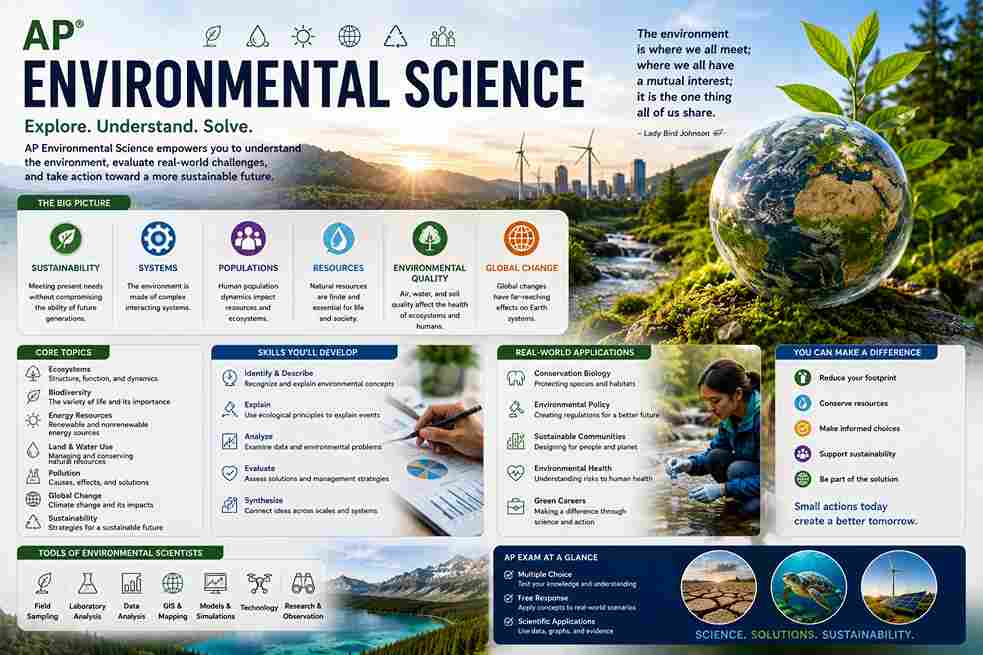
Cambridge IGCSE Environmental Management (0680): Water Supply & Pollution Notes for Sharjah
By EdFlik Team | November 20, 2026
For Key Stage 4 students across Sharjah—from Al Majaz, Al Khan, and Al Nahda to Muwaileh, University City, and Al Taawun—enrolled in Cambridge IGCSE Environmental Management (0680), Topic 4: Water and Its Management is one of the highest-yielding units across both Paper 1 (Theory) and Paper 2 (Management in Context). Because Environmental Management bridges physical geography, biology, chemistry, and sustainable resource policy, examiners consistently test whether students can explain how fresh water is stored and extracted, why water scarcity arises in arid regions, and how water pollution triggers ecological cascades such as eutrophication and waterborne disease.
For students living in Sharjah and the Northern Emirates, Topic 4 is far more than abstract textbook theory. Living in an arid Arabian Gulf environment—where renewable surface water is scarce, underground aquifers face heavy extraction pressure, and seawater desalination (alongside wastewater treatment and conservation) underpins urban water security—gives Sharjah learners real-world insight into every syllabus objective. However, Cambridge 0680 mark schemes demand exact scientific terminology and complete causal chains. Writing vague statements like "dirty water kills fish" or "desalination is expensive" without explaining biological oxygen depletion or brine discharge and high energy demand costs easy marks.
Securing a Grade 8 or 9 ($A^*$) in Cambridge IGCSE Environmental Management (0680)—a strong foundation for A-Level Environmental Science, Geography, or Biology and IB Diploma Environmental Systems and Societies (ESS)—requires mastering the hydrological cycle, comparing water supply methods, memorizing the exact step-by-step sequence of eutrophication, and structuring balanced evaluation answers.
This masterclass revision guide provides complete Cambridge IGCSE Environmental Management (0680) Water Supply & Pollution notes, connects syllabus concepts to Sharjah's water landscape, walks through exam-style Paper 1 and Paper 2 worked questions, highlights common mark-scheme traps, and includes 100% copy-paste JSON-LD schema markup.
Key Takeaways
- Only a Tiny Fraction of Earth's Water Is Accessible Fresh Water: Roughly $97\%$ of global water is saline ocean water, and of the remaining $3\%$ fresh water, most is locked in ice caps and glaciers—leaving less than $1\%$ readily accessible in groundwater aquifers, rivers, and lakes.
- Know the Exact Hydrological Cycle Stores and Processes: Master the processes moving water between stores—evaporation, transpiration, condensation, precipitation, interception, surface run-off, infiltration, and groundwater flow (percolation)—and explain how urbanization and deforestation disrupt infiltration.
- Evaluate Desalination and Dams with Balanced Pros and Cons: In arid regions like Sharjah and the UAE, desalination (distillation and reverse osmosis) provides a reliable, climate-independent potable water supply, but carries high energy costs, greenhouse gas emissions (when powered by fossil fuels), and hypersaline brine disposal risks to marine ecosystems.
- Memorize the Complete Eutrophication Chain: On 4- to 6-mark water pollution questions, never skip the decomposer respiration step: nitrate/phosphate runoff $\to$ rapid algal bloom $\to$ sunlight blocked $\to$ submerged plants and algae die $\to$ aerobic bacteria decompose dead matter $\to$ dissolved oxygen depleted $\to$ aquatic organisms suffocate and die.
Part 1: Global Water Distribution & The Hydrological Cycle (Syllabus 4.1–4.2)
Cambridge IGCSE Environmental Management (0680) opens Topic 4 by testing where Earth's water is stored and how it cycles continuously between oceans, atmosphere, and land.
As illustrated in the hydrological cycle diagram above, solar energy drives evaporation from oceans and surface water, water vapor cools and undergoes condensation into clouds, and precipitation returns water to land—where it travels via run-off or infiltrates into underground stores before returning to collection basins [image_agent_tag_5138780718469589673]
Essential Hydrological Terms for Cambridge 0680:
- Transpiration: Loss of water vapor from plant leaves through stomata (often combined with evaporation as evapotranspiration).
- Interception: Precipitation caught temporarily by vegetation leaves and branches before reaching the ground.
- Infiltration & Percolation: Water soaking into upper soil layers (infiltration) and moving deeper downward through permeable rock (percolation) to recharge aquifers (underground water-bearing rock layers).
- Surface Run-off (Overland Flow): Water flowing over the land surface into streams and rivers when rainfall exceeds infiltration capacity or when surfaces are impermeable (such as concrete roads and rooftops in growing urban districts).
Part 2: Water Supply Sources, Scarcity, and Management in Sharjah (Syllabus 4.3–4.4)
Why Water Scarcity Occurs: Physical vs. Economic Scarcity
Cambridge 0680 distinguishes two main drivers of water shortage:
- Physical Water Scarcity: Low rainfall, high evaporation rates, and limited natural surface rivers or renewable aquifers—typical of arid desert climates across Sharjah and the UAE.
- Economic Water Scarcity: Adequate water exists naturally, but a country or region lacks the financial capital, infrastructure, pipes, or treatment facilities to extract, purify, and distribute safe water.
Comparing Water Supply Strategies in Sharjah & Globally
| Water Supply Strategy | How It Works | Advantages (Exam Strengths) | Disadvantages / Risks (Exam Limitations) |
Desalination (Distillation & Reverse Osmosis) | Removes dissolved salts from seawater via thermal heating/condensation or high-pressure semi-permeable membranes. | • Reliable year-round supply unaffected by drought. • Vital for coastal cities like Sharjah with access to seawater. | • Very high energy consumption and financial cost. • Produces concentrated brine that can raise local seawater salinity and temperature, harming marine life. |
Groundwater Extraction (Wells & Boreholes) | Pumps water from underground aquifers (water-bearing permeable rock bounded by impermeable layers). | • Naturally filtered through rock layers. • Accessible directly where surface rivers are absent. | • Over-extraction lowers the water table faster than natural recharge. • Can cause saltwater intrusion in coastal aquifers and land subsidence. |
| Multipurpose Dams & Reservoirs | Concrete barriers built across river valleys to trap and store water behind a reservoir. | • Stores large water volumes for irrigation and domestic use. • Controls downstream flooding and can generate hydroelectric power (HEP). | • Floods farmland, habitats, and settlements; displaces communities. • Traps nutrient-rich silt behind the dam, reducing downstream soil fertility and increasing erosion. |
| Treated Wastewater Recycling & Drip Irrigation | Treats domestic/municipal sewage for landscaping/industrial reuse; delivers water drop-by-drop to plant roots. | • Significantly cuts freshwater demand and evaporation loss. • Supports sustainable urban greening and agriculture. | • Requires public acceptance and strict monitoring to prevent pathogen or chemical contamination. |
Part 3: Water Pollution — Causes, Eutrophication, and Impact (Syllabus 4.5–4.7)
Water pollution in Cambridge 0680 is grouped into three primary sources: domestic waste, industrial processes, and agricultural practices.
As shown in the eutrophication diagram above, excess nutrients (nitrogen and phosphorus) entering freshwater or coastal ecosystems stimulate explosive surface phytoplankton growth (algae bloom), blocking sunlight from reaching rooted aquatic plants and triggering bacterial decay that strips dissolved oxygen from the water [image_agent_tag_5138780718469588322]
Summary of Major Water Pollutants & Control Strategies
| Pollutant Category | Typical Sources | Environmental & Human Health Impacts | Management & Prevention Strategies |
| Organic Waste & Sewage | Untreated domestic sewage, livestock slurry. | • Carries waterborne pathogens (cholera, typhoid). • High Biological Oxygen Demand (BOD) as bacteria decompose organic matter, suffocating aquatic life. | • Primary, secondary, and tertiary sewage treatment plants. • Chlorination / UV disinfection of drinking water and improved sanitation infrastructure. |
| Excess Fertilizers (Nitrates & Phosphates) | Agricultural run-off, golf courses, landscaped parks. | • Causes cultural eutrophication (algal blooms, light blockage, bacterial decay, severe hypoxia/fish kills). | • Apply fertilizers only during dry weather and in precise amounts. • Use organic manure, buffer strips along waterways, and drip irrigation. |
| Toxic Industrial Chemicals & Heavy Metals | Factories, mining, metal plating, chemical plants (e.g., mercury, lead, PCBs). | • Bioaccumulation in individual organisms and biomagnification up food chains, causing neurological damage, birth defects, or death in top predators and humans. | • Strict environmental legislation, effluent treatment before discharge, fines, and closed-loop industrial recycling. |
| Oil Spills & Marine Debris | Tanker accidents, offshore drilling, shipping lanes, urban litter. | • Coats seabird feathers (loss of insulation/buoyancy) and clogs fish gills; blocks sunlight for marine photosynthesis; plastics persist and enter food webs. | • Double-hulled oil tankers, booms and chemical dispersants, port waste reception facilities, and single-use plastic bans. |
| Acid Rain | Sulfur dioxide ($\text{SO}_2$) and nitrogen oxides ($\text{NO}_x$) from fossil fuel combustion dissolving in rainwater. | • Lowers lake/river pH, killing acid-sensitive fish eggs and invertebrates and leaching toxic aluminum ions from soils into water. | • Flue-gas desulfurization (scrubbers) in power stations, catalytic converters in vehicles, and switching to renewable energy. |
Part 4: Full Exam-Style Worked Questions (Paper 1 & Paper 2 Style)
Worked Question 1: Explaining Eutrophication (4 Marks — Paper 1)
Question: A farming valley lies next to a freshwater lake. After heavy rainfall, farmers notice a thick green layer of algae covering the lake surface, followed two weeks later by large numbers of dead fish floating on the water. Explain how agricultural practices caused the death of the fish. [4 marks]
Step-by-Step Mark-Scheme Answer:
- Nutrient Leaching / Run-off (1 mark): Heavy rain washed excess nitrate and phosphate fertilizers from the farmland into the lake.
- Algal Bloom & Light Blockage (1 mark): The high nutrient concentration caused rapid algal growth (algal bloom), which blocked sunlight from reaching submerged aquatic plants so they could no longer photosynthesize and died.
- Bacterial Decomposition (1 mark): When the submerged plants and short-lived algae died, aerobic bacteria (decomposers) multiplied rapidly to break down the dead organic matter.
- Dissolved Oxygen Depletion (1 mark): The aerobic bacteria used up dissolved oxygen in the water through cellular respiration, leaving insufficient oxygen for fish to respire so they suffocated and died.
Worked Question 2: Evaluating Desalination for Coastal Cities (6 Marks — Paper 2)
Question: Rapid population growth in coastal cities such as Sharjah increases demand for potable water. Evaluate the use of seawater desalination as a long-term solution to water scarcity. [6 marks]
Step-by-Step Balanced Answer:
- Arguments in Favor (Strengths — 3 marks):
- Seawater provides an almost unlimited raw water source along the Arabian Gulf coast, ensuring a reliable water supply even during prolonged periods with zero rainfall.
- Modern reverse osmosis plants produce high-purity potable water that eliminates waterborne diseases such as cholera and typhoid.
- Pairing desalination with solar power reduces reliance on fossil fuels and supports long-term urban growth without depleting fragile inland aquifers.
- Arguments Against (Limitations — 3 marks):
- Desalination requires huge amounts of energy, making operational costs high and increasing carbon dioxide ($\text{CO}_2$) emissions if powered by fossil fuels.
- The process generates hot, highly concentrated brine (and chemical residues); discharging brine back into coastal waters raises local salinity and temperature, harming coral, seagrass, and marine fish nurseries.
- Desalination is technically complex and expensive to maintain, meaning supply-side expansion should be paired with demand management (water-saving fixtures, leak repair, and treated wastewater recycling for irrigation).
Part 5: Top 4 Exam Traps That Cost Cambridge 0680 Students Marks
- Saying "Algae Eat All the Oxygen" in Eutrophication Questions: Live algae produce oxygen during daylight photosynthesis; it is decomposing bacteria breaking down dead algae and plants that consume dissolved oxygen via respiration. Always include the bacterial decomposition step!
- Confusing Bioaccumulation with Biomagnification: Bioaccumulation is the build-up of a persistent toxin (like mercury or DDT) inside one organism over its lifetime; biomagnification is the increasing concentration of that toxin at higher trophic levels along a food chain.
- Giving One-Sided Evaluation Answers on Dams or Desalination: Whenever a 5- or 6-mark question uses the command word "Evaluate" or "Discuss", you must include both benefits and drawbacks (plus a brief concluding judgment) to unlock top-band marks.
- Forgetting Sewage Treatment vs. Water Purification Differences: Sewage treatment cleans used wastewater before returning it safely to rivers/seas or irrigation; water treatment (screening, sedimentation, filtration, chlorination) purifies raw water to make it safe for human drinking (potable).
For expert 1-on-1 online tutoring support to master Cambridge IGCSE Environmental Management (0680) Paper 1 theory, Paper 2 data-handling and evaluation questions, and Grade 8/9 ($A^*$) exam strategies in Sharjah, book a class on EdFlik.
Frequently Asked Questions (FAQs)
Q1: What is the difference between physical water scarcity and economic water scarcity in Cambridge 0680?
Ans: Physical water scarcity happens when natural water demand exceeds the region's renewable water supply due to arid climate, low precipitation, or high evaporation (such as in desert regions). Economic water scarcity occurs when water is physically present in rivers or aquifers, but a lack of investment, infrastructure, or governance prevents people from accessing clean, safe water.
Q2: Why is desalination both essential and challenging for coastal cities like Sharjah?
Ans: Desalination provides a dependable, drought-proof source of clean drinking water from seawater without over-pumping limited groundwater aquifers, but it demands high energy input, incurs significant financial costs, and produces hypersaline brine waste that must be carefully managed to protect coastal marine ecosystems.
Q3: How can students score full marks on 6-mark Paper 2 evaluation questions in IGCSE Environmental Management?
Ans: Use data or context directly from the Paper 2 insert, organize your answer into balanced points for and against (covering environmental, economic, and social angles), use precise syllabus terms (eutrophication, aquifer recharge, brine, BOD, biomagnification), and finish with a brief reasoned conclusion.