IB Environmental Systems and Societies (ESS) Tutor UAE 2026 — IA, Papers and Case Study Guide
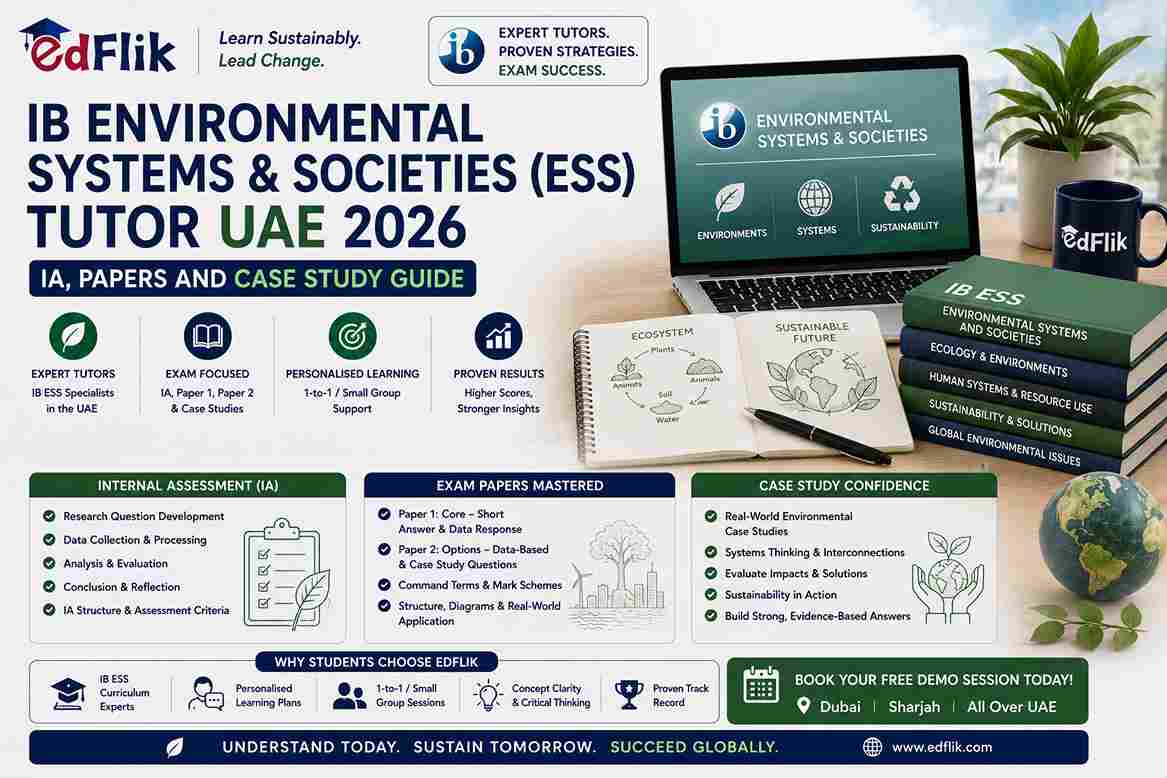
IB Environmental Systems and Societies (ESS) is one of the most strategically advantageous IB subject choices available to UAE students — it simultaneously satisfies both the Group 3 (Individuals and Societies) and Group 4 (Sciences) IB requirements, freeing up an entire subject slot in the student's timetable. It is also a genuinely intellectually engaging subject that links environmental science, ecology, economics, and ethics. This guide covers the full assessment structure, the IA fieldwork investigation, and the two-paper examination approach.
Why IB ESS Is Strategically Valuable for UAE Students
Most IB students must choose one Group 3 subject (Humanities) and one Group 4 subject (Sciences). ESS is the only IB subject that counts for BOTH simultaneously. This means a student who takes ESS can:
• Fulfil both science and humanities Group requirements with one subject
• Add a fifth subject in a different group — giving flexibility to add Art, Music, a second Language, or another subject that strengthens the university application
• Reduce overall HL pressure — since ESS only exists at SL, taking it frees a slot that might otherwise need to be an HL science
|
UAE students
who are strong in humanities and weaker in sciences should consider ESS
seriously. It allows them to satisfy the science requirement without the
depth demands of IB Chemistry, Physics, or Biology HL — while the breadth and
interdisciplinary nature of ESS is genuinely impressive on a university
application for humanities, social science, law, or policy programmes. |
IB ESS Topic Overview
|
Topic |
Core Content |
Assessment
Relevance |
|
Topic 1 —
Foundations |
Systems
thinking, EVS (environmental value systems), ecological footprint,
sustainability concepts |
Systems
diagrams always appear in Paper 2; EVS perspectives required for extended
essays |
|
Topic 2 —
Ecosystems |
Energy
transfer (photosynthesis, respiration, food chains), nutrient cycles (carbon,
nitrogen, phosphorus), biodiversity metrics, succession |
Most heavily
tested topic in Paper 2; productivity calculations, S-value diversity indices |
|
Topic 3 —
Biodiversity and Conservation |
IUCN Red List,
threats to biodiversity (habitat loss, invasive species, pollution),
conservation approaches (in-situ, ex-situ) |
Case study
questions in Paper 1 often focus on conservation dilemmas |
|
Topic 6 —
Atmospheric Systems |
Greenhouse
effect, climate change evidence, feedback loops (positive and negative),
ozone depletion, acid rain, photochemical smog |
Always appears
in Paper 2; requires ability to evaluate evidence and consider multiple
perspectives |
|
Topic 7 —
Climate Change and Energy |
Renewable and
non-renewable energy, energy futures, impacts of climate change, mitigation
and adaptation strategies |
Extended
response essays in Section B; EVS perspectives on energy policy |
The IB ESS Internal Assessment — Fieldwork Investigation
The ESS IA is a genuine environmental field or laboratory investigation worth 25% of the final grade. It must include primary data collection — not secondary data from existing databases. The assessment is structured across five criteria:
• Research Design: A focused, specific research question; justified methodology appropriate to the question; controlled variables; sample size and replication planning
• Data Collection and Processing: Raw data table with units and uncertainties; appropriate graphs with labelled axes and error bars where relevant; mean, standard deviation, and at least one statistical test (typically Chi-squared, Spearman's rank, or t-test)
• Conclusion and Evaluation: A specific answer to the research question supported by the statistical results; evaluation of methodology limitations with specific suggestions; evaluation of whether the data supports the original hypothesis
Common UAE ESS IA Topics
• Biodiversity surveys: Comparing species diversity between two habitat types (e.g. managed garden vs natural area in UAE) using diversity indices (Simpson's Index, Shannon Index)
• Soil quality: Comparing soil characteristics (pH, organic content, moisture) between disturbed and undisturbed sites in UAE desert or agricultural contexts
• Water quality: Testing water samples from different UAE sources for turbidity, pH, dissolved oxygen, or coliform bacteria
• Air quality: Measuring particulate matter or NO₂ levels at different distances from roads in Dubai or Abu Dhabi
Paper 1 — Unseen Case Study
Paper 1 (30% of final grade) is based on an unseen case study distributed on the day of the exam — typically a 3-5 page document describing a real environmental situation (a dam project, a biodiversity hotspot under threat, an urban development, a fisheries management scheme). Students must apply ESS concepts, systems thinking, and multiple EVS perspectives to analyse the case study. The most important preparation skill: practising rapid analysis of real-world environmental scenarios using the ESS framework.
|
EdFlik IB ESS
tutors cover all eight topic areas, IA fieldwork design and statistical
analysis, and Paper 1 case study analysis technique. From AED 65 per session.
Free diagnostic trial. Book at www.edflik.com or WhatsApp +91 88788 96600. |
Frequently Asked Questions
Q: What is IB Environmental Systems and Societies (ESS)?
An interdisciplinary IB SL-only subject counting simultaneously as both a Group 3 (Humanities) and Group 4 (Sciences) qualification. Students who take ESS satisfy both requirements with one subject, freeing a slot for another choice.
Q: What topics does IB ESS cover?
Eight topics: Foundations, Ecosystems and Ecology, Biodiversity and Conservation, Water Systems, Soil Systems, Atmospheric Systems, Climate Change and Energy, and Human Systems and Resource Use. Breadth across scientific and socioeconomic perspectives throughout.
Q: Is IB ESS easier than IB Biology or Chemistry?
Structured differently rather than simpler. Less mathematical depth than Chemistry or Physics; more qualitative and analytical. Requires breadth across eight topics and the ability to evaluate environmental issues from economic, social, ethical, and scientific perspectives simultaneously.
Q: What is the IB ESS Internal Assessment?
An Individual Investigation with fieldwork worth 25% of the final grade. Students design and conduct an environmental investigation with primary data collection, statistical analysis, and interpretation. Common UAE topics: biodiversity surveys, soil quality, water quality, air quality.
Q: What are the IB ESS exam papers?
Paper 1 (30%, 1 hour): unseen environmental case study distributed on exam day — apply ESS concepts to analyse it. Paper 2 (50%, 2 hours): short-answer and extended-response questions covering the full ESS syllabus.