CAT4 Levels A, B and C UAE 2026 — Primary School Preparation Guide for Ages 7 to 12

CAT4 Levels A, B, and C target younger primary school students — ages 7 to 12. While most UAE tutoring content focuses on CAT4 Level D and E (the levels used for Year 7 entry to selective British curriculum schools), the lower levels are used by many UAE schools for Year 2-5 admissions, internal streaming, and gifted and talented identification. This guide covers the specific features of each lower level, the age-appropriate question content, and how to prepare younger children effectively.
CAT4 Level Overview — Matching Level to Age and Year Group
|
CAT4 Level |
Age Range |
Year Group
Equivalent |
Typical UAE
School Use |
|
Level X |
Age 6 |
Year 1-2 |
Rarely used
for admissions; primarily school-internal assessment |
|
Level Y |
Age 7-8 |
Year 2-3 |
Early primary
school entry assessments at some selective UAE schools |
|
Level Pre-A /
A |
Ages 7.5-9.5 |
Year 3-4 |
Year 3-4
entry; internal ability assessments; gifted identification |
|
Level B |
Ages 8.5-10.5 |
Year 4-5 |
Year 4-5
entry; internal streaming; some school transition assessments |
|
Level C |
Ages 9.5-11.5 |
Year 5-6 |
Year 5-6
admissions; preparation year for Level D (Year 7 entry) |
|
Level D |
Ages 10.5-12.5 |
Year 6-7 |
Most UAE Year
7 school admissions — covered in Edflik existing guides |
|
Level E |
Ages 11.5-13.5 |
Year 7-8 |
Year 8 entry
at some UAE schools — covered in Edflik existing guides |
What Changes at Lower Levels — A vs D Comparison
|
Battery |
CAT4 Level A
(age 7.5-9.5) |
CAT4 Level D
(age 10.5-12.5) |
|
Verbal
Reasoning |
Simple
everyday vocabulary; shorter sentences; clear group categories in
classification |
Complex
vocabulary; abstract analogies; category groups that require broader
knowledge |
|
Quantitative
Reasoning |
Single-digit
number analogies; simple arithmetic sequences; smaller number ranges |
Multi-step
number patterns; ratio and proportion elements; larger number sequences |
|
Non-Verbal
Reasoning |
Simple shape
sequences with 1-2 variables changing; figure classification with obvious
categories |
Complex
matrices with multiple simultaneous rules; subtle spatial pattern changes |
|
Spatial
Reasoning |
Basic 2D shape
combinations; simple reflections; no 3D rotation at Level A |
Full 3D
rotation; cube nets; complex spatial pattern sequences |
Preparing a Primary-Age Child for CAT4 — Age-Specific Considerations
For Level A Children (Ages 7.5-9.5)
Preparation at Level A is fundamentally about familiarisation rather than intensive drilling. The key considerations for this age group:
• Computer-based test experience: Many Year 3 children in UAE have limited experience with computer-based testing. Ensuring the child can use a mouse or trackpad comfortably, read questions from a screen, and understand how to select and confirm an answer is more important than subject-specific preparation at this age.
• Short session lengths: Preparation sessions for 7-9 year olds should be maximum 15-20 minutes, multiple times per week — not 45-minute intensive sessions. Concentration at this age is genuinely limited.
• Verbal Reasoning through reading: Wide reading (stories, information books, comics) builds the vocabulary and language awareness that Verbal Reasoning tests at Level A. Explicit VR question practice should begin 4-6 weeks before the assessment.
For Level B Children (Ages 8.5-10.5)
Level B preparation can begin to include more structured question type practice — typically 20-30 minutes per session:
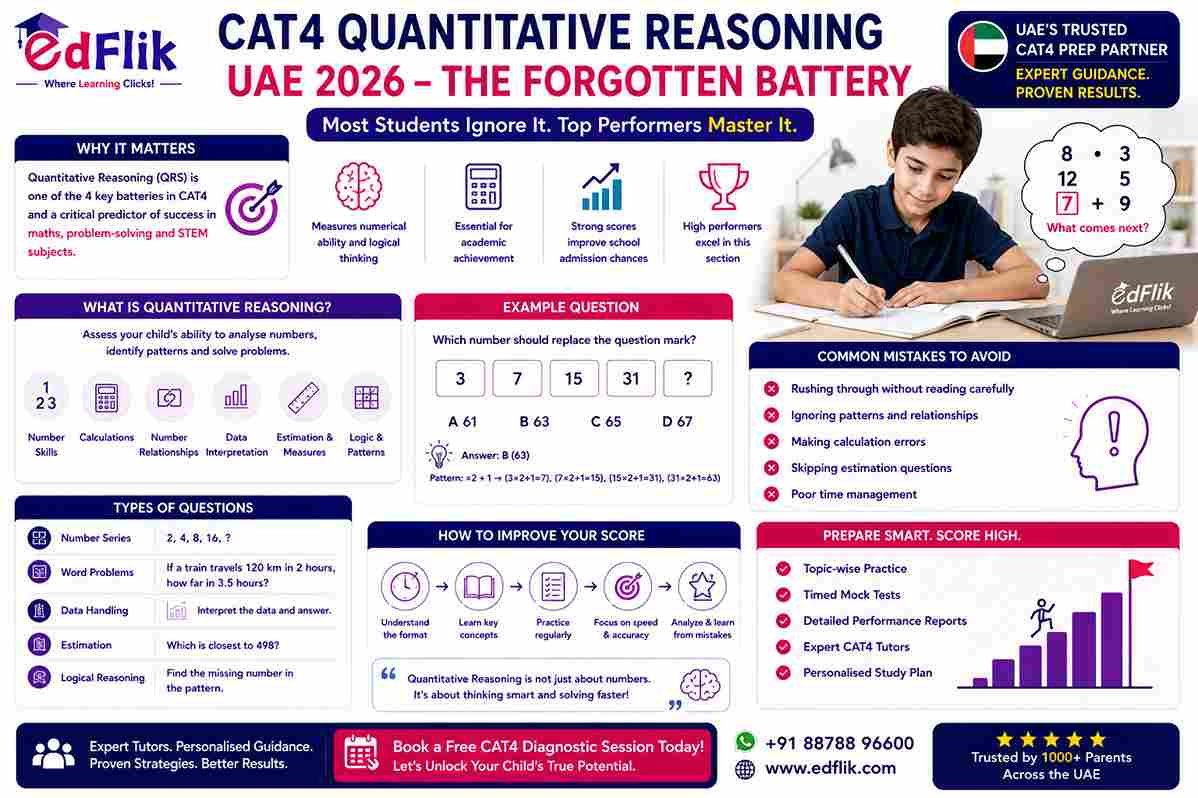
• Quantitative Reasoning at Level B: Number analogies at Level B use addition, subtraction, multiplication, and simple division rules. Ensure times tables are secure (at minimum to 10×10) before beginning QR practice — children who cannot quickly recall table facts struggle with QR number analogies.
• Non-Verbal Reasoning introduction: Level B NVR introduces figure matrices (2×2 and 3×3 grids). Systematic approach: identify one rule at a time — look at what changes across each row, then across each column.
For Level C Children (Ages 9.5-11.5)
Level C is the most structured preparation tier — children are at Year 5-6 level and can engage with more sustained focused practice:
• Level C as a gateway to Level D: Many Year 6 students in UAE will eventually sit Level D (for Year 7 entry). Preparing well for Level C in Year 5 gives children a year of accumulated familiarity with CAT4 question types that significantly reduces the novelty of Level D when it matters.
• All four batteries at Level C: Level C includes all four batteries with meaningful difficulty. Spatial Reasoning at Level C includes basic 2D shape combinations and reflections — the foundation for the 3D rotation that appears at Level D. Starting Spatial Reasoning practice at Level C builds the spatial vocabulary needed for Level D.
The Most Effective Home Preparation Activities by CAT4 Level
|
Activity |
Best for
Level |
Why It Helps |
|
Daily reading
(stories, information books) |
All levels —
especially A and B |
Builds
vocabulary for Verbal Reasoning; improves reading speed |
|
Mental
arithmetic (times tables, number bonds) |
B and C
especially |
Direct
foundation for Quantitative Reasoning number patterns |
|
Block building
(LEGO, K'nex, wooden blocks) |
A — physical
3D activity |
Develops
spatial reasoning sense before formal Spatial Reasoning practice |
|
Jigsaw puzzles |
A and B |
Non-Verbal
Reasoning spatial pattern recognition; 2D shape relationships |
|
Tangram
puzzles |
B and C |
2D shape
combination — direct preparation for Spatial Reasoning Level B-C |
|
Structured
VR/QR/NVR workbook practice |
C especially;
B from 6 weeks before assessment |
Builds
question-type familiarity and timing |
|
EdFlik CAT4
preparation covers Levels A through G, including age-appropriate sessions for
younger children. Primary school CAT4 preparation is structured for shorter
sessions with interactive engagement appropriate for 7-11 year olds. From AED
60 per session. Free diagnostic. Book at www.edflik.com or WhatsApp +91 88788
96600. |
Frequently Asked Questions
Q: Which UAE schools use CAT4 Levels A, B, and C?
Schools using CAT4 for primary admissions or internal streaming — including some GEMS schools, Brighton College, Repton, and Abu Dhabi British curriculum schools. Always confirm with the specific school which level is used for which year group entry.
Q: What is the difference between CAT4 Levels A, B, and C?
Same four batteries (Verbal, Quantitative, Non-Verbal, Spatial) at age-appropriate difficulty. Level A (ages 7.5-9.5): simple vocabulary and 2D shapes only. Level B (ages 8.5-10.5): moderate complexity. Level C (ages 9.5-11.5): approaching Level D difficulty; foundation for Year 7 preparation. SAS scoring (69-141) is identical across all levels.
Q: Is CAT4 Level C different from Level D?
Yes — Level C (Year 5-6 equivalent) is easier than Level D (Year 6-7 equivalent). Level D adds harder vocabulary, complex number patterns, and 3D rotation questions not present in Level C. A Year 6 student sitting Level D for the first time finds it harder than Level C.
Q: What Verbal Reasoning content appears in CAT4 Levels A, B, C?
Verbal classification, verbal analogies, and odd one out — with age-appropriate vocabulary. Level A uses everyday primary vocabulary; Level C uses Year 6 reading-level vocabulary.
Q: How long is a CAT4 assessment at Levels A, B, or C?
Approximately 40-50 minutes total (four batteries at approximately 8-10 minutes each, plus instructions and practice questions). Shorter than Levels D-G because younger children have shorter concentration spans.