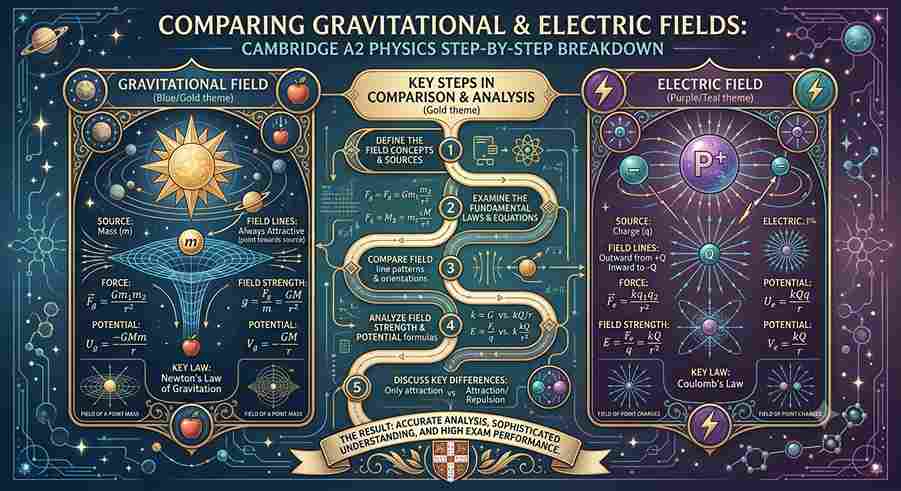
Comparing Gravitational and Electric Fields: Cambridge A2 Physics Step-by-Step Breakdown
Last Updated: October 2026 | By EdFlik Education Team
For international high school students preparing for the Cambridge International AS & A Level Physics (9702) examinations, Paper 4 (A2 Structured Questions) represents the ultimate test of physical reasoning and quantitative problem-solving. Among the most conceptual and heavily tested topics in the A2 syllabus is the comparative analysis of Gravitational Fields (Topic 13) and Electric Fields (Topic 17 & 18).
At first glance, gravitational and electric fields appear almost identical: both obey inverse-square laws, both utilize field lines to visualize force vectors, and both define potential functions based on radial distance. However, CIE examiners frequently design multi-part questions specifically to test your ability to pinpoint their critical mathematical and physical differences.
In this comprehensive, exam-focused masterclass guide, our expert Cambridge A-Level physics educators break down the core equations, highlight key similarities and contrasts, and provide a step-by-step problem-solving framework to help you secure an $A^*$ grade on Paper 4.
Part 1: Fundamental Definitions — Field Strength and Potential
To compare these two fundamental force fields, you must first master their basic definitions as outlined in the Cambridge 9702 syllabus.
                           FORCE FIELDS IN A2 PHYSICS
                                       |
        +------------------------------+------------------------------+
        |                                                             |
GRAVITATIONAL FIELDS (Topic 13)                               ELECTRIC FIELDS (Topic 17 & 18)
• Mass ($m$) generates field                                 • Charge ($q$) generates field
• Always attractive                                          • Attractive or Repulsive
• Weak field constant ($G = 6.67 \times 10^{-11}$)           • Strong field constant ($k = 8.99 \times 10^9$)
1. Field Strength ($g$ vs. $E$)
Field strength is defined as the force exerted per unit property placed at a point in the field:
- Gravitational Field Strength ($g$): The gravitational force exerted per unit mass acting on a small test mass placed at that point.$$g = \frac{F_G}{m} \quad [\text{N kg}^{-1} \text{ or } \text{m s}^{-2}]$$
- Electric Field Strength ($E$): The electric force exerted per unit positive charge acting on a small stationary test charge placed at that point.$$E = \frac{F_E}{q} \quad [\text{N C}^{-1} \text{ or } \text{V m}^{-1}]$$
2. Potential ($V_g$ vs. $V_E$)
Potential at a point is defined relative to a reference point of zero potential at infinity ($\infty$):
- Gravitational Potential ($V_g$): The work done per unit mass in bringing a small test mass from infinity to that point.$$V_g = \frac{W}{m} \quad [\text{J kg}^{-1}]$$
- Electric Potential ($V_E$): The work done per unit positive charge in bringing a small test charge from infinity to that point.$$V_E = \frac{W}{q} \quad [\text{J C}^{-1} \text{ or } \text{V}]$$
Part 2: Comparative Equations Table for Cambridge Paper 4
The following mathematical mapping is essential for answering comparative structured questions on CIE Paper 4:
| Physical Concept | Gravitational Field (Mass M) | Electric Field (Charge Q) |
| Generating Source | Mass ($M$) [always positive] | Charge ($Q$) [positive or negative] |
| Governing Force Law | Newton's Law of Gravitation: $F_G = -\frac{G M m}{r^2}$ | Coulomb's Law: $F_E = \frac{Q q}{4\pi\varepsilon_0 r^2}$ |
| Field Strength (Point Mass/Charge) | $g = \frac{G M}{r^2}$ | $E = \frac{Q}{4\pi\varepsilon_0 r^2}$ |
| Potential (Point Mass/Charge) | $V_g = -\frac{G M}{r}$ | $V_E = \frac{Q}{4\pi\varepsilon_0 r}$ |
| Potential Energy ($E_p$ or $U$) | $E_p = -\frac{G M m}{r}$ | $E_p = \frac{Q q}{4\pi\varepsilon_0 r}$ |
| Field-Potential Gradient Relationship | $g = -\frac{\Delta V_g}{\Delta r}$ | $E = -\frac{\Delta V_E}{\Delta r}$ |
| Fundamental Constant | $G = 6.67 \times 10^{-11} \text{ N m}^2 \text{ kg}^{-2}$ | $\frac{1}{4\pi\varepsilon_0} = 8.99 \times 10^9 \text{ N m}^2 \text{ C}^{-2}$ |
Part 3: Deep Dive — Key Similarities and Critical Differences
Cambridge Paper 4 often asks students to "State two similarities and two differences between gravitational and electric fields." Here is how to structure full-mark responses:
Key Similarities:
- Inverse-Square Dependence: Both force laws follow an inverse-square relationship with distance ($F \propto \frac{1}{r^2}$).
- Radial Symmetry for Point Sources: Both point masses and point charges produce radial field lines extending outward or inward from the center.
- Potential Gradient Relation: In both fields, field strength equals the negative spatial gradient of potential ($g = -\frac{dV_g}{dr}$ and $E = -\frac{dV_E}{dr}$).
- Conservation of Energy: Both fields are conservative force fields; the work done in moving a test particle between two points is path-independent.
Critical Differences:
- Nature of Force (Attraction vs. Repulsion):
- Gravitational forces are strictly attractive because negative mass does not exist.
- Electric forces can be either attractive or repulsive depending on whether the charges are opposite or like signs.
- Sign of Potential ($V$):
- Gravitational potential ($V_g$) is always negative everywhere (reaching zero at infinity). This signifies that work must be done against the field to move a mass to infinity.
- Electric potential ($V_E$) can be positive or negative, depending entirely on the sign of the source charge $Q$.
- Relative Magnitude (Strength):
- The electrostatic constant ($\frac{1}{4\pi\varepsilon_0} \approx 9 \times 10^9$) is roughly $10^{20}$ times larger than the gravitational constant ($G \approx 6.67 \times 10^{-11}$). Electrostatic forces dominate on atomic and molecular scales, whereas gravitational forces dominate on astronomical scales.
- Shielding Effects:
- Electric fields can be shielded or blocked using conducting materials (Faraday cages).
- Gravitational fields cannot be shielded or absorbed by any known material.
Part 4: Step-by-Step Problem-Solving Framework for Paper 4
When tackling radial field calculations on CIE Physics Paper 4, execute this four-step protocol:
Step 1: Identify the Source and Test Quantities
Label source masses ($M$) or charges ($Q$) versus test masses ($m$) or test charges ($q$). Verify whether electric charges are positive or negative before substituting values into potential equations.
Step 2: Pay Attention to the Sign of Potential
- Always include the negative sign for gravitational potential ($V_g = -\frac{GM}{r}$).
- Include the correct algebraic sign for electric potential ($V_E = +\frac{Q}{4\pi\varepsilon_0 r}$ for positive source charges; $V_E = -\frac{Q}{4\pi\varepsilon_0 r}$ for negative source charges).
Step 3: Work Done and Energy Changes
To find the work done ($W$) moving a mass or charge between two radii ($r_1$ and $r_2$):
$$\Delta W = m \Delta V_g = m (V_{g,2} - V_{g,1})$$$$\Delta W = q \Delta V_E = q (V_{E,2} - V_{E,1})$$
Step 4: Graphical Interpretation (Gradients and Areas)
- Gradient of $V$-$r$ Graph: The negative gradient of a Potential vs. Distance graph yields the Field Strength ($g$ or $E$).
- Area Under $F$-$r$ Graph: The area under a Force vs. Distance graph represents Work Done ($\Delta E_p$).
Part 5: Top 4 Traps That Cost Cambridge A2 Physics Marks
- Forgetting the Negative Sign in Gravitational Potential: Writing $V_g = \frac{GM}{r}$ without the negative sign. CIE mark schemes explicitly penalize missing negative signs in gravitational potential derivations.
- Confusing Field Strength ($E$) with Potential ($V_E$): Using the inverse-square formula ($\frac{1}{r^2}$) when asked to calculate potential, or using the inverse-distance formula ($\frac{1}{r}$) when asked for field strength.
- Measuring Distance ($r$) from the Surface Instead of the Center: Measuring radial distance $r$ from the surface of a spherical planet or conducting sphere rather than from its center. Always add the radius of the sphere ($R$) to the height above the surface ($h$): $r = R + h$.
- Mixing Up Permittivity of Free Space ($\varepsilon_0$): Inaccurately copying $\varepsilon_0 = 8.85 \times 10^{-12} \text{ F m}^{-1}$ from the data formula sheet or omitting the $4\pi$ factor in $E = \frac{Q}{4\pi\varepsilon_0 r^2}$.
Preparing for Cambridge A2 Physics exams and aiming for an $A^$ grade? EdFlik connects international school students globally with expert, 1-to-1 online A-Level physics tutors, helping you master gravitational fields, electromagnetism, quantum physics, and structured Paper 4 exam techniques.*Book a Free Demo Class Today!
Frequently Asked Questions (FAQs)
Q1: Why is gravitational potential always negative?
Ans: By convention, gravitational potential is defined as zero at infinity ($\infty$). Because the gravitational force is strictly attractive, work is done by the field as a mass moves from infinity toward a planet. Consequently, potential decreases below zero as you get closer to the source, resulting in negative values everywhere.
Q2: What is an equipotential surface?
Ans: An equipotential surface is a 3D locus of points where the potential is constant. No work is done when moving a test mass or charge along an equipotential line or surface ($\Delta V = 0 \implies W = 0$). Equipotential lines are always perpendicular to field lines.
Q3: Is electric field strength inside a hollow conducting sphere zero?
Ans: Yes! According to Gauss's Law, all net charge resides on the outer surface of a conductor in electrostatic equilibrium. Therefore, the electric field strength $E$ inside a hollow conducting sphere is zero, and the electric potential $V_E$ is constant throughout the interior (equal to the potential at the surface).
Q4: How does EdFlik support Cambridge A-Level Physics students?
Ans: EdFlik connects international school students worldwide with vetted, expert 1-to-1 online A-Level tutors specializing in Cambridge Assessment International Education (CIE 9702). Our personalized coaching focuses on clarifying complex physical mechanics, analyzing Paper 4 past papers, and building exam confidence.