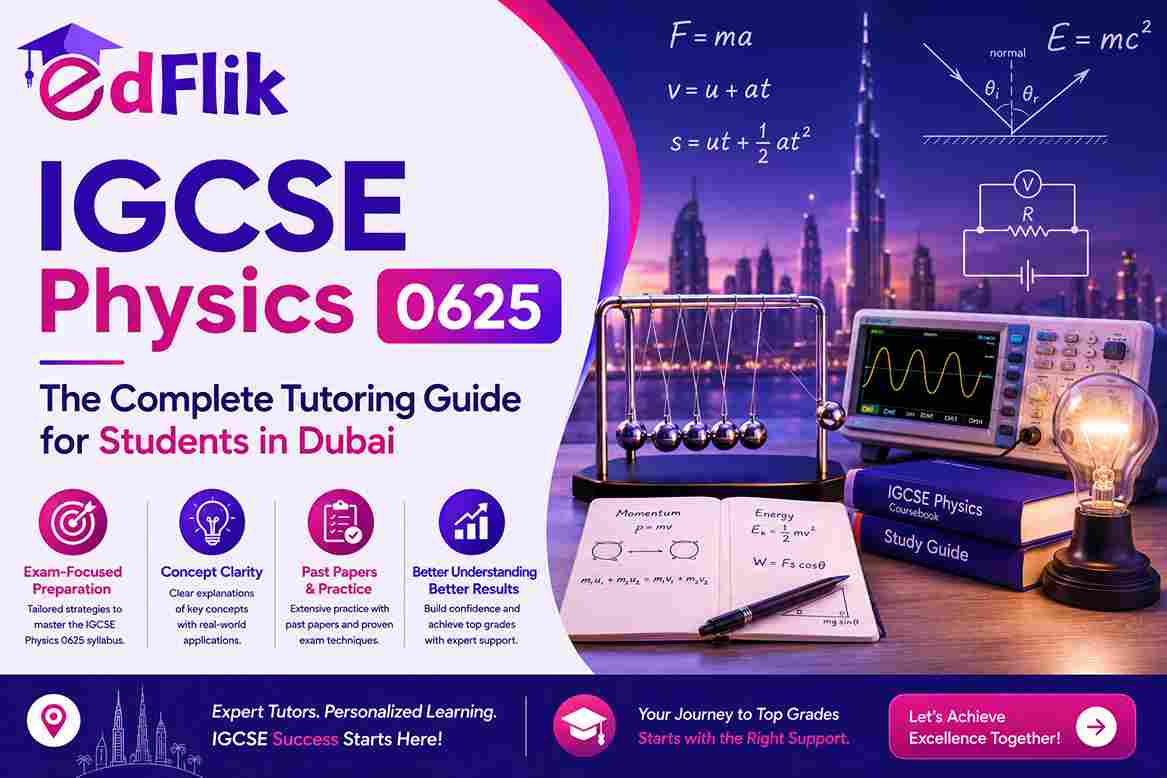
IGCSE Physics 0625: The Complete Tutoring Guide for Students in Dubai
The Challenge: Why IGCSE Physics Overwhelms Even Math-Strong Students
Your child is strong in Maths. You'd assume Physics would be straightforward. Yet IGCSE Physics combines maths *and* conceptual understanding in ways that trip up even high-achieving students.
They struggle with kinematics (why does velocity-time graph area equal distance?). Electricity feels abstract and unintuitive. Waves seem to have rules that contradict each other. And Paper 6 — the practical exam — tests lab skills that were never explicitly taught in Year 9.
**Most tutors teach Physics as applied Maths.** They show formulas, work through examples, assign problem sets. Your child can parrot solutions but genuinely doesn't understand *why the world works this way*.
EdFlik tutors teach the *understanding* first, then the maths. This transforms how students approach IGCSE Physics.
What Makes an Effective IGCSE Physics Tutor
1. Conceptual Clarity on Mechanics, Electricity, and Waves
These three topics are worth ~60% of the grade. A tutor who skimps on understanding here costs your child dearly.
Mechanics:
· Motion (displacement, velocity, acceleration, graphs)
· Forces (Newton's laws, equilibrium, friction)
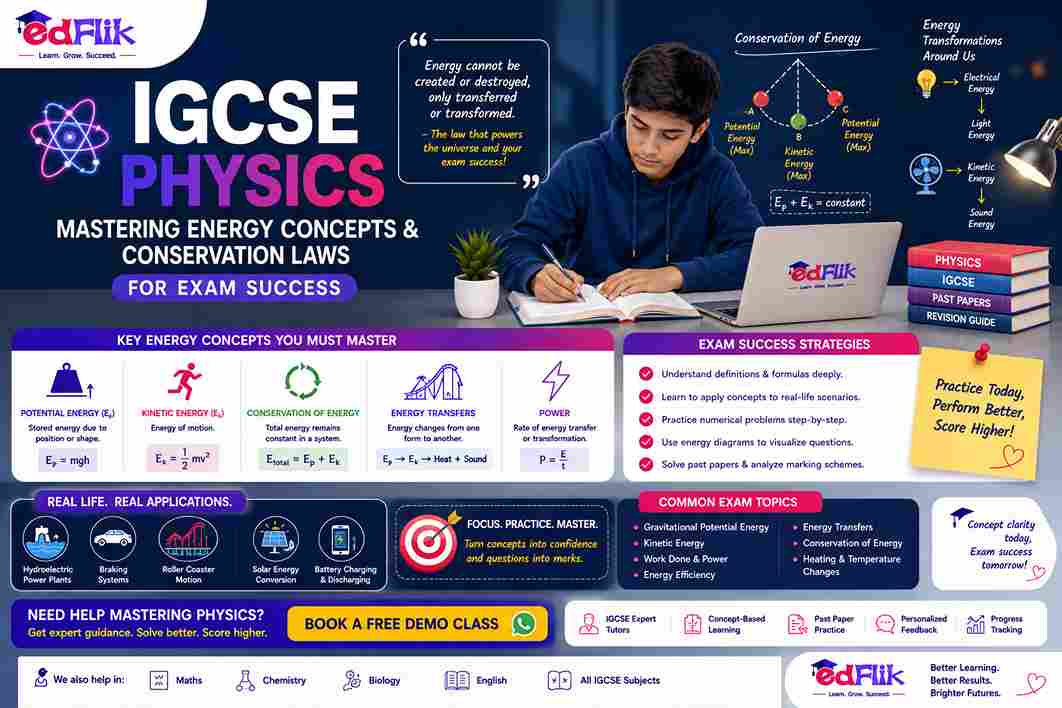
· Energy (kinetic, potential, conservation, work, power)
· Moments & levers
· Pressure
The challenge? Students memorise v = u + at but don't understand what acceleration *is* or why this formula works. A good tutor builds conceptual scaffolding *before* introducing the formula.
Electricity:
· Current, potential difference, resistance (Ohm's Law)
· Series vs. parallel circuits
· Power & energy in circuits
· Household wiring & safety
· Electrostatics
Electricity is notoriously abstract. You can't see current flowing. A good tutor uses analogies (water flowing through pipes) and diagrams to make it tangible.
Waves:
· Properties (amplitude, frequency, wavelength, speed)
· Types (transverse vs. longitudinal)
· Sound & light
· Reflection, refraction, diffraction
· Doppler effect
Waves are counterintuitive. Why does sound bend around a corner but light doesn't (much)? A tutor who builds this understanding wins.
2. Paper 6 Practical Lab Skills
Like Chemistry, Physics has a practical exam (Paper 6, 15% of the grade). Many students flounder because they haven't been taught lab protocol properly.
A good tutor guides:
· **Experiment design** — identifying dependent/independent variables, controls
· **Apparatus use** — vernier calipers, micrometers, stopwatches, ammeters, voltmeters
· **Data collection** — measurements with appropriate significant figures, repeated trials
· **Analysis** — plotting graphs, calculating gradients, interpreting trends
· **Evaluation** — identifying sources of error, suggesting improvements
By exam day, your child has conducted 8–10 standard physics practicals and can execute the exam practicals with confidence.
3. Problem-Solving Under Pressure
IGCSE Physics papers include extended-response questions where students must combine concepts:
· "A car accelerates from rest. Calculate the distance travelled in 5 seconds if acceleration is 2 m/s²."
This is easy if you remember the formula. But what if the exam asks:
· "A car's kinetic energy doubles. By what factor does its velocity increase?"
This requires conceptual thinking, not formula recall. Good tutors coach this higher-order thinking.
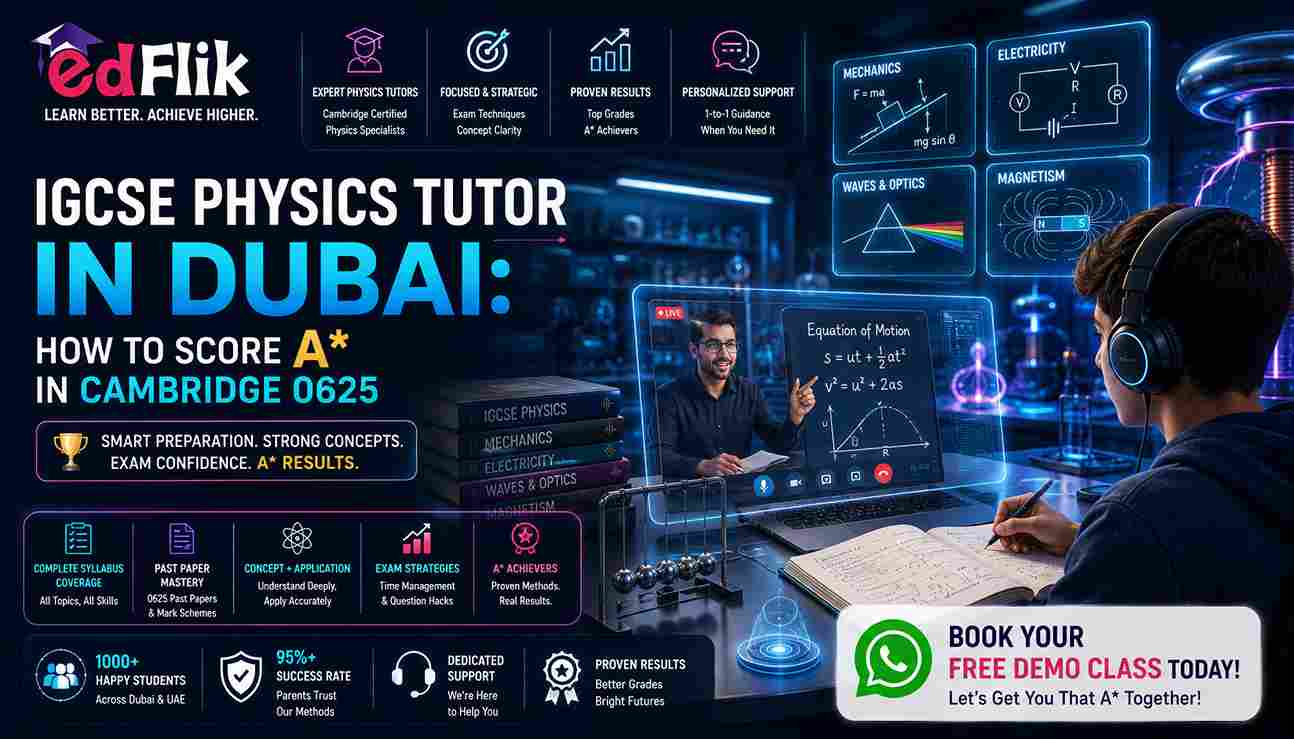
Book Your Free Trial Now
Unlock Physics confidence.
Book a free trial class with an IGCSE Physics specialist. WhatsApp **+91 88788 96600** or www.edflik.com
Most students feel more confident within 2–3 weeks of tutoring.
5 Tutoring Mistakes Dubai Parents Make (And How to Avoid Them)
Mistake 1: Skipping Conceptual Work
Jumping straight to formula-based problem-solving leaves students without understanding. Insist that your tutor explains the *why* before the *how*.
Mistake 2: Ignoring Paper 6 Until Late
Paper 6 practicals are worth 15%. Waiting until April to teach lab skills is a mistake. Start practical training by January.
Mistake 3: Avoiding Difficult Topics
Students naturally want to focus on topics they enjoy. A good tutor balances this — ensuring weak areas get attention too.
Mistake 4: Not Using Past Papers as a Diagnostic Tool
Mock exams reveal gaps. If your child scores poorly on a question about waves, that's the focus area for next week's tutoring. EdFlik tutors use mock papers this way.
Mistake 5: Underestimating Electricity
Electricity is abstract, so students often under-prepare. Then exam day arrives and they're shocked (pun intended) by how much weight electricity carries on the paper. Start electricity tutoring early.
Why EdFlik IGCSE Physics Tutors Get Results
Certified Teachers with Lab Experience
Our tutors aren't just teaching Physics — they've conducted experiments in real labs. They know which practicals trip students up and how to coach them through.
Conceptual Teaching First
We build understanding before introducing formulas. By the time your child sees v = u + at, they understand what each letter means and *why* the relationship holds.
Complete Syllabus Mastery
· Motion & forces
· Energy, work & power
· Moments, pressure & density
· Waves
· Electricity & magnetism
· Thermal physics
· Modern physics (nuclear, radioactivity)
· Paper 6 practicals
Monthly Progress Tracking
Every month you'll know:
· Topics covered
· Weak areas identified
· Mock exam trends
· Focus for next month
Exam Paper Mastery
We analyse past papers to identify recurring question types and coach your child on them.
IGCSE Physics 0625 Curriculum
Core Topics:
· General physics (length, area, volume, density, mass, weight, centre of gravity)
· Mechanics (motion, forces, Newton's laws, energy, work, power, pressure)
· Waves (sound & light, reflection, refraction, diffraction, electromagnet spectrum)
· Electricity & Magnetism (current, EMF, resistance, circuits, magnetic fields, electromagnetic induction)
· Thermal Physics (temperature, heat, expansion, latent heat)
· Atomic & Nuclear Physics (atomic structure, radioactivity, nuclear reactions)
· Astrophysics (stars, galaxies, cosmology)
Paper 6 Practicals Include:
· Measurement of density
· Velocity of falling objects
· Friction forces
· Spring constant (Hooke's Law)
· Electrical resistance
· Speed of sound
· Light reflection & refraction
· ~8–10 core practicals total
How It Works: 6 Steps to Physics Success
Step 1: Contact EdFlik
WhatsApp +91 88788 96600 or www.edflik.com. Tell us your child's weak areas and exam date.
Step 2: Tutor Matching
Within 24 hours, we match a qualified IGCSE Physics specialist.
Step 3: Free Trial
Your child attends 1–2 free classes to ensure the tutor's style matches their learning preference.
Step 4: Structured Learning
2–3 sessions per week (2–3 hours total). Early focus on conceptual clarity; later focus on problem-solving and practicals.
Step 5: Monthly Progress Reports
Every month you'll see:
· Topics mastered
· Remaining weak areas
· Mock exam scores (if available)
· Next month's plan
Step 6: Exam Readiness
By exam month, your child has solved dozens of past papers and practised all Paper 6 experiments.
What Students Say
*"Physics finally made sense when my tutor explained that acceleration is just the rate of change of velocity. Then all the motion equations clicked."*
— Fatima Al-Falasi, Dubai
*"My tutor made electricity tangible using water pipe analogies. Current, resistance, power — suddenly it wasn't abstract anymore."*
— Hassan Al-Mazrouei, Sharjah
*"Paper 6 scared me until I'd done the practicals with my tutor. By the exam, I felt prepared. Scored 36/40."*
— Pooja Desai, Ajman
FAQs:-
Q: When should tutoring start?
A: September/October for a May exam. This allows 6–7 months to cover topics deeply and practise extensively.
Q: How much tutoring is optimal?
A: 2–3 sessions per week (2–3 hours) works for most. Struggling students sometimes do 4; stronger students do 1–2.
Q: Is Physics harder than Chemistry?
A: They're different challenges. Chemistry requires memorisation + calculations. Physics requires understanding + problem-solving. Many students find Physics more logical once they grasp the concepts.
Q: What if my child is weak at Maths?
A: IGCSE Physics requires some maths (basic algebra, graphs, rearranging formulas). If your child struggles with maths, we recommend starting tutoring slightly earlier (summer before Year 10) to build maths confidence alongside Physics.
Q: Can we focus on just one topic (e.g. electricity)?
A: Yes. Many students focus on weak areas while working independently on strengths.
Q: What's the cost?
A: Starting at 45 AED per hour. Most families invest 180–270 AED per week on tutoring.
Q: How do I know my child will pass?
A: With consistent tutoring starting 6+ months before the exam, passing is very likely. Most students improve by 1–2 grades within 3–4 months of tutoring.