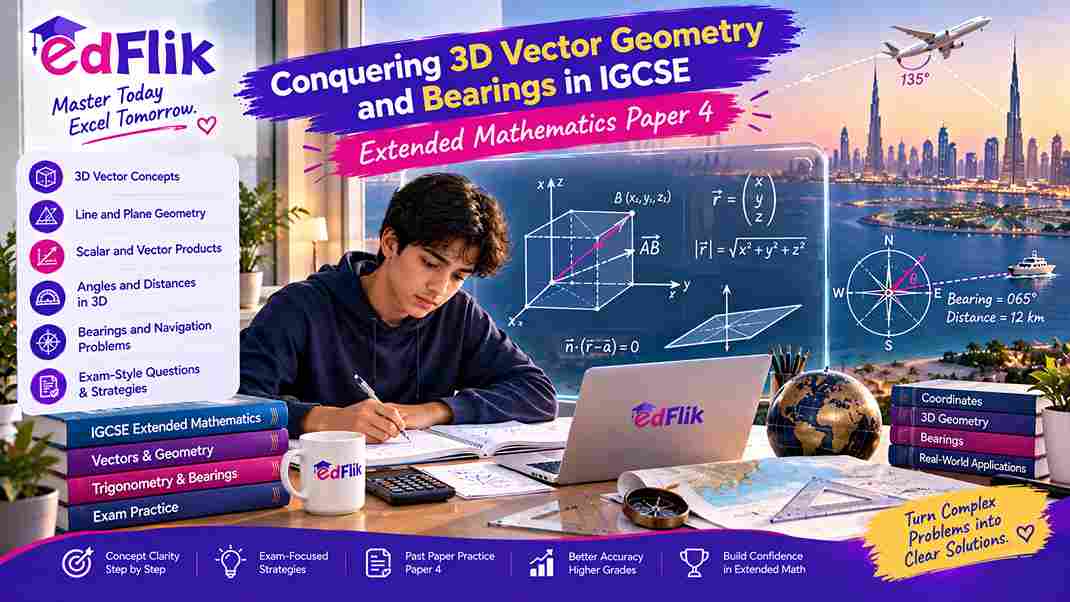
Conquering 3D Vector Geometry and Bearings in IGCSE Extended Mathematics Paper 4
Last Updated: October 2026 | By EdFlik Education Team
For high school students completing the Cambridge IGCSE Extended Mathematics (0580) or Pearson Edexcel IGCSE Mathematics A (4MA1) qualifications, securing a top grade ($8$ or $9 / A^*$) requires complete command over the most demanding extended paper topics. Featured prominently on Paper 4 (Extended Calculator), 3D Vector Geometry and 3-Figure Bearings with Trigonometry consistently rank among the highest-tariff, multi-step problem sets on the examination.
These topics do not merely test basic recall; they require students to visualize spatial relationships in three dimensions, apply the Pythagorean theorem across multiple planes, manipulate vector combinations algebraically, and navigate multi-step sine/cosine rule applications centered on precise navigational angles.
In this comprehensive, exam-focused masterclass guide, our expert IGCSE mathematics educators break down spatial vector proofs, 3D coordinate geometry, bearings rules, non-right-angled trigonometry, and common examiner traps to help you score full marks on Paper 4.
Part 1: Mastering 3-Figure Bearings and Trigonometric Geometry
A bearing is a precise directional angle used in navigation and surveying. To avoid costly mark deductions on IGCSE Paper 4, you must adhere strictly to three golden rules:
                      THE THREE GOLDEN RULES OF BEARINGS
                                       |
        +------------------------------+------------------------------+
        |                              |                              |
 1. MEASURED FROM NORTH        2. CLOCKWISE DIRECTION         3. THREE-DIGIT FORMAT
 Always draw a vertical North   Always measure the angle       Always write bearings using 3 digits
 line starting at the pivot.    moving in a clockwise arc.     (e.g., $042^\circ$ or $007^\circ$, NOT $42^\circ$).
1. Reverse Bearings (Back Bearings)
A frequent 2-mark question asks: "If the bearing of $B$ from $A$ is $075^\circ$, find the bearing of $A$ from $B$."
                             REVERSE BEARING GEOMETRY

                      N                         N
                      |                         |
                      |   / B                   |   / B
                      |  /                      |  /
                      | /                       | /
                      |/ 075°                   |/ 255°
                      A -----------------------> A
The Universal Formula for Back Bearings:
To find the bearing of $A$ from $B$ when given the bearing of $B$ from $A$ ($\theta$):
$$\text{Bearing of } A \text{ from } B = \begin{cases} \theta + 180^\circ & \text{if } \theta < 180^\circ \\ \theta - 180^\circ & \text{if } \theta \ge 180^\circ \end{cases}$$
Example: If Bearing of $B$ from $A = 075^\circ$ ($< 180^\circ$), then Bearing of $A$ from $B = 75^\circ + 180^\circ = 255^\circ$.
2. Multi-Step Non-Right-Angled Trigonometry in Bearings
When solving bearings word problems on Paper 4, ships, planes, or hikers usually form scalene triangles in the horizontal plane. You must deploy the Sine Rule and Cosine Rule:
- The Cosine Rule (Use when you know SAS or SSS):$$a^2 = b^2 + c^2 - 2bc \cos(A) \quad \text{or} \quad \cos(A) = \frac{b^2 + c^2 - a^2}{2bc}$$
- The Sine Rule (Use when you know an opposite angle-side pair):$$\frac{a}{\sin(A)} = \frac{b}{\sin(B)} = \frac{c}{\sin(C)}$$
Part 2: Spatial 3D Trigonometry and Geometry
In Paper 4, 3D geometry questions often feature cuboids, rectangular pyramids, or triangular prisms, requiring you to find lengths and angles between line segments and 3D planes.
                   3D DISTANCE AND ANGLE CALCULATIONS
                                   |
      +----------------------------+----------------------------+
      |                                                         |
3D PYTHAGOREAN THEOREM                                ANGLE BETWEEN LINE AND PLANE
Finds space diagonal $d$ in a cuboid:                  1. Identify the line segment.
$d = \sqrt{x^2 + y^2 + z^2}$                          2. Project the line vertically onto the base.
                                                      3. Calculate $\theta$ using $\tan(\theta) = \frac{\text{Height}}{\text{Base Projection}}$.
Step-by-Step Worked Example (3D Angle to a Base Plane):
Question: A cuboid has dimensions $a = 8\text{ cm}$ (length), $b = 6\text{ cm}$ (width), and $c = 5\text{ cm}$ (height). Calculate the angle that the space diagonal $AG$ makes with the horizontal base $ABCD$.
Step 1: Find the length of the base diagonal ($AC$)
Applying 2D Pythagoras on the horizontal base $ABCD$:
$$AC = \sqrt{a^2 + b^2} = \sqrt{8^2 + 6^2} = \sqrt{64 + 36} = \sqrt{100} = 10\text{ cm}$$
Step 2: Use the vertical right-angled triangle $ACG$
The height $CG = 5\text{ cm}$ is perpendicular to base diagonal $AC = 10\text{ cm}$.
$$\tan(\theta) = \frac{\text{Opposite}}{\text{Adjacent}} = \frac{CG}{AC} = \frac{5}{10} = 0.5$$$$\theta = \tan^{-1}(0.5) \approx 26.6^\circ \quad \text{(1 decimal place)}$$
Part 3: Vector Geometry and Proofs in 2D and 3D
Vector questions on Extended Paper 4 carry between 6 and 9 marks, divided into column vector calculations and geometric vector proofs.
                     VECTOR ALGEBRA AND PROOFS
                                 |
      +--------------------------+--------------------------+
      |                                                     |
COLUMN VECTOR OPERATIONS                              GEOMETRIC VECTOR PROOFS
If $\vec{a} = \begin{pmatrix} x_1 \\ y_1 \end{pmatrix}$ and $\vec{b} = \begin{pmatrix} x_2 \\ y_2 \end{pmatrix}$:  To prove points $P, Q, R$ are **collinear**:
• Magnitude $|\vec{a}| = \sqrt{x_1^2 + y_1^2}$          1. Show $\vec{PQ} = k \cdot \vec{QR}$ (Parallel).
• $\vec{a} + \vec{b} = \begin{pmatrix} x_1 + x_2 \\ y_1 + y_2 \end{pmatrix}$ 2. State that point $Q$ is a **common point**.
1. Vector Proof Protocol: Collinearity and Parallel Lines
On Paper 4, examiners frequently ask you to prove that three points $A, B,$ and $C$ lie on a straight line (are collinear), or that two line segments are parallel.
To prove two vectors are parallel:
Show that one vector is a scalar multiple of the other:
$$\vec{AB} = k \cdot \vec{CD} \quad (k \text{ is a scalar constant})$$
To prove three points $A, B, C$ are collinear:
- Find the vector expression for $\vec{AB}$.
- Find the vector expression for $\vec{BC}$ (or $\vec{AC}$).
- Show that $\vec{AB} = k \cdot \vec{BC}$ (proving they are parallel).
- Mandatory Exam Sentence: Write: "Since $\vec{AB} = k \cdot \vec{BC}$ and point $B$ is common to both vectors, points $A, B,$ and $C$ lie on a straight line (are collinear)."
Part 4: Top 4 Traps That Cost Students Marks on Paper 4
- Writing Bearings Without Leading Zeros: Writing $45^\circ$ or $8.5^\circ$ instead of $045^\circ$ or $008.5^\circ$. Bearings must always contain three digits before the decimal point!
- Degree vs. Radian Mode Errors on Calculators: Setting your scientific calculator to Radian ($\text{R}$) or Gradian ($\text{G}$) mode. All IGCSE geometry and bearing calculations must be performed in Degree ($\text{D}$) mode!
- Forgetting the "Common Point" Statement in Vector Proofs: Showing that $\vec{PQ} = 2\vec{QR}$ but failing to state that "Point $Q$ is a common point." Without this statement, you lose the final accuracy/reasoning mark.
- Inappropriate Rounding Mid-Calculation: Rounding intermediate values (e.g., rounding a bearing angle to $2$ s.f. halfway through a 5-step problem). Keep full calculator display values until the final line, then round angles to $1$ decimal place and side lengths to $3$ significant figures as specified on the front cover of Paper 4.
Preparing for Cambridge (0580) or Edexcel (4MA1) IGCSE Extended Mathematics and aiming for an $8/9$ ($A^$) grade? EdFlik connects high school students globally with expert, 1-to-1 online IGCSE math tutors, helping you master 3D geometry, vector proofs, non-right-angled trigonometry, and past-paper Paper 4 strategies. *Book a Free Demo Class Today!
Frequently Asked Questions (FAQs)
Q1: What is the difference between a position vector and a displacement vector?
Ans: A position vector represents the location of a point relative to the origin $O$ (e.g., $\vec{OA} = \mathbf{a}$). A displacement vector represents the path from one specific point to another (e.g., $\vec{AB} = \vec{AO} + \vec{OB} = -\mathbf{a} + \mathbf{b} = \mathbf{b} - \mathbf{a}$).
Q2: How do I calculate the magnitude of a 3D vector?
Ans: The magnitude (length) of a 3D column vector $\vec{v} = \begin{pmatrix} x \\ y \\ z \end{pmatrix}$ is calculated using 3D Pythagoras: $\vert{}\vec{v}\vert{} = \sqrt{x^2 + y^2 + z^2}$.
Q3: How are angles rounded in IGCSE Extended Mathematics papers?
Ans: According to standard Cambridge and Edexcel rubric instructions, all angles must be given to $1$ decimal place (unless explicitly asked otherwise in the question), while non-exact numerical answers should be rounded to $3$ significant figures.
Q4: How does EdFlik support IGCSE Mathematics students?
Ans: EdFlik connects international school students worldwide with vetted, expert 1-to-1 online tutors specializing in Cambridge (0580) and Pearson Edexcel (4MA1) IGCSE Extended Mathematics. Our personalized coaching focuses on simplifying complex 3D geometry, solving multi-step bearing problems, mastering vector proofs, and building exam confidence under timed conditions.