Conquering Math Anxiety: Pedagogical Strategies Our 1-on-1 Tutors Use to Unlock Student Potential
Last Updated: August 2026 | By: EdFlik Education Team
Quick Contact: Need an online math tutor in Dubai & UAE 2026 right now? WhatsApp us at +91 88788 96600 | Sessions starting from AED 55–70/hour | Book a Free Trial Class today viawww.edflik.com.
Introduction: The Hidden Barrier to Academic Success
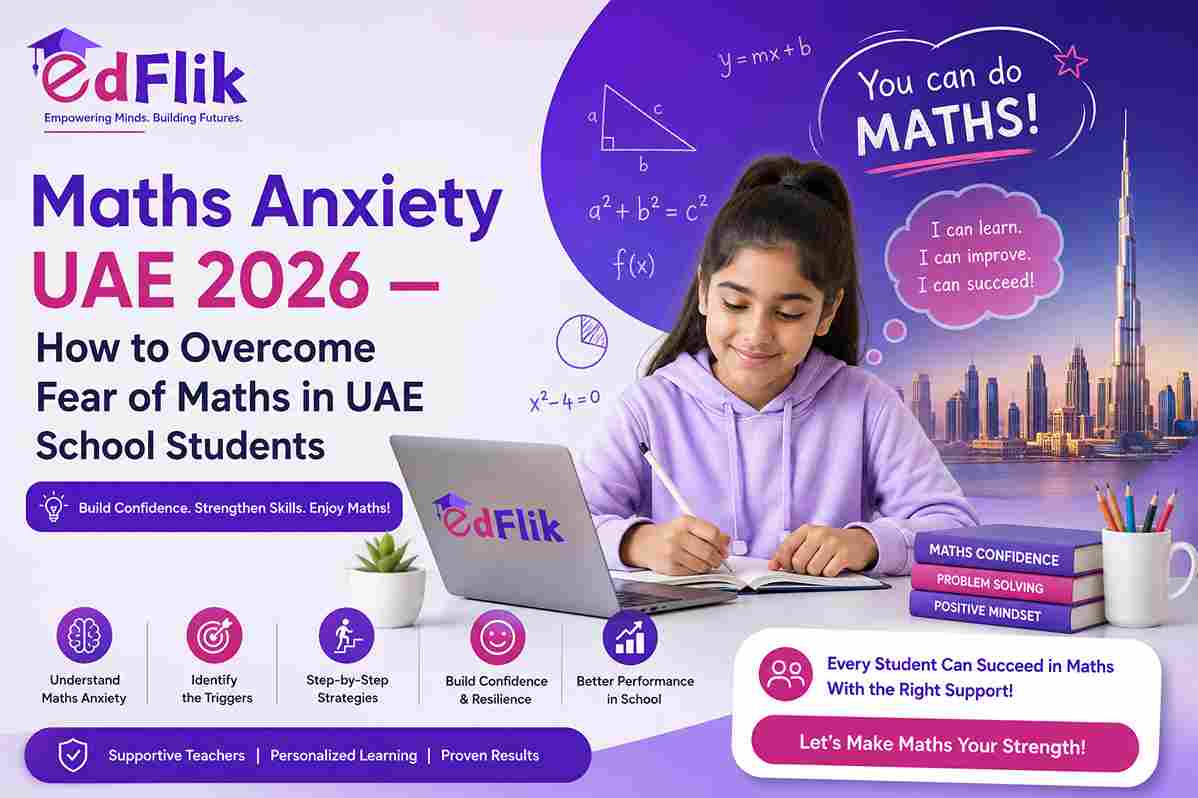
Imagine a bright, capable student staring at a blank algebra test paper. Their heart races, their palms sweat, and their mind goes completely blank. It is not a lack of intelligence or a failure to study that causes this reaction; it is math anxiety.
Math anxiety is a real psychological and physiological phenomenon that affects millions of students worldwide, from middle school classrooms to high-stakes international exam halls across Dubai and the UAE. When fear and panic take over, the brain’s working memory capacity plummets, turning routine arithmetic or complex calculus into insurmountable walls.
Traditional brick-and-mortar classrooms—with fast-paced teaching schedules, large student bodies, and public peer pressure—often make math anxiety worse. However, shifting to a structured, live 1-on-1 online tutoring environment provides a safe, empathetic space that rewires how students interact with numbers. This guide explores the core pedagogical strategies EdFlik tutors use to dismantle math anxiety and unlock hidden student potential.
Section 1: The Anatomy of Math Anxiety (Why Traditional Classrooms Fail)
To solve math anxiety, we must first understand where it originates. Traditional school environments often inadvertently foster math fear through several structural flaws:
- The "Speed Cult": Classrooms frequently reward students who answer math problems the fastest, teaching slower or more contemplative learners that taking time equals being "bad at math."
- Public Performance Pressure: Being called upon to solve a problem on a whiteboard in front of thirty peers creates a high-stakes, threatening environment where making a mistake feels humiliating.
- Cumulative Gaps: Math is strictly hierarchical. If a student misses a foundational concept in fractions or negative numbers in Year 6, quadratic equations in Year 9 become overwhelmingly confusing, triggering chronic avoidance.
Section 2: Core Pedagogical Strategies Used by Expert 1-on-1 Tutors
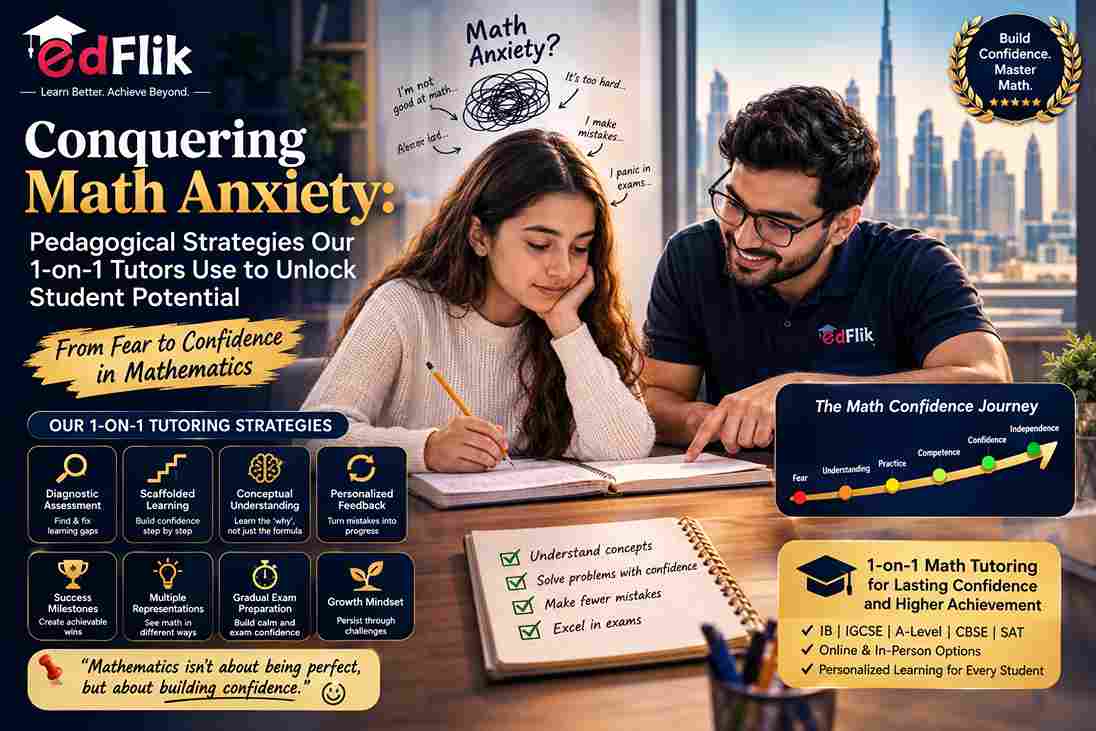
At EdFlik Education, our tutors do not just teach formulas; they act as educational mentors who address the psychological and cognitive roots of math fear. Here are the four primary strategies our 1-on-1 tutors use to restore student confidence:
1. Cultivating a "Safe-to-Fail" Digital Environment
In a private 1-on-1 online session, there are no judging peers, no red ink on public blackboards, and no rushing.
- The Approach: Tutors explicitly normalize mistakes as a critical step in the learning process. When a student makes an error, the tutor does not say "That's wrong." Instead, they ask, "Interesting approach! Walk me through your logic so we can find where the path split." This transforms error-making from a source of shame into a collaborative puzzle.
2. Micro-Scaffolding Complex Problems
When students look at a multi-part calculus or simultaneous equation problem, they see an overwhelming mountain.
- The Approach: Tutors use micro-scaffolding—breaking monumental problems down into bite-sized, digestible steps. By solving small, winnable micro-tasks consecutively, the student's brain experiences repeated dopamine hits of success, building momentum and dissolving intimidation.
3. Multi-Sensory and Visual Representation
Many students suffer from math anxiety because they are forced to memorize abstract rules without understanding the physical or visual reality behind them.
- The Approach: Utilizing interactive digital whiteboards and graphical tools, tutors bring numbers to life. Whether it is visualizing algebraic transformations, geometric vectors, or probability distribution curves visually, seeing why a math law works makes it intuitive rather than terrifying.
4. Metacognitive Questioning (Guiding, Not Telling)
Anxious students often develop "learned helplessness," immediately asking a teacher or parent, "How do I start this?" because they are afraid of choosing the wrong path.
- The Approach: Tutors practice metacognitive scaffolding—asking Socratic, guiding questions (e.g., "What do we know about this variable?" or "What rule did we use for a similar question last week?"). This trains students to trust their own thinking process rather than relying on rote memorization.
Section 3: Common Mistakes Parents Make When Trying to Help
Well-meaning parents often try to help with math homework, but can accidentally fuel anxiety without realizing it:
- Imposing Time Limits: Forcing children to drill flashcards under a ticking stopwatch, which hyper-activates the fight-or-flight response.
- Using Outdated Methods: Explaining mathematical procedures using methods that conflict with modern international school curriculums (Cambridge, IB, or American), leading to classroom confusion.
- Expressing Math Negativity: Saying things like "I was never good at math either, so it's okay if you struggle," which inadvertently validates the idea that math ability is genetic rather than learned.
Section 4: Success Stories & Testimonials
"My daughter used to cry before every math test because she felt completely paralyzed by numbers. Her EdFlik tutor was so patient and encouraging. By breaking down algebra step-by-step on the digital whiteboard, her anxiety vanished. She just scored a 9 in her IGCSE Math exam!"
— Parent in Dubai Marina
"I always thought I was just 'not a math person.' My online tutor showed me that I just needed a calmer environment to understand how functions and calculus actually worked. My grades jumped from a D to an A."
— Hamza R., Dubai Student
Frequently Asked Questions (FAQ)
What causes math anxiety in students?
Math anxiety is typically triggered by public embarrassment, rigid timed testing, strict grading pressure, and accumulated learning gaps from earlier grade levels.
How does 1-on-1 online tutoring help reduce anxiety?
Online 1-on-1 tutoring removes peer pressure, provides a judgment-free "safe-to-fail" space, and allows tutors to customize the pacing entirely to the student's emotional and cognitive needs.
How much does online math tutoring cost with EdFlik?
EdFlik offers expert 1-on-1 math tutoring starting at an accessible AED 55–70/hour, delivering elite academic and emotional support without inflated agency fees.
Ready to Help Your Child Conquer Math Anxiety?
Don't let fear of numbers stand between your child and their true academic potential. Experience the EdFlik difference today.
- WhatsApp Us:+91 88788 96600
- Visit Us:www.edflik.com
- Special Offer: Book your Free Trial Class now!