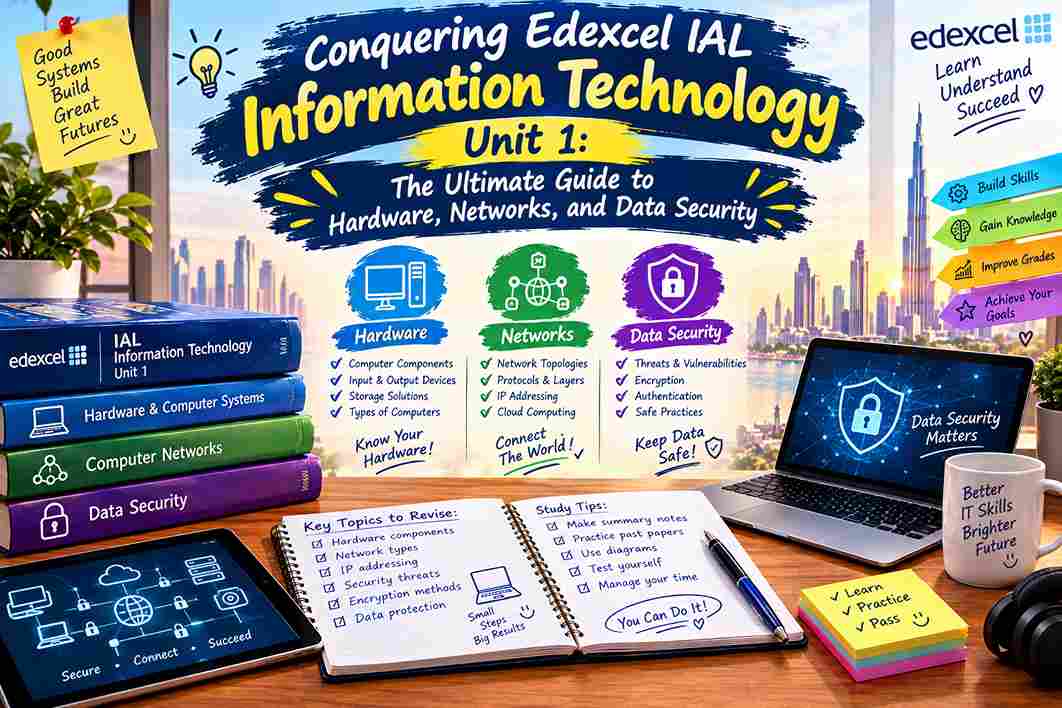
Conquering Edexcel IAL Information Technology Unit 1: The Ultimate Guide to Hardware, Networks, and Data Security
Last Updated: September 2026 | By EdFlik Education Team
For students studying the Pearson Edexcel International Advanced Level (IAL) Information Technology (YIT11) curriculum, Unit 1 (Exploratory digital technology and data security) forms the theoretical backbone of the entire AS qualification. Accounting for 50% of your IAS mark, this 2-hour written exam requires precise technical definitions, structural application of network topologies, and comprehensive knowledge of hardware, data security, and wider ethical issues.
Among the core syllabus modules, mastering Hardware components, Networks, and Data Security is essential. Examiners frequently award high-tariff marks for scenario-based questions where students must recommend specific network configurations or hardware upgrades for corporate environments.
In this comprehensive guide, our expert IT curriculum advisors break down core technical pillars, share high-impact revision strategies, and provide a roadmap to securing an $A$ grade.
Part 1: Hardware and Digital Devices Architecture
Understanding internal and peripheral components goes beyond memorizing names; you must understand their precise function and performance metrics under exam conditions.
1. Core Hardware Components
- Central Processing Unit (CPU): Executes instructions using the Fetch-Decode-Execute cycle. Performance is dictated by clock speed (GHz), number of cores, and cache size.
- RAM vs. ROM: RAM is volatile working memory holding active applications, while ROM is non-volatile and stores crucial firmware (like the BIOS/UEFI) required for system boot-up.
- Secondary Storage: Compare magnetic hard disk drives (HDDs), solid-state drives (SSDs), and optical media based on capacity, portability, durability, speed, and cost per gigabyte.
2. Emerging Trends: Technological Convergence & Miniaturization
- Technological Convergence: The integration of multiple digital technologies into a single device (e.g., a modern smartphone combining a cellular phone, high-resolution digital camera, GPS navigation unit, and internet browser).
- Miniaturization: The continuous manufacturing trend toward smaller, lighter, and more energy-efficient components, heavily influencing wearable tech and IoT (Internet of Things) devices.
Part 2: Networks and Transmission Topologies
Network architecture questions are standard features of Unit 1 past papers. You must be fluent in both hardware devices and protocols.
1. Essential Network Hardware
- Router: Connects disparate networks (such as a local home/office network to the wider internet) and forwards data packets using IP addresses.
- Switch: Connects devices within a local area network (LAN) and uses MAC addresses to forward data frames directly to the intended destination port.
- Modem: Modulates digital signals into analog signals (and vice versa) for transmission over telephone or cable lines.
2. Network Topologies Compared
Edexcel frequently asks you to evaluate topologies based on reliability, expansion cost, and installation complexity:
- Star Topology: All devices are connected to a central switch or server. Advantage: If one cable fails, only that device is disconnected. Disadvantage: Central switch failure brings down the entire network.
- Bus Topology: Devices connect to a single central backbone cable. Disadvantage: High vulnerability; a break in the main cable halts all communication.
- Mesh Topology: Every device has a dedicated point-to-point connection to every other device (Full Mesh) or multiple nodes (Partial Mesh). Advantage: Exceptional redundancy and fault tolerance. Disadvantage: Highly expensive and complex cabling.
Part 3: Data Security and Threat Mitigation
Data is an organization's most valuable asset. Unit 1 tests your ability to distinguish between security threats and deploy robust multi-layered protection mechanisms.
1. Common Threats to Digital Systems
- Malware: An umbrella term for malicious software—including viruses, trojans, ransomware, and spyware—designed to disrupt systems or exfiltrate data.
- Phishing: Social engineering attacks using deceptive emails or websites designed to trick users into revealing sensitive credentials or financial information.
- Hacking & Unauthorized Access: Exploiting system vulnerabilities or weak authentication controls to bypass security barriers.
2. Defensive Strategies
- Encryption: Converting plain text into ciphertext using complex cryptographic algorithms and keys. Even if intercepted during transmission, data remains unreadable without the decryption key.
- Firewalls: Hardware or software systems that monitor incoming and outgoing network traffic, filtering packets based on a predetermined set of security rules.
- Robust Authentication: Implementing Multi-Factor Authentication (MFA), biometric checks, and strong password policies to verify user identity before granting access.
- Disaster Recovery & Backups: Routine scheduling of full, incremental, and differential backups stored securely off-site or in the cloud.
Part 4: Top 4 Strategies to Secure an $A$ Grade in Unit 1
- Deconstruct Command Words: Pay careful attention to exam terminology. If a question asks you to identify, a single word or short phrase suffices. If it asks you to discuss or evaluate, you must present balanced arguments weighing advantages against disadvantages.
- Master Scenario-Based Application: EdFlik tutors emphasize that memorizing definitions isn't enough. You must apply theory to scenarios—such as designing a secure network topology for a multi-floor hospital or corporate headquarters.
- Practice Past Papers Under Timed Conditions: Work backward through official Pearson Edexcel IAL Unit 1 past papers and mark schemes. Pay close attention to how examiners allocate marks for technical explanations.
- Use Precise Technical Vocabulary: Avoid generic terms like "internet box" or "memory stick." Use correct industry terminology such as "wireless access point," "solid-state storage," or "packet switching."
Preparing for Edexcel IAL Information Technology Unit 1? EdFlik offers expert, 1-to-1 online tutoring customized specifically for international school students, helping you master complex theory, decode exam rubrics, and secure top grades.Book a Free Demo Class Today!
Frequently Asked Questions (FAQs)
Q1: What is the structure of the Edexcel IAL Information Technology Unit 1 exam?
Ans: Unit 1 (WIT11/01) is a 2-hour written theory examination worth 80 raw marks, contributing 50% to your International AS (IAS) grade and 25% to your full International A-Level grade.
Q2: What is the difference between a switch and a hub?
Ans: A hub broadcasts incoming data packets to every port on the network regardless of the destination, creating unnecessary network traffic and security vulnerabilities. A switch is intelligent; it reads the destination MAC address and forwards data only to the specific device intended to receive it.
Q3: How important is past paper practice for Unit 1?
Ans: Extremely important. Edexcel exam papers frequently recycle core theoretical themes (such as encryption, network security policies, and storage media comparisons), meaning familiarity with past mark schemes gives you a major advantage.
Q4: How can EdFlik support my EdFlik IT studies?
Ans: EdFlik connects students worldwide with vetted, experienced 1-to-1 online tutors specializing in Edexcel IAL Information Technology Units 1 through 4. Our sessions focus on clarifying difficult concepts, practicing database/web constructs, and refining exam technique.