Cracking the AP Physics 1 Experimental Design FRQ: Step-by-Step Walkthrough
Last Updated: October 2026 | By EdFlik Education Team
For high school students enrolled in AP Physics 1, exam day brings a unique set of challenges. While multiple-choice questions test your ability to quickly apply physical principles, the free-response section separates students who merely memorize formulas from those who truly understand experimental physics.
Among all the FRQs on the AP Physics 1 exam, the Experimental Design question (typically worth 12 points) strikes fear into the hearts of many students. Unlike traditional algebraic problem-solving, this question requires you to design a laboratory procedure from scratch, identify equipment, sketch graph setups, analyze experimental uncertainty, and explain how data will be used to verify a physical relationship or measure a constant like gravitational acceleration ($g$).
Many capable physics students lose easy points on this question not because they don't know Newton's laws or energy conservation, but because their experimental procedures are vague, they fail to specify what measurements to take, or they don't know how to linearize non-linear equations for graph plotting.
In this comprehensive, exam-focused masterclass guide, our expert AP physics educators break down the College Board's experimental design rubric, provide a foolproof step-by-step walkthrough, and share elite strategies to secure maximum points.
Part 1: Anatomy of the AP Physics 1 Experimental Design FRQ
The Experimental Design FRQ is structured around specific College Board scientific practices. When you open your exam booklet and encounter Question 3 or 4, you will be given a physical scenario (e.g., investigating friction on an inclined plane, spring constant oscillations, or rotational inertia of a pulley) and asked to address several key components:
- Experimental Setup & Equipment: What apparatus do you need, and how do you assemble it?
- Measurements & Instruments: What physical quantities will you measure, and with what measuring tools?
- Procedure & Data Collection: What steps will you take to collect reliable data across multiple trials?
- Graphing & Linearization: How will you manipulate your raw data to plot a straight-line graph whose slope or intercept reveals the desired physical quantity?
- Error Analysis & Justification: How will you minimize experimental uncertainty, and how do you use your graph to answer the physics prompt?
Part 2: The Step-by-Step Walkthrough Framework
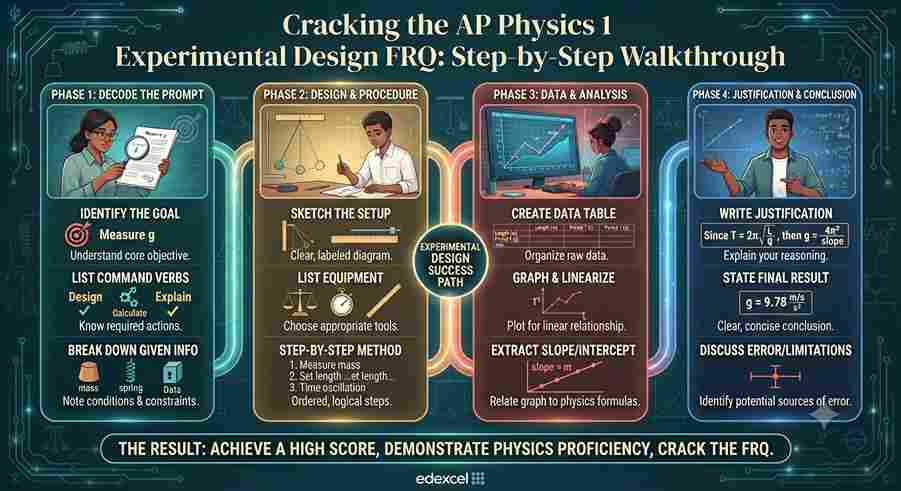
To consistently earn full credit on an experimental design prompt, use this systematic five-step execution framework:
Step 1: List Explicit Equipment and Draw a Diagram
Never write vague equipment lists like "use a timer and a ruler." Be exceptionally specific.
- Bad: "Measure time and distance."
- Good: "Measure the drop height using a meter stick with millimeter precision ($\pm 0.001\text{ m}$), and measure fall time using a digital electronic photogate timer connected to a release mechanism."
- Diagram Tip: Always sketch a clean, labeled diagram of your experimental setup. AP readers love clear diagrams; they often award points for correctly illustrating how sensors, tracks, masses, or spring scales are arranged.
Step 2: Define the Independent and Dependent Variables
Clearly state what you are intentionally changing (Independent Variable), what you are measuring in response (Dependent Variable), and what variables you must control (keep constant) to ensure a fair test.
- Example (Mass-Spring System): Independent variable = hanging mass $m$; Dependent variable = oscillation period $T$; Controlled variables = spring stiffness $k$ and amplitude of oscillation.
Step 3: Write a Step-by-Step Procedure
Your procedure must be clear enough for another student in your class to replicate your experiment exactly.
- Rule of Multiples: Always specify taking multiple trials for each data point (e.g., "Repeat the measurement three times for each mass and calculate the average time $t_{avg}$ to reduce human reaction time error").
- Logical Flow: Number your steps sequentially. Describe how you zero instruments, start measurements, and record data in a neat table.
Step 4: Plan the Data Analysis and Linearization
This is where most students lose points. The College Board almost always asks you to plot a graph that will yield a straight line ($y = mx + b$). If the theoretical relationship is non-linear (e.g., a power law or quadratic equation), you must linearize the data.
How to Linearize Data Like a Pro:
Suppose you are investigating the period of a pendulum, where theoretical physics tells us:
$$T = 2\pi \sqrt{\frac{L}{g}} \implies T^2 = \left(\frac{4\pi^2}{g}\right)L$$
If you plot $T$ versus $L$, you get a curve (parabola). To get a straight line:
- Define your vertical axis ($y$-axis) as $T^2$ (measured in $\text{s}^2$).
- Define your horizontal axis ($x$-axis) as $L$ (measured in $\text{m}$).
- The equation of your line becomes $y = (\frac{4\pi^2}{g})x$, which fits $y = mx$.
- Therefore, the slope ($m$) of your experimental graph equals $\frac{4\pi^2}{g}$, allowing you to solve for $g$ as $g = \frac{4\pi^2}{\text{slope}}$.
Step 5: Address Experimental Uncertainty and Reduction of Error
Conclude your design by explaining how you minimized systematic and random errors.
- Mention friction reduction (e.g., adding lubricating oil to axles or using an air track).
- Mention parallax error elimination (e.g., reading meter stick graduations at eye level).
- Mention air resistance mitigation for falling object experiments.
Part 3: Top 4 Traps That Cost AP Physics 1 Points
- Omitting Measuring Instruments: Forgetting to state how you will measure a quantity. Saying "Measure the velocity" earns zero points unless you specify "Measure velocity using a motion detector or by dividing photogate flag width by gate blocking time" ($v = \frac{d}{t}$).
- Plotting Non-Linear Graphs: Sketching a curved line on your graph axes when the prompt asks you to plot data that yields a straight line. Always show your algebraic derivation of how to square, invert, or square-root your variables to create a linear relationship.
- Failing to Control Variables: Ignoring external factors that could skew results (e.g., allowing temperature to fluctuate during a gas law or thermodynamics lab, or letting battery voltage drop during an electrical circuit experiment).
- Leaving Graph Axes Unlabeled: Sketching a blank graph without labeling the vertical and horizontal axes with both the physical quantity name and its correct SI units (e.g., $T^2 \text{ (s}^2\text{)}$ vs. $L \text{ (m)}$).
Preparing for AP Physics 1 exams and aiming for a top score of 5? EdFlik connects international school students globally with expert, 1-to-1 online AP physics tutors, helping you master experimental design FRQs, conquer mechanics and circuits, and build elite scientific reasoning skills. Book a Free Demo Class Today!
Frequently Asked Questions (FAQs)
Q1: What should I do if I am asked to measure something I haven't seen in class?
Ans: Don't panic! AP Physics 1 experimental design questions test your underlying scientific reasoning, not rote memorization of specific lab kits. Think about fundamental physical definitions: velocity is distance over time, force is mass times acceleration, and torque is force times radius. Build your measuring tools around those core principles.
Q2: Do I need to include a numerical calculation in an experimental design question?
Ans: Usually no. Unless the prompt specifically provides a sample data table with numbers and asks you to calculate a final experimental value (like experimental $g = 9.78\text{ m/s}^2$), your primary job is to write out a symbolic, algebraic procedure and explain how slope represents the target variable.
Q3: How strict are AP graders on experimental error descriptions?
Ans: AP graders look for specific, plausible sources of error rather than generic complaints. Avoid vague statements like "human error" or "I made a mistake reading the ruler." Instead, specify exact experimental limitations, such as "unaccounted rotational inertia of the pulley wheel" or "minor frictional drag from the table surface."
Q4: How does EdFlik support AP Physics students?
Ans: EdFlik connects international school students worldwide with vetted, expert 1-to-1 online AP tutors specializing in College Board curricula. Our personalized coaching focuses on dissecting past FRQ rubrics, mastering complex physics concepts, and practicing under timed exam conditions.