Database Normalization Made Simple: 1st, 2nd, and 3rd Normal Form in A-Level IT
Last Updated: October 2026 | By EdFlik Education Team
For high school students studying A-Level Information Technology (IT)—whether under the Cambridge International (9626) or Pearson Edexcel syllabus—relational database design is a core module that routinely appears on both structured practical papers and theory exams.
Among all database concepts, Normalization is the ultimate grade differentiator. When presented with a messy, unnormalized flat-file table containing student records, course enrolments, and teacher details, students are expected to break it down systematically through First Normal Form (1NF), Second Normal Form (2NF), and Third Normal Form (3NF).
Many capable students lose easy marks on normalization questions not because they don't understand computers, but because they confuse partial dependencies with transitive dependencies or fail to identify composite primary keys correctly.
In this comprehensive, exam-focused masterclass guide, our expert A-Level IT educators break down the mechanics of database normalization, expose common exam traps, and provide a step-by-step framework to help you secure an $A^*$ grade.
Part 1: Why Do We Need Normalization? (The Problem of Anomalies)
Before diving into the rules of normal forms, you must understand why databases need normalization.
Imagine a school storing all student and teacher data in a single massive spreadsheet table. Every time a student enrolls in a new subject, teacher details are repeated. This lack of structure leads to three major database anomalies:
- Insertion Anomaly: You cannot add new data (e.g., a new teacher or a newly created course) without also adding dummy student data, because mandatory fields would be left blank.
- Deletion Anomaly: If you delete the last student enrolled in a specific course, you accidentally wipe out all records of that course and its instructor from the database.
- Update Anomalies / Data Redundancy: If an instructor changes their phone number or office location, you have to update dozens or hundreds of duplicate rows. If you miss even one row, the database becomes inconsistent (data redundancy).
Normalization is the step-by-step process of organizing data into multiple related tables to eliminate redundancy and protect against these anomalies.
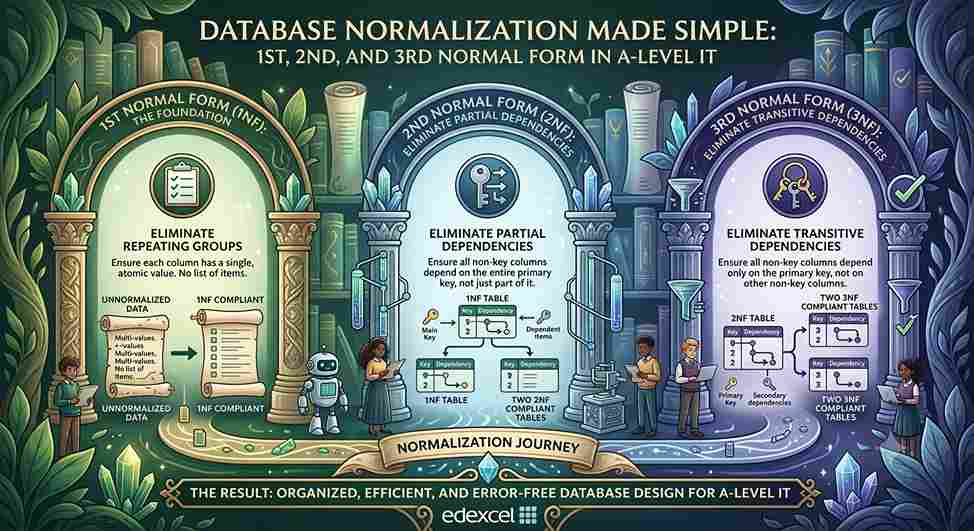
Part 2: First Normal Form (1NF) — Eliminating Repeating Groups
A table is in First Normal Form (1NF) if and only if it satisfies two strict rules:
1. The Rules of 1NF:
- Atomic Values: Every cell in the table must contain a single, atomic (indivisible) value. There must be no lists, arrays, or repeating groups within a single cell (e.g., a cell containing
Math, Physics, Chemistryviolates 1NF). - Unique Rows: Every row must be unique, and the table must have a defined Primary Key that uniquely identifies each record.
2. How to Transform a Table into 1NF:
- Identify repeating attributes or multi-valued cells.
- Break out the repeating groups into separate rows, duplicating the primary identifier for each entry, OR split them into a new linked table.
Part 3: Second Normal Form (2NF) — Removing Partial Dependencies
Once a table is in 1NF, you can test for Second Normal Form (2NF).
1. The Rule of 2NF:
- A table is in 2NF if it is already in 1NF, and all non-key attributes are fully dependent on the entire primary key.
2. What is a Partial Dependency?
Partial dependency occurs in tables with a composite primary key (a primary key made up of two or more attributes, such as StudentID + CourseID). If a non-key attribute (like StudentName or CourseFee) depends on only part of that composite key (e.g., StudentName depends only on StudentID, not on CourseID), you have a partial dependency.
3. How to Transform a Table into 2NF:
- Identify any composite primary keys.
- Isolate the attributes that depend on only part of the key.
- Move those attributes into a brand-new table along with the specific part of the primary key they depend on.
Part 4: Third Normal Form (3NF) — Eliminating Transitive Dependencies
Once a table is in 2NF, you can graduate to Third Normal Form (3NF), which is the standard benchmark required for relational database design in A-Level IT.
1. The Rule of 3NF:
- A table is in 3NF if it is already in 2NF, and there are no transitive dependencies.
2. What is a Transitive Dependency?
A transitive dependency occurs when a non-key attribute depends on another non-key attribute, rather than directly depending on the primary key.
- Example: Primary Key =
StudentID. Non-key attribute 1 =TeacherID. Non-key attribute 2 =TeacherOffice. Here,TeacherOfficedepends onTeacherID, which in turn depends onStudentID. Therefore,TeacherOfficeis transitively dependent on the primary key.
3. How to Transform a Table into 3NF:
- Identify non-key attributes that determine other non-key attributes.
- Extract those dependent attributes and their immediate determinant into a separate table, leaving a Foreign Key behind in the original table.
Part 5: Summary Table of Normal Forms
| Normal Form | Key Requirement | What It Eliminates |
| 1NF | Atomic values in every cell; unique rows with a primary key. | Repeating groups / multi-valued attributes. |
| 2NF | Must be in 1NF + no partial dependencies on a composite key. | Partial dependencies (attributes depending on only part of a compound key). |
| 3NF | Must be in 2NF + no transitive dependencies. | Transitive dependencies (non-key attributes depending on other non-key attributes). |
Part 6: Top 4 Traps That Cost A-Level IT Marks
- Confusing Primary Keys with Foreign Keys: Failing to define proper foreign keys when splitting tables in 2NF and 3NF, breaking relational integrity.
- Missing Composite Keys in 1NF/2NF: Forgetting to underline primary keys or composite primary keys in exam answers when asked to write out normalized relation schemas (e.g.,
Student(<u>StudentID</u>, StudentName, CourseID)). - Stopping at 2NF When 3NF is Required: Leaving transitive dependencies intact because the table passed the 2NF check, resulting in lost marks on structural questions.
- Creating Unnecessary Tables: Splitting attributes that share a direct, functional dependency with the primary key, cluttering the database design.
Preparing for A-Level IT exams and aiming for an $A^$ grade? EdFlik connects international school students globally with expert, 1-to-1 online A-Level IT and computer science tutors, helping you master database normalization, spreadsheet formulas, web authoring, and structured past-paper exam techniques. *Book a Free Demo Class Today!
Frequently Asked Questions (FAQs)
Q1: Can a database be normalized beyond 3NF?
Ans: Yes! Higher normal forms exist, such as Boyce-Codd Normal Form (BCNF), Fourth Normal Form (4NF), and Fifth Normal Form (5NF). However, for A-Level IT syllabi (Cambridge and Edexcel), 3NF is the highest level tested and is considered the optimal standard for operational databases.
Q2: What is the difference between a primary key and a foreign key?
Ans: A Primary Key is a unique identifier for a record within its own table. A Foreign Key is an attribute in one table that links to the primary key of another table, establishing a relational connection between them.
Q3: How do I know if an attribute is atomic in 1NF?
Ans: An attribute is atomic if it cannot be logically broken down further into smaller, meaningful sub-components for database querying. For example, FullName can sometimes be split into FirstName and LastName, while DateOfBirth is treated as atomic.
Q4: How does EdFlik support A-Level IT students?
Ans: EdFlik connects international school students worldwide with vetted, expert 1-to-1 online tutors specializing in Cambridge and Edexcel A-Level IT and Computer Science. Our personalized coaching focuses on clearing complex database normalization problems, mastering practical software applications, and practicing under timed exam conditions.