Demystifying Supply and Demand Curves: A Beginner’s Guide for IB MYP Humanities
Last Updated: October 2026 | By EdFlik Education Team
For students beginning their journey through the International Baccalaureate (IB) Middle Years Programme (MYP) Humanities and Individuals & Societies framework, economics introduces an entirely new way of thinking about the world. Whether you are investigating resource allocation, market systems, or global trade, one fundamental economic model underpins almost everything: Supply and Demand.
At first glance, economic graphs filled with intersecting lines, axes, and shifting curves can feel intimidating. However, supply and demand is simply a mathematical and visual representation of how human choices, prices, and desires interact every single day—from the price of video games and sneakers to global oil markets.
In this comprehensive, beginner-friendly masterclass guide, our expert MYP Humanities educators break down the laws of supply and demand, teach you how to read and draw economic graphs, and explain how market equilibrium is established.
Part 1: The Building Blocks — What is a Market?
In economics, a market is not necessarily a physical marketplace with fruit stalls; it is any arrangement where buyers and sellers come together to exchange goods and services.
Every market is driven by two opposing forces:
- Consumers (Demanders): People who want to buy goods and services and are willing to exchange money for them.
- Producers (Suppliers): Businesses and individuals who create goods and services to sell in exchange for profit.
Part 2: Demystifying the Demand Curve
1. The Law of Demand
Imagine your favorite chocolate bar or smartphone app suddenly doubles in price. What happens to your desire or ability to buy it? Naturally, you will buy fewer of them. This common-sense behavior is captured by the Law of Demand:
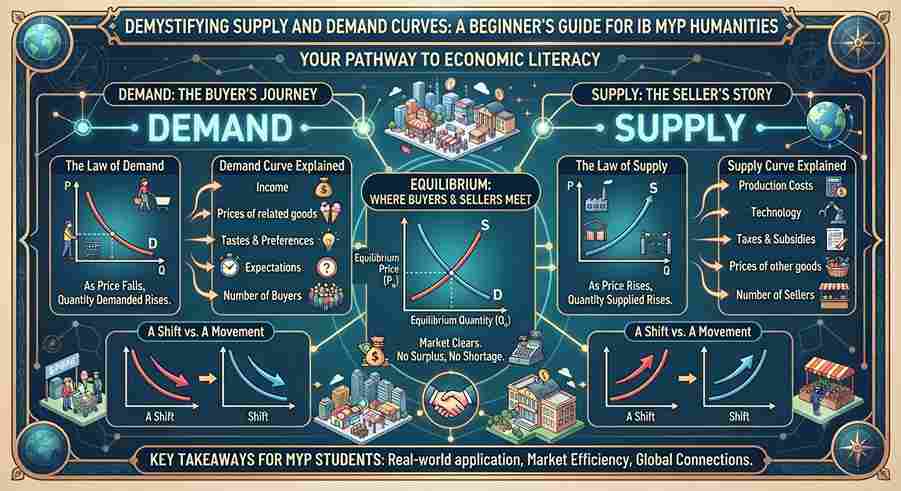
The Law of Demand states that, other things remaining equal (ceteris paribus), as the price of a good increases, the quantity demanded decreases. Conversely, as the price decreases, the quantity demanded increases.
This inverse relationship means the demand curve always slopes downwards from left to right.
2. Why Does the Demand Curve Slope Downward?
- The Income Effect: When prices drop, your purchasing power increases—your pocket money or income effectively stretches further, allowing you to buy more.
- The Substitution Effect: If the price of one brand of sneakers rises significantly, consumers will switch to a cheaper alternative brand, reducing demand for the expensive option.
Part 3: Demystifying the Supply Curve
1. The Law of Supply
Now, look at things from the perspective of the business owner or manufacturer. If the market price for selling handmade skateboards skyrockets, what will you want to do as a business? You will want to manufacture and sell as many skateboards as possible to maximize your profit. This is captured by the Law of Supply:
The Law of Supply states that, other things remaining equal (ceteris paribus), as the price of a good increases, the quantity supplied increases. Conversely, as the price decreases, the quantity supplied decreases.
This direct, positive relationship means the supply curve always slopes upwards from left to right.
Part 4: Bringing It Together — Market Equilibrium
What happens when consumers who want low prices meet producers who want high prices? They clash in the marketplace until they reach a compromise known as Equilibrium.
1. What is Equilibrium?
Equilibrium is the "sweet spot" where the quantity demanded equals the quantity supplied. On a graph, it is represented by the exact point where the downward-sloping Demand curve intersects the upward-sloping Supply curve.
- Equilibrium Price: The price at which buyers are willing to buy the exact same amount that sellers are willing to sell.
- Equilibrium Quantity: The total amount bought and sold at that perfect price.
2. Surpluses and Shortages
- Excess Supply (Surplus): If sellers set the price too high, consumers buy very little, leaving producers with unsold goods. To get rid of inventory, sellers are forced to lower their prices down toward equilibrium.
- Excess Demand (Shortage): If sellers set the price too low, everyone wants to buy the item, causing empty shelves. Frustrated consumers are willing to pay more, driving prices back up toward equilibrium. Markets naturally self-correct!
Part 5: Top 4 Traps That Cost Students MYP Marks
- Confusing "Change in Quantity Demanded" with "Change in Demand": A change in price causes movement along the existing demand curve. A change in non-price factors (like consumer income, fashion trends, or advertising) causes the entire curve to shift left or right.
- Drawing Curves the Wrong Way: Forgetting that Demand slopes down (like a slide) and Supply slopes up (like a hill).
- Omitting Axis Labels: Drawing graphs without labeling the vertical axis ($P$ for Price) and the horizontal axis ($Q$ for Quantity) loses easy marks on MYP assessments.
- Forgetting "Ceteris Paribus": Assuming prices change in isolation without acknowledging that external economic conditions can influence buyer and seller behavior.
Struggling with IB MYP Humanities concepts, economic inquiry cycles, or assessment criteria? EdFlik connects international school students globally with expert, 1-to-1 online humanities tutors, helping you master economic models, graph analysis, and structured writing to secure top MYP achievement levels.Book a Free Demo Class Today!
Frequently Asked Questions (FAQs)
Q1: What does "ceteris paribus" mean in economics?
Ans: It is a Latin phrase meaning "all other things being equal." Economists use it when analyzing the effect of one variable (like price) while assuming everything else that could affect the market remains constant.
Q2: Can the supply or demand curve shift entirely?
Ans: Yes! Non-price factors—such as a new technological invention, a natural disaster, or a sudden change in consumer preferences—will cause the entire curve to shift to the right (increase) or left (decrease).
Q3: How does economics fit into the IB MYP Humanities curriculum?
Ans: Economics in MYP Individuals & Societies helps students develop critical thinking, financial literacy, and global citizenship by examining how resources are allocated and how human choices shape local and global societies.
Q4: How does EdFlik support IB MYP Humanities students?
Ans: EdFlik connects international school students worldwide with vetted, expert 1-to-1 online tutors specializing in IB MYP Humanities, Individuals & Societies, and economics. Our personalized sessions focus on clarifying complex graph mechanics, inquiry-based projects, and assessment preparation.