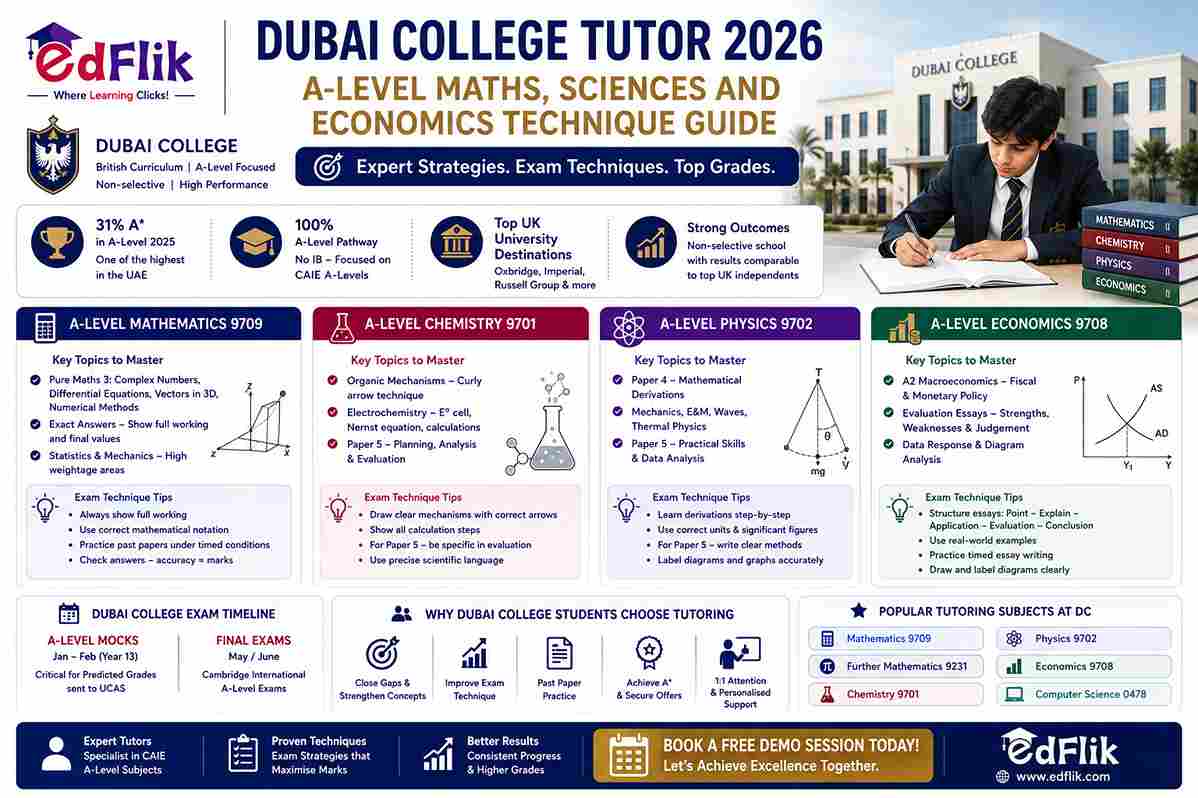
Dubai College Entrance Maths Module 2026 — Problem-Solving, Mental Arithmetic and Adaptive Format Guide
The Dubai College entrance exam Maths module is specifically designed to assess mathematical problem-solving ability — not just curriculum knowledge. Many Year 6 students who perform well in school Maths find the DC module harder than expected, because it presents familiar mathematical content in unfamiliar, multi-step problem-solving contexts and at speed without a calculator. This guide covers the core content areas, the most common problem types, and how to develop the mental arithmetic speed and problem-solving flexibility the module demands.
Maths Content by Priority Level
|
Content Area |
Priority |
Year Level |
Most Common
DC Question Format |
|
Times tables
and mental multiplication |
Critical — no
calculator |
Year 4-5 |
Direct
calculation or embedded in word problem (e.g. "27 students each need 4
exercise books. How many books altogether?") |
|
Fractions,
decimals, percentages |
Critical |
Year 5-6 |
Convert
between forms; find percentage of quantity; percentage increase/decrease |
|
Multi-step
word problems |
Critical |
Year 5-7 |
2-3 step
problems requiring selecting the correct operation at each step |
|
Ratio and
proportion |
Important |
Year 6-7 |
Sharing in a
ratio; finding one quantity given another in a ratio |
|
Area and
perimeter |
Important |
Year 5-6 |
Composite
shapes; finding a missing dimension given area |
|
Data
interpretation |
Important |
Year 5-6 |
Reading bar
charts, pie charts, tables for specific values; calculating differences and
totals |
|
Basic algebra |
Supporting |
Year 7 |
Function
machines; finding missing values; simple linear equations |
|
Angles and
geometry |
Supporting |
Year 5-6 |
Angles in
triangles/quadrilaterals; angles on a straight line; basic circle questions |
Mental Arithmetic — The No-Calculator Challenge
The DC entrance exam does not provide a calculator. Every calculation must be done mentally or in head. The most important mental arithmetic skills to build:
• Times tables to 12×12 — instant recall: not counted on fingers, not computed — the answer appears immediately. This underpins every other calculation. Any gap here slows every problem.
• Multiplying two-digit numbers mentally: 24 × 15 = 24 × 10 + 24 × 5 = 240 + 120 = 360. The method: split the second number into its constituent parts. This applies to all DC multiplication questions.
• Percentage calculations without a calculator: 15% of 80 = 10% of 80 + 5% of 80 = 8 + 4 = 12. The method: always find 10% first (divide by 10), then build up from that.
• Converting between fractions, decimals, and percentages fluently: 3/8 = 0.375 = 37.5%. Know the common conversions (1/4 = 0.25 = 25%; 1/3 ≈ 0.333 = 33.3%; 3/5 = 0.6 = 60%) instantly.
The Problem-Solving Method — Breaking Down Multi-Step Questions
DC Maths word problems typically require 2-3 operations in sequence. The most consistent error: performing the right operations in the wrong order, or missing one step entirely. The approach:
• Step 1 — Underline the question: what are you being asked to find? (not what is the question about)
• Step 2 — Identify what information is given: list the numbers and what they represent
• Step 3 — Plan the operations: what needs to happen first? second? Do you need to find a total before finding a fraction of it?
• Step 4 — Calculate step by step: do not try to do all steps in your head simultaneously
• Step 5 — Check the answer makes sense: is the answer the right order of magnitude? the right unit?
Adaptive Format — Year 7 Content for Top Scores
Students who answer the first 8-10 Maths questions correctly are presented with Year 7-level questions. Preparing Year 6 students for this possibility requires introducing:
• Ratio problems at Year 7 level: "Cement, sand, and gravel are mixed in the ratio 1:3:5. If 18 kg of sand is used, how much gravel is needed?" (answer: 30 kg — sand is 3 parts = 18 kg, so 1 part = 6 kg, and gravel at 5 parts = 30 kg)
• Simple algebraic equations: "Find the value of x if 3x + 7 = 22" (answer: x = 5) — basic linear equations arising in context
• Multi-step percentage problems: "A price of AED 240 is increased by 15% and then reduced by 10%. What is the final price?" (answer: AED 248.40 — this requires two sequential percentage calculations)
|
EdFlik DC
entrance Maths preparation covers all Year 5-7 content with emphasis on
mental arithmetic speed and problem-solving approach, including adaptive
challenge content for Year 6 students targeting the top score band. From AED
60. Free diagnostic. Book at www.edflik.com or WhatsApp +91 88788 96600. |
Frequently Asked Questions
Q: What does the Dubai College entrance exam Maths module test?
Year 5-7 maths in problem-solving context — number operations, multi-step word problems, data interpretation, basic algebra, geometry, and ratio/proportion. Adaptive: top performers encounter Year 7-8 questions.
Q: Is a calculator allowed in the Dubai College Maths module?
No — the exam is computer-based and no calculator is provided. Mental arithmetic fluency is essential. Times tables, percentage calculation methods, and mental multiplication must be automatic.
Q: What level of maths should a Year 6 student know for DC entry?
Instant times tables; mental multiplication and division; fractions, decimals, and percentages; area and perimeter; basic angles; probability; data interpretation. Top students also need ratio, proportion, and simple algebra (Year 7 content).
Q: How does the adaptive format affect the Maths module?
Correct answers trigger harder questions — top performers encounter Year 7+ material including ratio, algebra, and multi-step percentage problems. Preparation should cover secure Year 6 content AND introduce Year 7 content for students targeting top scores.
Q: What Maths problem-solving types appear in the DC entrance exam?
Multi-step word problems, ratio and proportion, percentage problems in context, time/speed/distance calculations, data interpretation (charts, graphs), pattern sequences, and simple algebra.