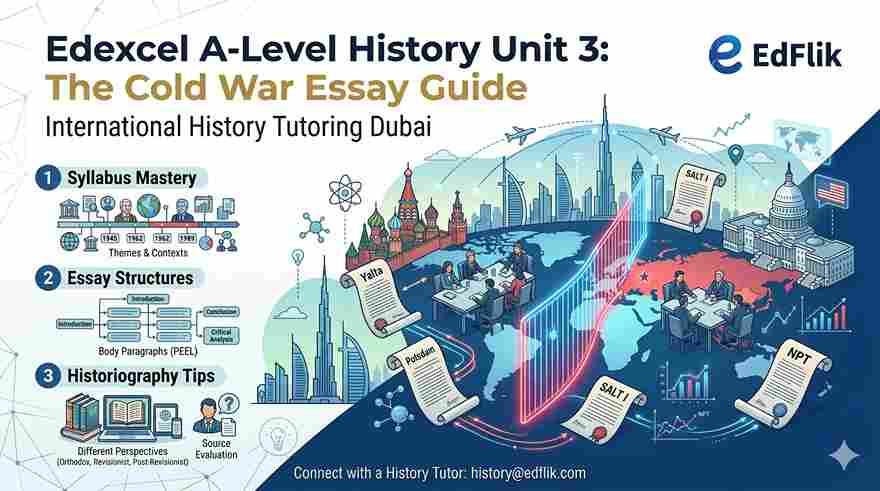
Edexcel A-Level history unit 3 notes, Cold War essay writing guide, international history tutoring Dubai
Last Updated: September 2026 | By EdFlik Education Team
For students studying Pearson Edexcel International A-Level (IAL) History, Unit 3 (Thematic Study with Source Evaluation)—particularly options focusing on the Cold War, such as The World Divided: Superpower Relations, 1943–90—represents the pinnacle of historical scholarship in secondary education. Unlike AS-Level breadth studies that focus on narrative recall, Unit 3 demands rigorous analytical depth, sophisticated source evaluation, and highly structured argumentative essay writing.
Many students possess a strong grasp of Cold War chronology (from the Yalta Conference and the Berlin Blockade to the Cuban Missile Crisis and the collapse of the Soviet Union) but struggle to translate that knowledge into top-band examination essays. Examiners are not looking for a simple story of what happened; they want to see a sustained, critical evaluation of causation, change, and significance.
In this comprehensive guide, our expert Edexcel A-Level History tutors break down core Unit 3 revision themes, masterclass strategies for Cold War essay writing, and explain how working with an expert international history tutoring Dubai provider can help you secure an $A^*$.
Part 1: Core Revision Themes — The Cold War (1943–1990)
To excel in Unit 3, you must master both the overarching thematic developments and the specific historiographical debates that characterize superpower relations.
1. Origins and Escalation (1943–1953)
- The Breakdown of Wartime Alliance: Analyze the ideological and geopolitical clash between Western capitalism/democracy and Soviet communism. Examine key turning points including the Tehran, Yalta, and Potsdam conferences, Churchill's Iron Curtain speech (1946), the Truman Doctrine, the Marshall Plan, and the Berlin Blockade and Airlift (1948–49).
- The Historiographical Debate: Be prepared to evaluate different historical interpretations:
- Orthodox View: Blames Soviet expansionism and Stalin's aggressive pursuit of security and ideology in Eastern Europe.
- Revisionist View: Blames American economic imperialism and Truman’s aggressive diplomacy for forcing the Soviet Union into a defensive posture.
- Post-Revisionist View: Views the Cold War as a tragic series of mutual misperceptions, security dilemmas, and bureaucratic inertia rather than single-sided villainy.
2. Peaceful Coexistence and Confrontation (1953–1979)
- The Khrushchev Era and Crises: Explore Nikita Khrushchev’s policy of Peaceful Coexistence, the De-Stalinization speech (1956), the Hungarian Uprising, the construction of the Berlin Wall (1961), and the brinkmanship of the Cuban Missile Crisis (1962).
- Detente and Arms Control: Examine why both superpowers sought relaxation of tensions in the 1970s (SALT I, Helsinki Accords), and analyze why detente ultimately collapsed following the Soviet invasion of Afghanistan in 1979 and the election of Ronald Reagan.
3. The Second Cold War and the Collapse of Communism (1979–1990)
- Reagan and the "Evil Empire": Analyze the resurgence of Cold War tensions in the early 1980s, the Strategic Defense Initiative (SDI), and the Reagan Doctrine.
- Gorbachev’s New Thinking: Evaluate the internal economic and political crises of the USSR, and how Mikhail Gorbachev's policies of Glasnost (openness) and Perestroika (restructuring) inadvertently triggered the collapse of the Eastern Bloc, the fall of the Berlin Wall (1989), and the dissolution of the Soviet Union in 1991.
Part 2: Masterclass on Edexcel Unit 3 Cold War Essay Writing
Edexcel Unit 3 essays (typically carrying high tariff points) require a disciplined, analytical architecture. You cannot afford to write unstructured, narrative-heavy responses.
1. The Anatomy of a Top-Band Essay
- Introduction (Approx. 100–150 words):
- Define the core terms of the prompt immediately.
- Acknowledge the complexity of the historical debate.
- Set out a clear, overarching thesis statement that directly answers the question.
- The Thematic Body Paragraphs (PEEL / Argument-Driven):
- Point: State your analytical point (e.g., "Economic stagnation was the primary catalyst for Gorbachev's reforms rather than external military pressure").
- Evidence: Deploy precise historical evidence, dates, treaties, and key actors.
- Explanation & Historiography: Explain how this evidence proves your point, and weave in historian perspectives where appropriate.
- Link: Directly tie the paragraph back to the essay prompt.
- The Conclusion (Approx. 100–150 words):
- Do not just summarize your points; synthesize your argument.
- Provide a definitive, nuanced judgment addressing the "extent to which" or "how far" phrasing of the prompt.
Part 3: The Advantage of International History Tutoring in Dubai
Edexcel A-Level History is notoriously rigorous. Scoring an $A^*$ requires moving beyond memorization to master sophisticated essay technique and critical source evaluation.
Collaborating with a specialized provider of international history tutoring Dubai offers targeted advantages:
- Essay Structuring Drills: Learning how to plan a balanced, multi-perspective essay in under 10 minutes.
- Historiographical Fluency: Integrating named historians (e.g., John Lewis Gaddis, Eric Hobsbawm, Robert Service) naturally into your arguments to impress examiners.
- Timed Past Paper Practice: Practicing under strict exam conditions to eliminate rushed conclusions and poor time management.
Part 4: Top 4 Strategies to Secure an A* in Edexcel A-Level History
- Answer the Exact Question Set: The #1 reason students drop marks is "question drift"—writing everything they know about the Cold War instead of answering the specific prompt (e.g., writing about nuclear arms races when asked about economic factors).
- Integrate Historiography Critically: Do not just drop historian names like window dressing. Explain why a particular historian holds their view based on available archival evidence or ideological background.
- Maintain a Balanced Argument: Every major argument should consider counter-evidence. If you argue that the arms race bankrupted the USSR, acknowledge the counter-argument regarding internal structural flaws in the command economy.
- Prioritize Quality Over Quantity: Examiners prefer three deeply analyzed, well-evidenced paragraphs over five rushed, descriptive paragraphs. Depth wins top bands.
Struggling with Edexcel A-Level History Unit 3, Cold War essay structures, or source analysis? EdFlik offers expert, 1-to-1 online tutoring customized specifically for international school students across Dubai and the UAE, helping you build historical analytical confidence and secure an $A^$.*Book a Free Demo Class Today!
Frequently Asked Questions (FAQs)
Q1: How important is historiography in Edexcel A-Level History Unit 3?
Ans: Historiography is crucial for achieving top bands (Levels 4 and 5). Examiners expect you to demonstrate awareness that history is an interpretive discipline by discussing differing historian viewpoints on key controversies like the origins of the Cold War.
Q2: How should I manage my time during the Unit 3 exam?
Ans: Time management is vital. Spend approximately 10 minutes planning each essay (mapping out your thesis, key evidence, and historiography) and 35–40 minutes writing. Never leave an essay unfinished.
Q3: Can I use bullet points or abbreviations in my A-Level History essays?
Ans: No. Edexcel History essays must be written in formal, continuous prose using full academic English. Avoid bullet points, informal abbreviations, and conversational language entirely.
Q4: How can EdFlik help me find an expert history tutor in Dubai?
Ans: EdFlik connects students across Dubai and the UAE with vetted, experienced 1-to-1 online tutors specializing in Pearson Edexcel International A-Level History. Our personalized sessions focus on clarifying complex historical debates, structuring high-scoring essays, and mastering exam technique.