Edexcel IAL Statistics 1 notes, hypothesis testing guide A-Level, math tutoring Abu Dhabi
Last Updated: September 2026 | By EdFlik Education Team
For students studying Pearson Edexcel International A-Level (IAL) Mathematics, Statistics 1 (WST01 / S1) is one of the most practical and heavily rewarding applied modules. While Pure Mathematics builds abstract algebraic fluency, Statistics 1 teaches students how to organize raw data, calculate probabilities, analyze random variables, and make statistically significant decisions using hypothesis testing.
Among all topics in the S1 syllabus, Hypothesis Testing is the crown jewel—carrying significant point weight on exam papers and often serving as the culmination of the entire course. Many students lose easy marks not because the math is overly complex, but because they misinterpret critical regions, confuse one-tailed and two-tailed tests, or fail to write precise contextual conclusions.
In this comprehensive guide, our expert Edexcel IAL Mathematics tutors break down core S1 revision notes, a step-by-step masterclass on hypothesis testing, and why targeted support from an expert math tutoring Abu Dhabi service can unlock your $A^*$.
Part 1: S1 Core Revision Notes — Probability and Random Variables
Before diving into hypothesis testing, you must master the foundational building blocks of Statistics 1.
1. Representation and Summary of Data
- Measures of Location and Spread: Mastering mean, median, mode, variance ($s^2$ or $\sigma^2$), and standard deviation ($\sigma$). Be comfortable calculating these from both raw data and frequency tables.
- Skewness: Understanding positive skew ($\text{Mean} > \text{Median} > \text{Mode}$) versus negative skew ($\text{Mean} < \text{Median} < \text{Mode}$), alongside Karl Pearson’s coefficient of skewness:$$\text{Skewness} = \frac{3(\text{Mean} - \text{Median})}{\text{Standard Deviation}}$$
2. Probability and Discrete Random Variables
- Venn Diagrams and Probability Laws: Mastering addition rules ($P(A \cup B) = P(A) + P(B) - P(A \cap B)$), conditional probability ($P(A\vert{}B) = \frac{P(A \cap B)}{P(B)}$), and independence ($P(A \cap B) = P(A) \times P(B)$).
- Probability Distributions: Ensuring that the sum of all probabilities in a discrete probability distribution equals $1$ ($\sum P(X = x) = 1$). Calculating expected value $E(X)$ and variance $\text{Var}(X)$ using:$$E(X) = \sum x P(X = x)$$$$\text{Var}(X) = E(X^2) - [E(X)]^2$$
Part 2: The Ultimate Hypothesis Testing Guide for S1
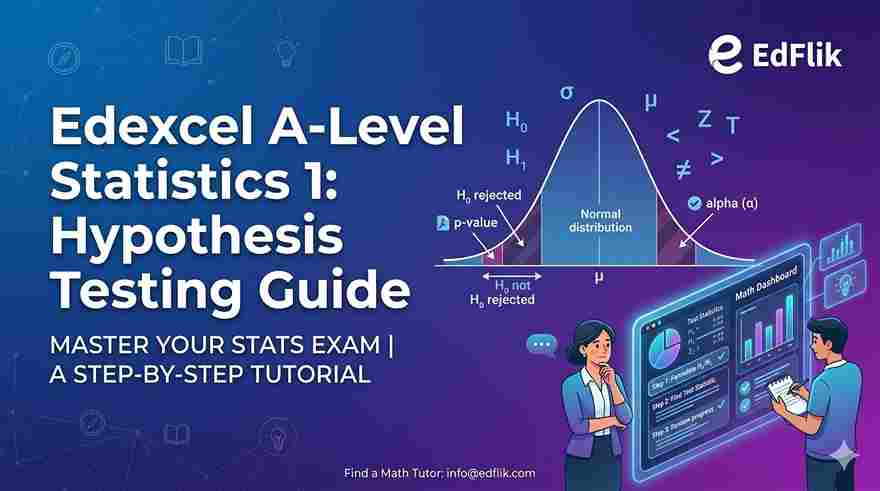
Hypothesis testing is a statistical procedure used to determine whether there is enough evidence in a sample of data to reject a preconceived null hypothesis in favor of an alternative hypothesis.
1. Key Terminology You Must Know
- Null Hypothesis ($H_0$): The assumption that there is no change, no effect, or that a parameter remains at its default/status quo value (e.g., $H_0: p = 0.2$).
- Alternative Hypothesis ($H_1$): What you believe is true if the null hypothesis is rejected. Can be one-tailed ($p < \hat{p}$ or $p > \hat{p}$) or two-tailed ($p \neq \hat{p}$).
- Significance Level ($\alpha$): The probability of rejecting the null hypothesis when it is actually true (Type I error). Common levels in S1 are $5\%$ ($0.05$), $10\%$ ($0.10$), or $1\%$ ($0.01$).
- Critical Region: The range of values that would lead you to reject $H_0$.
- Actual Significance Level: The true probability of falling in the critical region under the binomial distribution.
2. Step-by-Step Approach to Solving Hypothesis Testing Questions
When an exam question asks you to test a claim at a $5\%$ significance level using a binomial distribution $X \sim B(n, p)$, follow this exact 4-step structure:
- Define the Parameter and Hypotheses Clearly:
- Let $p$ be the probability of a successful outcome.
- $H_0: p = 0.3$
- $H_1: p < 0.3$ (Stating whether it is one-tailed or two-tailed).
- State the Distribution Under $H_0$:
- Assume $X \sim B(20, 0.3)$.
- Calculate the Probability (or Find the Critical Region):
- For a given observed test statistic (e.g., $x = 3$), calculate $P(X \le 3)$ using cumulative binomial probability tables or your calculator.
- Compare this calculated probability ($p$-value) against the significance level (e.g., compare $0.107$ with $0.05$).
- Write a Contextual Conclusion:
- If probability > significance level: "There is insufficient evidence to reject $H_0$. There is no reason to suspect a change in the proportion."
- If probability < significance level: "There is sufficient evidence to reject $H_0$. There is significant evidence to suggest that..." (Always write your conclusion in the context of the question, mentioning the actual scenario, whether it's faulty items, customer preferences, or medical trials).
Part 3: The Advantage of Professional Math Tutoring in Abu Dhabi
Edexcel IAL Statistics 1 is notoriously unforgiving with phrasing. A student might calculate the correct numerical probability but lose all marks because they failed to define their hypotheses correctly or wrote an ambiguous conclusion.
Partnering with an expert provider of math tutoring Abu Dhabi gives students a distinct competitive edge:
- Targeted Conceptual Clarity: Breaking down tricky probability rules and binomial cumulative functions until they become second nature.
- Past Paper Drill-Down: Working through years of official Edexcel S1 past papers under timed conditions to eliminate careless arithmetic errors.
- Exam Technique Mastery: Learning how examiners award method ($M$) and accuracy ($A$) marks so you never leave easy points on the table.
Part 4: Top 4 Strategies to Secure an A* in Edexcel S1
- Always Define Your Variables First: Never start calculating probabilities without explicitly writing down what your random variable $X$ represents (e.g., "Let $X$ be the number of defective batteries in a sample of 50").
- Double-Check One-Tailed vs. Two-Tailed Tests: If a two-tailed test is requested at a $5\%$ significance level, remember to split your significance level in half ($2.5\%$ on each tail) when finding critical values. This is the #1 trap where students lose marks.
- Show Full Probability Workings: Even if your final decimal calculation is slightly off due to a calculator entry error, clear writing of your formula and binomial expansion steps ensures you secure partial method marks.
- Memorize Expectation Formulae: Ensure you are fluent in using $E(aX + b) = aE(X) + b$ and $\text{Var}(aX + b) = a^2\text{Var}(X)$. These properties appear frequently in S1 structured questions.
Struggling with Edexcel IAL Statistics 1, hypothesis testing, probability distributions, or preparing for your upcoming exams in the UAE? EdFlik offers expert, 1-to-1 online tutoring customized specifically for international mathematics curricula, helping you build analytical confidence and secure an $A^$.*Book a Free Demo Class Today!
Frequently Asked Questions (FAQs)
Q1: Is Edexcel IAL Statistics 1 a calculator or non-calculator exam?
Ans: Pearson Edexcel International A-Level Mathematics exams (including Statistics 1) permit the use of approved scientific and graphical calculators across all papers. However, you must still show full statistical working, hypotheses statements, and contextual conclusions to earn full credit.
Q2: How do I know whether to use a one-tailed or two-tailed hypothesis test?
Ans: Read the wording of the alternative hypothesis ($H_1$). If the question asks if there has been an increase or a decrease, use a one-tailed test ($>$ or $<$). If the question asks if there has simply been a change or if the proportion is different, use a two-tailed test ($\neq$).
Q3: What is the difference between a Type I and Type II error in S1?
Ans: A Type I error occurs when you incorrectly reject a true null hypothesis. A Type II error occurs when you incorrectly accept (fail to reject) a false null hypothesis. (Note: Type II errors are typically covered in further statistics modules, but understanding Type I error bounds is essential for S1).
Q4: How can EdFlik help me find the best math tutor in Abu Dhabi?
Ans: EdFlik connects students across Abu Dhabi, Dubai, and the UAE with vetted, experienced 1-to-1 online tutors specializing in Edexcel IAL Mathematics. Our personalized sessions focus on clarifying difficult topics, working through past papers, and refining exam technique.