GCSE vs IGCSE — Which Is Right for Your Child in UAE Schools 2026
One of the most consistently asked education questions in UAE parent communities is: what is the difference between GCSE and IGCSE, and which one does my child's school use? This guide gives UAE parents a definitive, practical answer — why UAE schools use IGCSE, how it compares academically, and what it means for university applications.
The Short Answer for UAE Parents
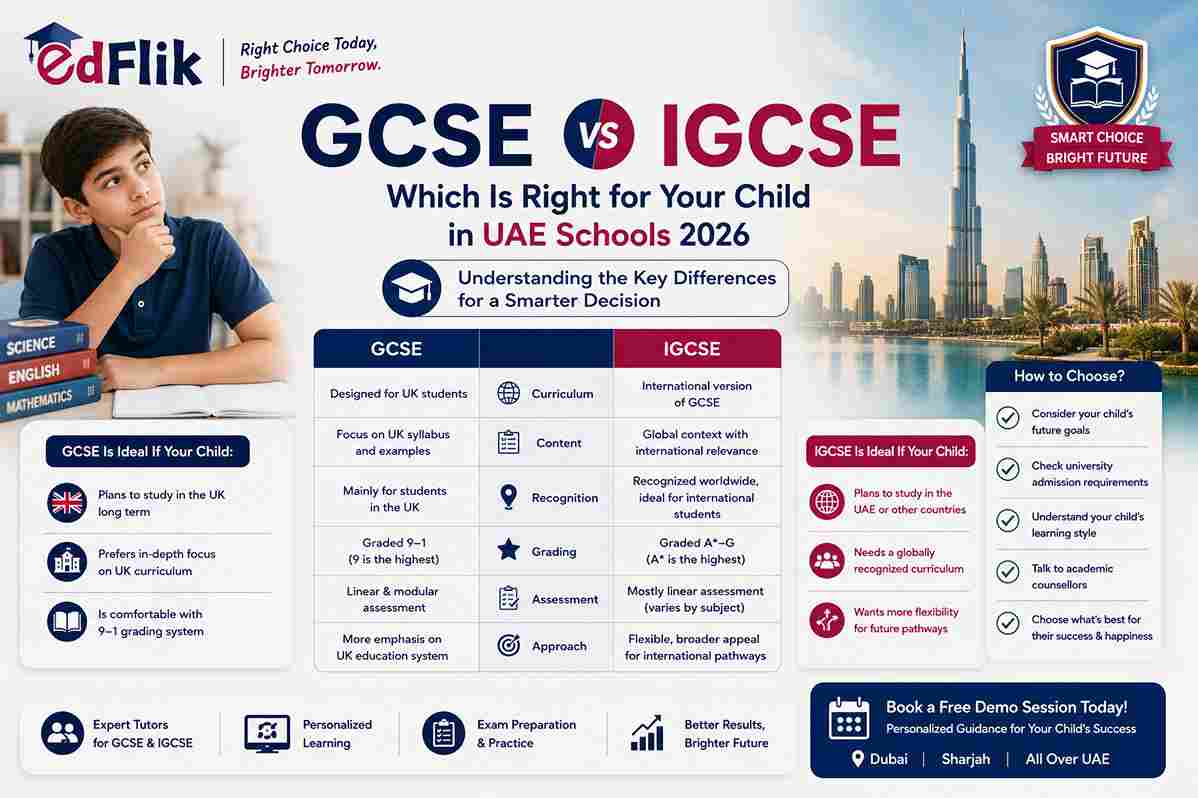
If your child attends a British curriculum private school in Dubai, Abu Dhabi, Sharjah, or anywhere else in the UAE, they are almost certainly sitting IGCSE — not GCSE. Standard GCSE is designed for students in England, Wales, and Northern Ireland and is regulated by the UK's Ofqual authority. IGCSE is Cambridge's and Edexcel's internationally delivered version of the same qualification, designed for students studying abroad.
|
Standard GCSE
(AQA, OCR, Edexcel GCSE) is not available to UAE students. It is an
England-regulated qualification delivered only in UK schools. What UAE
British curriculum students sit is IGCSE — and it is accepted by UK
universities as the direct equivalent of GCSE. |
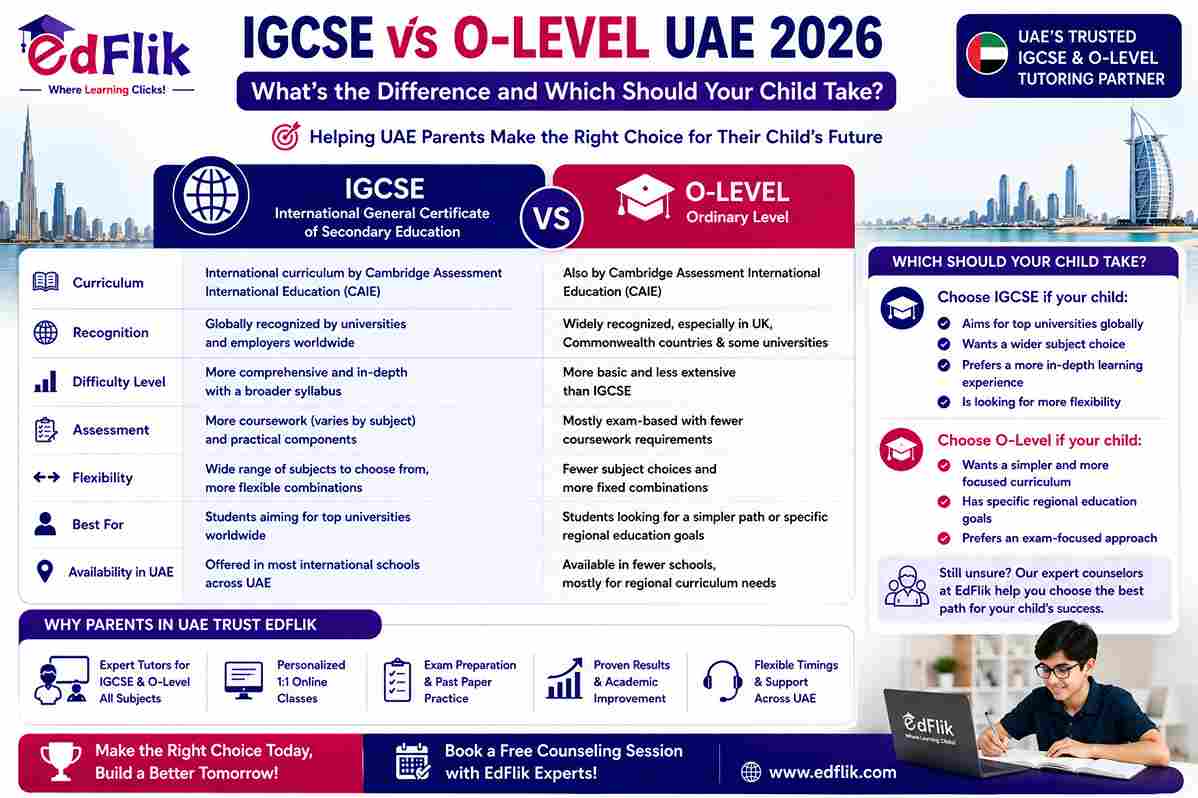
GCSE vs IGCSE — A Direct Comparison
|
Feature |
GCSE (England
only) |
IGCSE
(International — including UAE) |
|
Who delivers
it |
AQA, OCR,
Edexcel — England-regulated by Ofqual |
Cambridge CAIE
(0580, 0620 etc.) or Edexcel International (4MA1 etc.) |
|
Where
available |
England,
Wales, Northern Ireland only |
International
schools worldwide including all UAE |
|
Coursework |
Some subjects
include controlled assessment or coursework |
Most IGCSE
subjects are fully exam-based — no coursework |
|
UK-specific
content |
History,
English Literature, Geography often include UK-specific topics |
Syllabuses are
internationally neutral — no UK-centric content assumption |
|
Grading |
1–9 scale (9
highest) since 2017 reform |
A*–G scale (A*
highest) — some subjects now also offer 1–9 |
|
University
recognition |
Accepted by
all UK and international universities |
Accepted by
all UK and international universities — full equivalence |
Why UAE Schools Use IGCSE — The Specific Reasons
The reason is straightforward: IGCSE is designed for an internationally diverse student body, while GCSE assumes a UK-resident student with UK cultural context. Specific differences that matter:
• History IGCSE does not assume familiarity with UK political history — syllabus options include modern world history, colonial history, and 20th-century global events equally accessible to students from India, the Philippines, or Lebanon
• English Literature IGCSE does not require the same spoken language endorsement GCSE English requires, because consistent assessment outside UK-regulated environments cannot be guaranteed
• Science IGCSEs include an Alternative to Practical paper that can replace an actual practical exam — important for schools that cannot guarantee fully equipped laboratory conditions
Grading: A*–G vs 1–9
The most visible difference for parents comparing GCSE and IGCSE is the grading scale. Most IGCSE subjects use the A*–G scale. In England, GCSE reformed to a 1–9 numerical scale after 2017 (9 = highest, roughly equivalent to A*). The table below shows the equivalence:
|
IGCSE Grade
(A*–G) |
GCSE
Equivalent (1–9) |
What It Means
for University Entry |
|
A* |
8–9 |
Outstanding —
benchmark for competitive university courses |
|
A |
7 |
Strong —
minimum for competitive A-Level subject entry at most schools |
|
B |
5–6 |
Good — most
A-Level entries accept B with a strong school record |
|
C |
4 |
Pass — minimum
for most university entry requirements and A-Level progression |
|
D |
3 |
Below typical
threshold — unlikely to support A-Level entry in that subject |
What This Means for University Applications
For UK university applications, Cambridge IGCSE and Edexcel IGCSE grades are accepted as direct equivalents to GCSE grades by all universities including Russell Group and Oxbridge. A UAE student with Cambridge IGCSE A* in Maths, Chemistry, and Biology is assessed on exactly the same basis as a UK student with GCSE 9 in the same subjects.
For US university applications via Common App, IGCSE results are reported as international qualifications, and universities assess them in the international student context alongside A-Level or IB predicted grades.
|
EdFlik
provides curriculum-specialist tutoring for Cambridge IGCSE (CAIE) and
Edexcel IGCSE across all subjects and all 7 UAE emirates. From AED 45
(primary) to AED 60–80 (IGCSE). Free diagnostic trial. Book at www.edflik.com
or WhatsApp +91 88788 96600. |
Frequently Asked Questions
Q: What is the difference between GCSE and IGCSE?
GCSE is the England-regulated qualification for UK students. IGCSE is Cambridge's and Edexcel's internationally delivered version with internationally neutral content. Both are equivalent for university entry.
Q: Why do UAE schools use IGCSE instead of GCSE?
Standard GCSE is regulated by Ofqual and designed for UK delivery only. IGCSE is specifically designed for international schools and avoids UK-specific content assumptions.
Q: Is IGCSE harder than GCSE?
Broadly equivalent. IGCSE is often fully exam-based with no coursework. UK universities treat IGCSE grades as equivalent to GCSE for entry purposes.
Q: Is IGCSE recognised by UK universities?
Yes — Cambridge IGCSE and Edexcel IGCSE are fully recognised by all UK universities including Russell Group and Oxbridge as equivalent to GCSE.
Q: Can UAE students get GCSE rather than IGCSE?
No — standard UK GCSE is England-regulated and not available to UAE students. IGCSE is what all UAE British curriculum schools offer, and it is fully accepted worldwide as GCSE equivalent.