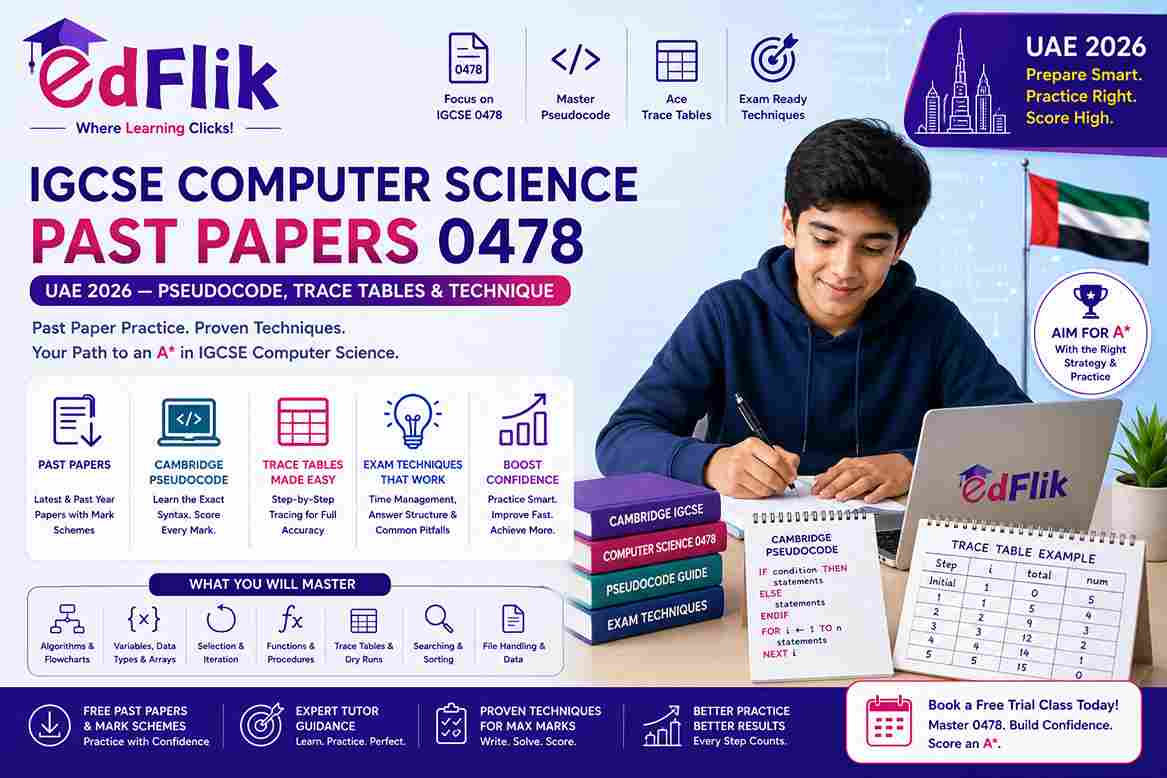
IGCSE Computer Science Past Papers 0478 UAE 2026 — Pseudocode, Trace Tables & Technique
IGCSE Computer Science is the fastest-growing IGCSE subject in UAE schools — driven by the UAE's national AI and coding education mandate, by the growing availability of Computer Science at British-curriculum schools, and by the genuine demand from UAE families who recognise that computing skills are foundational for the careers their children will enter. Yet it is also one of the most consistently misunderstood subjects by students who are already good programmers: the examination tests Cambridge's own pseudocode language, not any real programming language, and students who programme fluently in Python regularly underperform in Paper 2 because they write Python syntax where Cambridge requires its own format.
Cambridge IGCSE Computer Science 0478 — Paper Structure
|
Paper |
Duration |
Marks |
Content |
Most Common
UAE Entry |
|
Paper 1 — Theory |
1 hr 30 min |
75 |
Hardware/software, data representation, networking, security,
Boolean logic, databases, algorithms |
Yes — all UAE IGCSE CS students |
|
Paper 2 — Problem Solving and Programming |
1 hr 45 min |
75 |
Cambridge pseudocode algorithms, trace tables, debugging, program
structure, searching and sorting |
Yes — all UAE IGCSE CS students |
Cambridge Pseudocode — The Most Important Thing UAE Students Must Learn
Cambridge IGCSE Computer Science uses its own specific pseudocode notation. Every student must download the official Cambridge Pseudocode Guide from the Cambridge International website and treat it as the definitive reference for every Paper 2 answer. Key syntax differences from common programming languages:
|
Concept |
Cambridge
Pseudocode (REQUIRED) |
Python (WRONG
for Cambridge) |
JavaScript
(WRONG for Cambridge) |
|
Assignment |
x ← 5 |
x = 5 |
let x = 5 |
|
Variable declaration |
DECLARE x : INTEGER |
(no declaration needed) |
let x, var x |
|
IF statement |
IF x > 5 THEN ... ELSE ... ENDIF |
if x > 5: ... else: ... |
if (x > 5) { ... } else { ... } |
|
WHILE loop |
WHILE x < 10 DO ... ENDWHILE |
while x < 10: ... |
while (x < 10) { ... } |
|
FOR loop |
FOR i ← 1 TO 10 ... NEXT i |
for i in range(1, 11): ... |
for (let i=1; i<=10; i++) { ... } |
|
Array declaration |
DECLARE scores[1:10] : INTEGER |
scores = [0]*10 |
let scores = new Array(10) |
|
Array indexing |
scores[1] to scores[10] (starts at 1) |
scores[0] to scores[9] (starts at 0) |
scores[0] to scores[9] |
|
OUTPUT |
OUTPUT message |
print(message) |
console.log(message) |
|
INPUT |
INPUT x |
x = input() |
x = prompt() |
|
Procedure |
PROCEDURE name(param : TYPE) |
def name(param): |
function name(param) { |
|
Function (returns value) |
FUNCTION name(param : TYPE) RETURNS TYPE |
def name(param): ... return value |
function name(param) { ... return value } |
The rule: if any line of your Paper 2 answer uses Python or JavaScript syntax instead of Cambridge pseudocode syntax, that line earns zero marks. Cambridge examiners do not give credit for correct Python when Cambridge pseudocode is required. Learning Cambridge pseudocode from scratch — regardless of existing programming experience — is non-negotiable for Paper 2 preparation.
Trace Tables — Step-by-Step Method
Trace tables require following an algorithm exactly as a computer would execute it. The method:
1. Create the table with a column for each variable in the algorithm AND a column for any OUTPUT.
2. Begin at the first line of the algorithm. Execute it. Update only the variable(s) affected by that specific line.
3. For loops: check the loop condition BEFORE each iteration. Record the loop variable value at the start of each pass through the loop. Record any variable changes inside the loop after each line is executed.
4. For IF statements: evaluate the condition with the CURRENT values of all variables. Record only the branch that is taken.
5. Record OUTPUT values in the OUTPUT column when an OUTPUT statement is executed.
6. Continue until the algorithm ends. Do not skip steps — every line that changes a variable must be recorded.
The most common trace table error: updating multiple variables simultaneously. A line that reads 'x ← x + y' changes only x — y is unchanged and must not be updated in the same row.
High-Frequency Topics — Paper 1 and Paper 2
|
Topic |
Paper |
Frequency |
Key Technique |
|
Binary and hexadecimal conversion |
Paper 1 |
Every series |
Binary to denary: multiply each bit by 2^position and sum.
Hexadecimal: convert each hex digit to 4-bit binary and vice versa. |
|
Boolean logic gates and truth tables |
Paper 1 |
Every series |
Know all 7 gates: AND, OR, NOT, NAND, NOR, XOR, XNOR. Draw gate
diagrams and complete truth tables from Boolean expressions. |
|
Two's complement for negative numbers |
Paper 1 |
Most series |
Flip all bits then add 1. Or use the shortcut: copy bits from
right up to and including the first 1, then flip the rest. |
|
Array manipulation (read, write, search) |
Paper 2 |
Every series |
Access by index from 1 not 0; iterate with FOR loop; linear
search: compare each element in turn with a counter |
|
Bubble sort algorithm |
Paper 2 |
Most series |
Outer loop n-1 times; inner loop compares adjacent pairs; swap if
out of order; each pass bubbles the largest unsorted value to its correct
position |
|
Binary search algorithm |
Paper 2 |
Most series |
Find midpoint; if target equals midpoint return; if target less
than midpoint search lower half; if greater search upper half; requires
sorted array |
|
File reading and writing pseudocode |
Paper 2 |
Most series |
OPENFILE filename FOR READ; READFILE filename, variable;
CLOSEFILE filename — know all three operations |
|
SQL SELECT queries |
Paper 1 |
Most series |
SELECT field FROM table WHERE condition; know AND/OR in WHERE
clause; ORDER BY field ASC/DESC |
Frequently Asked Questions — IGCSE Computer Science 0478 UAE
Q: What is Cambridge IGCSE Computer Science 0478 and how is it assessed?
A: Entirely written — no physical programming in the examination. Paper 1 (1 hr 30 min, 75 marks): theory covering hardware, data representation, networking, security, Boolean logic, databases, algorithms. Paper 2 (1 hr 45 min, 75 marks): problem-solving using Cambridge's own pseudocode — writing, tracing, and debugging algorithms on paper.
Q: What is Cambridge pseudocode and why do UAE students struggle with it?
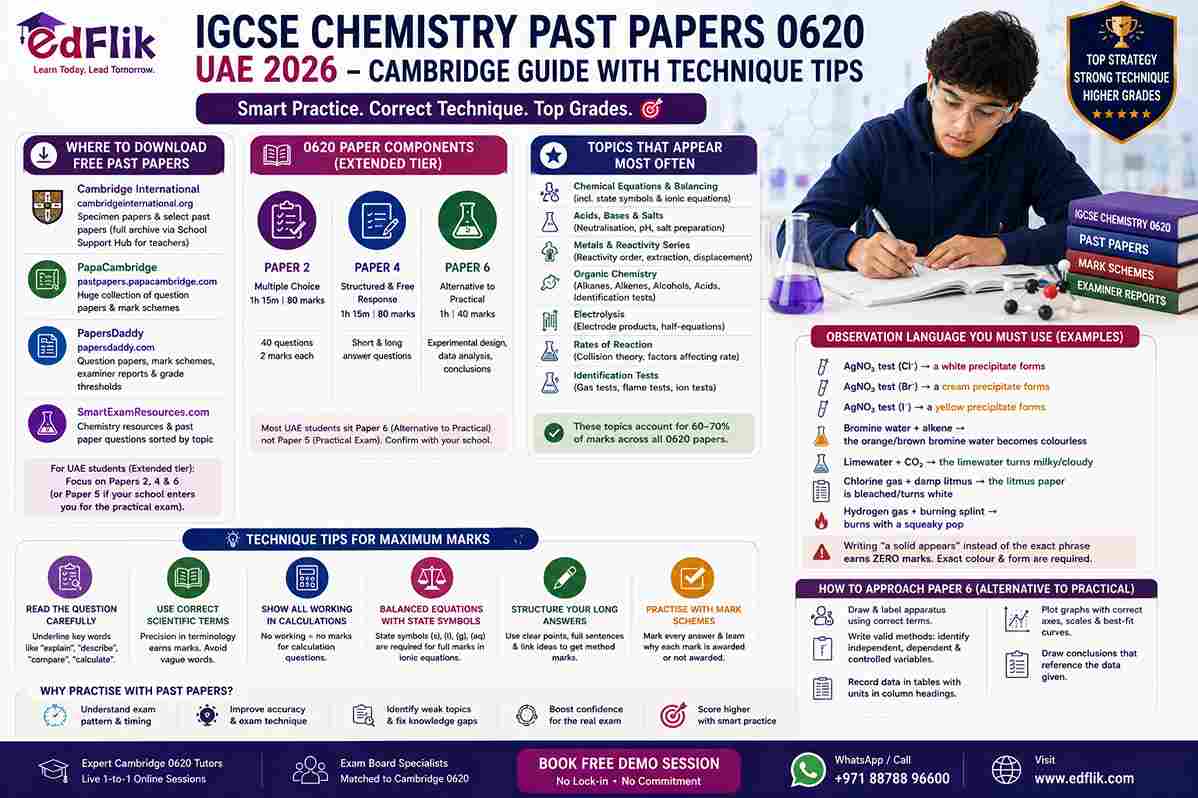
A: Cambridge's own proprietary notation — not Python, not JavaScript, not any real language. UAE students who programme in Python write Python syntax in Cambridge pseudocode answers and earn zero for every non-conforming line. Key differences: assignment uses ← not =; FOR loops use NEXT; WHILE uses DO-ENDWHILE; arrays start at index 1; all variables must be declared with type. Download the official Cambridge Pseudocode Guide and treat it as the definitive Paper 2 reference.
Q: How do students complete trace tables?
A: Follow the algorithm exactly as a computer would. Create columns for every variable and for OUTPUT. Execute one line at a time, updating only the variable(s) that specific line affects. Check loop conditions before each iteration. Do not update multiple variables in one step unless the algorithm explicitly updates both in the same line.
Q: What topics appear most frequently in 0478 past papers?
A: Paper 1: binary/hexadecimal conversion, Boolean logic gates and truth tables, two's complement, networking, cybersecurity, SQL SELECT. Paper 2: array manipulation, bubble sort, binary search, file operations (OPENFILE, READFILE, CLOSEFILE), functions and procedures with parameters.
Q: Where can UAE students download 0478 past papers free?
A: PapaCambridge (pastpapers.papacambridge.com), PapersDaddy (papersdaddy.com), and the official Cambridge International website — where the Cambridge Pseudocode Guide (essential for Paper 2) is also available as a free download. Always use the most recent series first to ensure current format familiarity.
How EdFlik Supports IGCSE Computer Science Students Across UAE
EdFlik IGCSE Computer Science 0478 tutors teach Cambridge pseudocode as the first session focus for all students — regardless of programming experience. Sessions from AED 60. Free demo. Book at www.edflik.com.