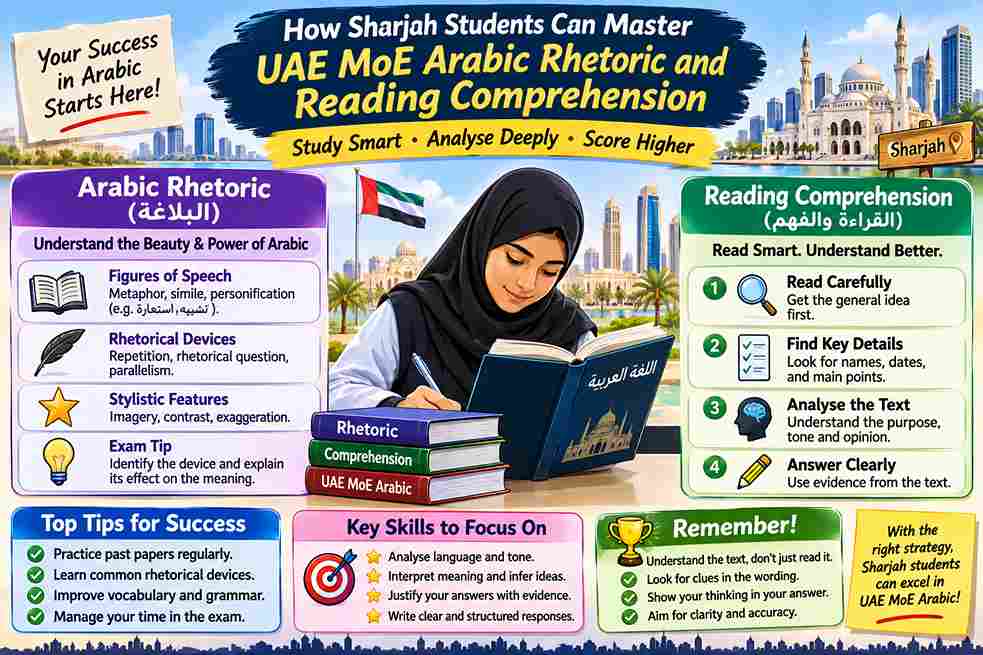
How Sharjah Students Can Master UAE MoE Arabic Rhetoric and Reading Comprehension
By EdFlik Team | November 20, 2026
For secondary and senior secondary students across Sharjah—from Al Majaz, Al Khan, and Al Nahda to Muwaileh, University City, and Al Taawun—Arabic Language under the UAE Ministry of Education (MoE) framework is a compulsory, high-priority subject across both government and private international schools (regulated by the Sharjah Private Education Authority, SPEA). Whether a student is enrolled in Arabic A (for native/first-language Arabic speakers) or Arabic B (for non-native learners) alongside British (IGCSE/A-Level), IB, or American programmes, internal school exams and standardized benchmarks test far more than conversational fluency.
In upper secondary grades (Years 9–13 / Grades 8–12), two sections consistently separate top-band achievers from mid-tier scorers: Arabic Rhetoric (Al-Balagha — البلاغة العربية) and Unseen Reading Comprehension (Al-Fahm wa Al-Isti'ab — الفهم والاستيعاب). While students may speak Arabic comfortably at home or navigate everyday conversations across Sharjah, MoE-aligned examinations evaluate classical and modern literary texts, implicit figurative imagery, rhetorical styles, and precise textual evidence.
Many capable students lose easy marks because they summarize a passage instead of analyzing how the author constructs meaning, or they name a rhetorical device (Tashbih or Isti'ara) without explaining its artistic and emotional impact (Atharuhu fi Al-Ma'na — أثره في المعنى).
This comprehensive masterclass guide breaks down the architecture of UAE MoE Arabic Rhetoric (Al-Balagha) and Reading Comprehension, explains key command words and analytical frameworks, provides a practical step-by-step exam workflow, exposes common mark-scheme traps, and includes 100% copy-paste JSON-LD schema markup.
Key Takeaways
- Treat MoE Arabic as an Analytical Discipline, Not Just Conversation: UAE Ministry of Education assessments evaluate Modern Standard Arabic (Al-Fusha) reading comprehension, grammatical application (Nahw & Sarf), and literary/rhetorical analysis (Balagha).
- Never Name a Rhetorical Device Without Its Effect on Meaning: Identifying a simile (Tashbih), metaphor (Isti'ara), or antithesis (Tibaq) only earns partial credit; full marks require explaining what image it paints and how it strengthens the author's tone or message.
- Decode Arabic Exam Command Words Before Writing: Words like Waddih (Explain), Sif (Describe), Hallil (Analyse), and Qayyim (Evaluate) dictate whether you need textual evidence, structural breakdown, or a weighed literary judgment.
- Build Daily Reading Stamina in Modern Standard Arabic: Reading short, high-quality Arabic articles, essays, and classical/modern poetry excerpts for 15–20 minutes daily builds vocabulary depth and speed for unseen passages.
Part 1: Deconstructing UAE MoE Arabic Assessment Pillars
Across Sharjah's private and public schools, UAE Ministry of Education Arabic assessments evaluate four progressive cognitive skills across reading and literary texts:
               UAE MoE ARABIC ASSESSMENT ARCHITECTURE
                                 |
  +------------------------------+------------------------------+
  |                                                             |
1. VOCABULARY & SYNTAX (Al-Mufradat & Al-Qawa'id)          2. READING COMPREHENSION (Al-Fahm wa Al-Isti'ab)
• Contextual word meanings, roots, synonyms/antonyms.        • Explicit main ideas (Al-Fikra Al-Ra'isiya).
• Sentence parsing (I'rab) & structural clarity.             • Implicit inference, author's purpose & tone.
  +------------------------------+------------------------------+
  |                                                             |
3. RHETORICAL ANALYSIS (Al-Balagha)                        4. CRITICAL EVALUATION (Al-Taqyeem)
• Ilm Al-Bayan (Imagery: Tashbih, Isti'ara, Kinaya).         • Assessing persuasiveness & stylistic choices.
• Ilm Al-Badi' (Sound/Contrast: Tibaq, Muqabala, Jinas).     • Supporting claims with direct textual quotes.
• Ilm Al-Ma'ani (Styles: Khabar vs. Insha').
As shown in the study workflow above, pairing active note-taking with systematic passage annotation helps students move from passive reading to structured literary analysis.
Part 2: Mastering the Three Branches of Arabic Rhetoric (Al-Balagha)
In UAE MoE secondary and senior secondary curricula (particularly in Arabic A and advanced Arabic B tracks), Arabic Rhetoric (Al-Balagha) is organized into three classic branches. Knowing which branch a device belongs to helps you write precise, examiner-ready explanations:
| Branch of Balagha | Core Devices (Arabic & English) | How to Spot It in a Text | How to Explain Its Effect (Atharuhu) |
Ilm Al-Bayan (Science of Imagery) | • التشبيه (Tashbih — Simile): Explicit comparison using particles like كـ or مثل. • الاستعارة (Isti'ara — Metaphor): Implied comparison where one element is omitted (Makniyya or Tasrihiyya). • الكناية (Kinaya — Metonymy/Allusion): Indirect expression conveying an implied trait. | Look for vivid sensory imagery, personification of nature/ideas, or symbolic expressions. | Explain what abstract idea is made concrete/visual (التجسيم or التشخيص) and what emotion it evokes. |
Ilm Al-Badi' (Science of Embellishments) | • الطباق (Tibaq — Antithesis): Two opposite words (e.g., الليل / النهار). • المقابلة (Muqabala — Parallel Contrast): Two or more contrasting phrases in sequence. • الجناس (Jinas — Paronomasia): Words with similar sounds/letters but different meanings. • السجع (Saj' — Prose Rhyme): Matching clause endings in prose. | Scan for sharp contrasts in meaning or musical rhythm across adjacent words/clauses. | For Tibaq/Muqabala: state that contrast clarifies and emphasizes meaning (توضيح المعنى وتوكيده). For Jinas/Saj': note musical rhythm (جرس موسيقي). |
Ilm Al-Ma'ani (Science of Meanings & Styles) | • الأسلوب الخبري (Uslub Khabari — Declarative): Statements conveying facts, certainty, or reflection. • الأسلوب الإنشائي (Uslub Insha'i — Performative): Commands (أمر), questions (استفهام), exclamations (تعجب), or calls (نداء). • التوكيد (Tawkid — Emphasis): Particles like إنّ, قد, or repetition. | Check whether the writer is stating information or addressing the reader with questions/commands. | Explain why the style fits the tone—e.g., rhetorical questions (استفهام استنكاري) provoke reflection or draw the reader in. |
Part 3: Decoding MoE Arabic Command Words & Question Types
Understanding Arabic exam command words prevents students from writing long paragraphs that miss the rubric's core demand:
- وضّح (Waddih — Explain): State the core idea clearly and back it up with two linked supporting details drawn directly from the passage.
- صِف (Sif — Describe): Trace the sequence of events, character traits, or stages of the author's argument accurately without adding unsupported personal opinions.
- حلّل (Hallil — Analyse): Break down a specific line or phrase—identifying the exact grammatical structure (I'rab) or rhetorical device (Balagha) and explaining its function in context.
- قيّم (Qayyim — Evaluate): Judge how effectively the writer persuades the reader, weighing stylistic strengths with direct textual evidence before stating a reasoned conclusion.
Part 4: A 4-Step Unseen Reading Comprehension Protocol
When facing a dense literary or informational passage in a Sharjah school assessment or MoE benchmark exam, follow this timed 4-step protocol:
                 4-STEP UNSEEN COMPREHENSION WORKFLOW
                                   |
  Step 1: Preview Questions First  ---> Read all comprehension & rhetoric prompts before reading
                                        the passage so you know what details to hunt for.
  Step 2: Active Passage Annotation---> Underline paragraph topic sentences, transition connectors
                                        (لكن، غير أن، وبناءً على ذلك), & vivid imagery.
  Step 3: Deduce Word Meanings in  ---> Use root letters (الجذر اللغوي) & surrounding sentence
          Context                       clues rather than panicking over an unfamiliar word.
  Step 4: Answer with "Claim +     ---> State your answer in formal MSA, quote the brief supporting
          Evidence + Effect"            phrase from the text, & explain its significance.
Practical Worked Example (Rhetoric & Inference):
Suppose an unseen passage on cultural heritage states:
"إنّ الكتابَ مصباحٌ يبدّدُ ظلامَ الجهل، ويزرعُ في العقولِ بذورَ المعرفة."
("Indeed, a book is a lamp that dispels the darkness of ignorance and plants seeds of knowledge in minds.")
- Rhetorical Identification:
- تشبيه بليغ (Eloquent Simile): "الكتاب مصباح" compares a book directly to a lamp (omitting the simile particle), illustrating how reading illuminates understanding (توضيح المعنى وتجسيمه).
- استعارة مكنية (Implied Metaphor): "يزرع في العقول بذور المعرفة" personifies/visualizes knowledge as seeds planted in fertile minds, emphasizing gradual intellectual growth.
- طباق إيجاب (Positive Antithesis): Contrast between "مصباح / يبدّد" (light/dispelling) and "ظلام" (darkness) highlights the transformative power of education (توضيح المعنى وتوكيده).
- أسلوب خبري مؤكد بـ (إنّ): Emphatic declarative sentence reinforcing certainty.
Part 5: Top 4 Traps That Cost Sharjah Students Marks in MoE Arabic
- Copying Full Paragraphs Instead of Paraphrasing + Quoting Briefly: Lifting three whole lines from the comprehension text without answering the prompt directly signals weak comprehension. Summarize in your own clear Modern Standard Arabic and embed short, targeted quotes.
- Naming a Balagha Device Without Explaining Its Artistic Effect: Writing "استعارة مكنية" alone often earns only half the available marks. Always add what it suggests and how it serves the writer's purpose.
- Ignoring Context When Defining Vocabulary (المفردات): Many Arabic words carry multiple meanings depending on prepositions and context. Always re-read the entire sentence before selecting a synonym or antonym.
- Mixing Colloquial Dialect (Al-Ammiyya) Into Written Answers: Even when ideas are strong, slipping into spoken dialect vocabulary or spelling errors lowers expression and accuracy scores. Keep written responses in clean, punctuated Fusha.
For expert 1-on-1 online tutoring support to master UAE Ministry of Education Arabic A and Arabic B rhetoric, reading comprehension, and grammar in Sharjah, book a class on EdFlik.
Frequently Asked Questions (FAQs)
Q1: What is the difference between Arabic A and Arabic B in Sharjah schools?
Ans: Arabic A is designed for native/first-language Arabic speakers and covers deeper classical and modern literature, advanced grammar (Nahw and Sarf), and detailed rhetorical analysis (Al-Balagha). Arabic B is tailored for non-native Arabic learners, building progressive proficiency across reading, listening, speaking, writing, and age-appropriate comprehension aligned with UAE Ministry of Education standards.
Q2: How can students improve quickly in Arabic Balagha (Rhetoric)?
Ans: Start by mastering the core devices in Ilm Al-Bayan (Tashbih, Isti'ara, Kinaya) and Ilm Al-Badi' (Tibaq, Muqabala, Jinas), and practice a three-part response habit: (1) name the device, (2) quote the exact phrase, and (3) explain its effect on meaning and tone.
Q3: How can Sharjah parents support children who struggle with unseen Arabic reading passages?
Ans: Encourage short, consistent exposure to Modern Standard Arabic outside homework—such as reading graded Arabic stories, youth cultural articles, or annotated poetry excerpts for 15 minutes a few times a week—and practicing root-word identification (الجذر اللغوي) to decode unfamiliar vocabulary.