How to Choose IGCSE Subject Combinations for A-Level and University in the UAE
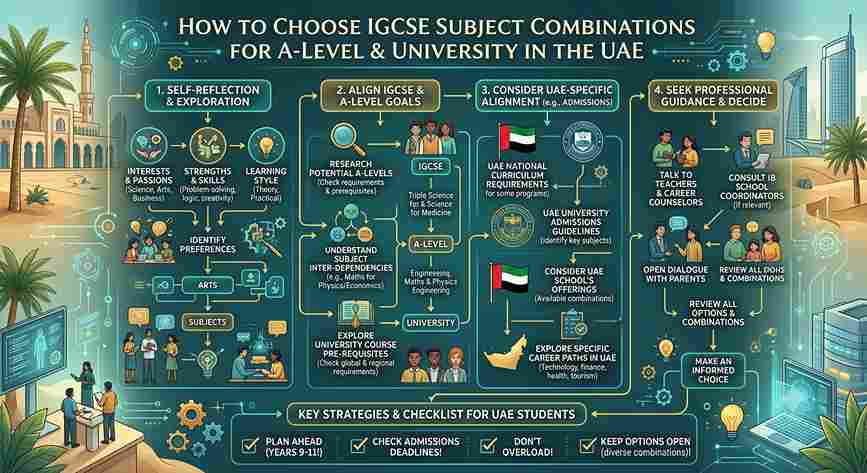
Who this is for: UAE private school students (Grades 8–9 / Years 9–10) in Dubai, Abu Dhabi, Sharjah, and the Northern Emirates selecting their Cambridge or Pearson Edexcel International GCSE options, alongside parents planning academic pathways toward A-Levels, the IB Diploma, and global university admissions.
What query it owns: how to choose IGCSE subject combinations for A-Level and university entry in the UAE.
Why this is safe: This guide outlines the strategic alignment between IGCSE subjects, post-16 qualifications, and university degree prerequisites, while EdFlik’s IGCSE resource hub offers structured subject guides and academic pathway mapping.
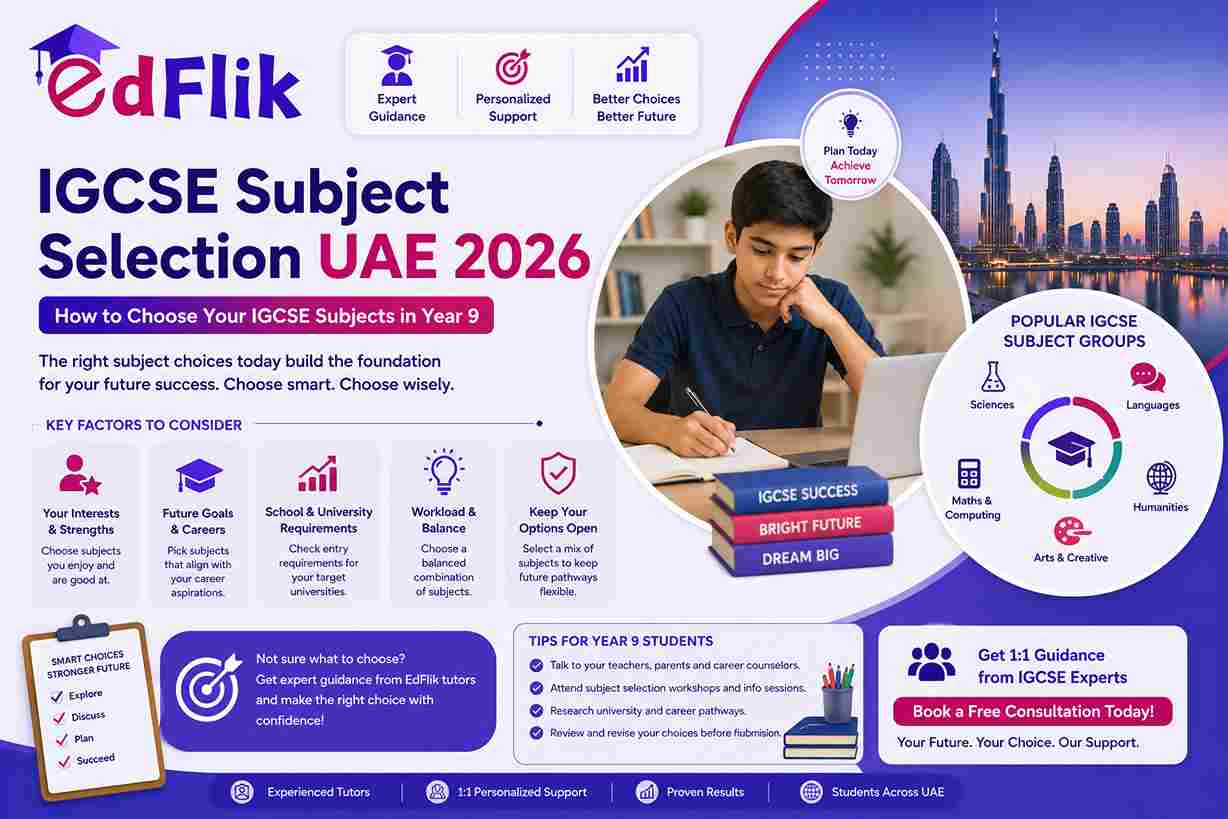
Selecting your International General Certificate of Secondary Education (IGCSE) subject combination is the single most critical academic decision of Year 9 / Grade 8. While IGCSEs are taken two years before university applications, the subject choices you make at age 14 dictate which A-Level subjects or International Baccalaureate (IB) Higher Level (HL) courses you are permitted to take at age 16. Dropping a core subject too early can permanently close doors to competitive degree pathways in Medicine, Engineering, Computer Science, Economics, and Law.
In the United Arab Emirates, where students apply across diverse higher education systems—including the UK (UCAS), US (Common App), Canada, Europe, and UAE-based higher education institutions—your IGCSE profile must balance degree prerequisites, academic rigor, and regional regulatory compliance (such as Ministry of Education equivalency rules).
This masterclass guide breaks down the architecture of IGCSE subject selection, details high-yield subject combinations for major university degree tracks, provides a 5-step decision framework, exposes top selection traps.
Key Takeaways
- IGCSEs set your A-Level ceiling: Sixth-form entry requirements at top UAE and UK schools typically demand a Grade 7 (AAA) or higher at IGCSE in the specific subject you wish to pursue at A-Level or IB Higher Level.
- The Core Foundation is non-negotiable: All UAE students must take English Language, Mathematics, and at least one Science. Under UAE Ministry of Education (MoE) guidelines, Ministry Arabic (Arabic A or B) is also compulsory through Grade 9/10.
- Separate Sciences vs. Combined Science: For students considering STEM or Medicine, choosing Triple Science (Biology, Chemistry, Physics) as distinct IGCSEs provides the strongest foundation for A-Level and university success.
- Quality beats sheer quantity: Admissions officers evaluate grade quality and subject rigor over total subject count; 8 to 9A∗/9–7A^*/9–7A∗/9–7 grades in rigorous subjects carry more weight than 11 mixed-grade passes.
Part 1: The Structure of IGCSE Subject Selection in the UAE
Most private international schools in Dubai and Abu Dhabi require candidates to take between 7 and 10 IGCSE subjects across two years (Years 10–11 / Grades 9–10).
                 THE IGCSE SUBJECT SELECTION ARCHITECTURE
                                     |
      +------------------------------+------------------------------+
      |                                                             |
1. COMPULSORY CORE SUBJECTS                                  2. ELECTIVE SUBJECT GROUPS
• English (First or Second Language)                         • Sciences (Biology, Chemistry, Physics)
• Mathematics (Core or Extended)                             • Humanities (History, Geography, Economics)
• Ministry Subjects (Arabic A/B, Islamic, Social Studies)    • Creative & Technical (Computer Science, Art, ICT)
Understanding Tiering: Core vs. Extended
For subjects like Mathematics and Sciences, exam boards (Cambridge CAIE and Pearson Edexcel) offer Core and Extended options:
- Core Tier: Papers cover foundational content; grades are capped at Grade C / Grade 5.
- Extended Tier: Covers the complete syllabus, enabling students to achieve top grades up to Grade A∗A^*A∗/ Grade 9.
- Strategic Rule: Always aim for the Extended tier in core subjects if you plan to study STEM, Business, or Quantitative disciplines at A-Level.
Part 2: High-Yield IGCSE Combinations by University Degree Track
To maximize university admission chances at top global institutions (Russell Group, Ivy League, and UAE universities), tailor your IGCSE electives to align with your long-term career track:
                      HIGH-YIELD COMBINATIONS BY MAJOR
                                       |
  • Medicine & Life Sciences  ---> Extended Maths + Chemistry + Biology + Physics
  • Engineering & Physics    ---> Extended Maths + Additional Maths + Physics + Chemistry
  • Computer Science & AI     ---> Extended Maths + Additional Maths + Computer Science + Physics
  • Economics & Finance       ---> Extended Maths + Additional Maths + Economics + History/Geography
  • Law & Humanities          ---> English Literature + History + Global Perspectives / Foreign Language
1. Medicine, Dentistry & Veterinary Science
- Essential IGCSEs: English Language, Extended Mathematics, Chemistry, Biology, Physics.
- Recommended Electives: Psychology, Modern Foreign Language, or History.
- Why this works: UK medical schools require A-Level Chemistry and Biology. Taking all three separate sciences at IGCSE prevents foundational knowledge gaps in biochemistry and medical physics.
2. Engineering, Physics & Architecture
- Essential IGCSEs: Extended Mathematics, Physics, Chemistry.
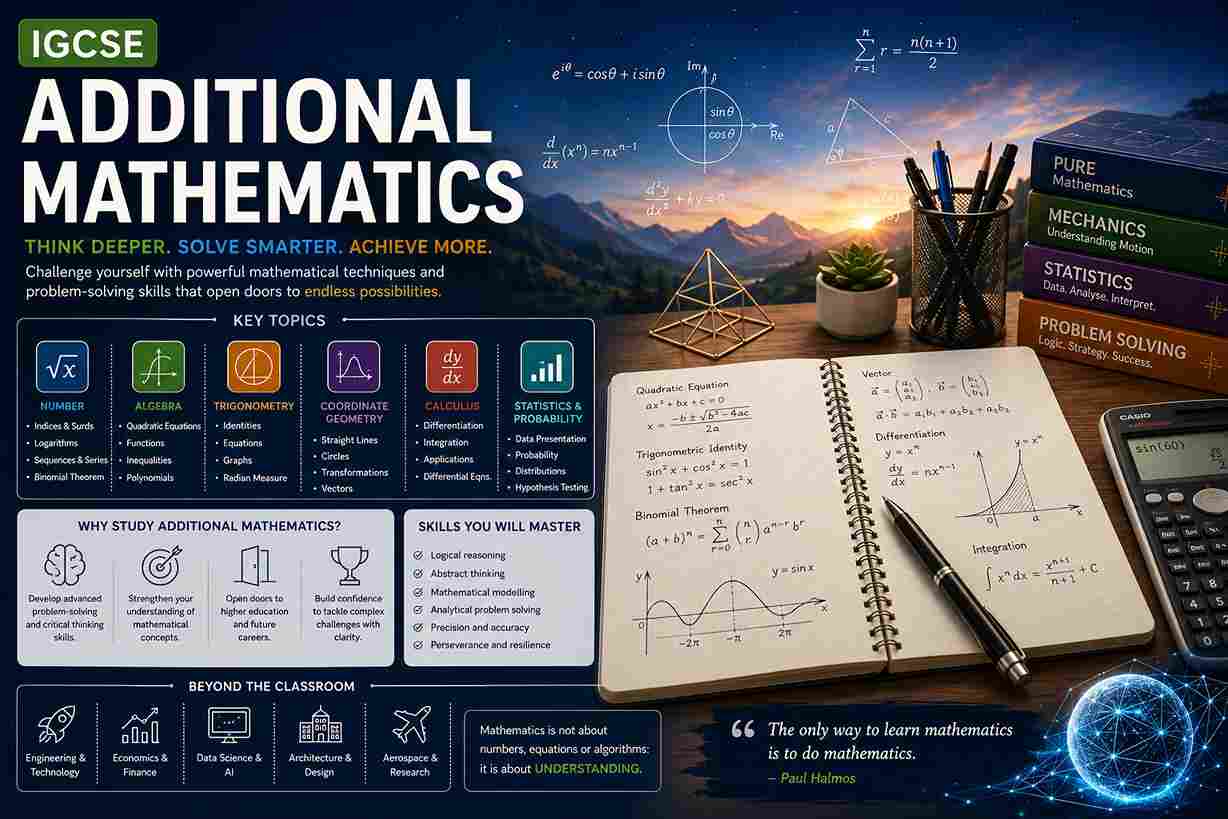
- High-Value Addition: Additional Mathematics (0606).Tutela Prep
- Recommended Electives: Computer Science, Design & Technology, or Art & Design (for Architecture).
- Why this works: A-Level Maths and Physics are non-negotiable for engineering. Taking Additional Maths at IGCSE introduces early calculus and trigonometry, easing the transition to A-Level Mathematics.
3. Computer Science, AI & Data Science
- Essential IGCSEs: Extended Mathematics, Computer Science, Physics.
- High-Value Addition: Additional Mathematics.
- Recommended Electives: Chemistry, Economics, or Logic-based subjects.
- Why this works: Top universities view Computer Science as a branch of applied mathematics. Demonstrating strong mathematical performance is more important for computer science admissions than basic coding skills.
4. Economics, Finance & Management
- Essential IGCSEs: Extended Mathematics, Economics.
- High-Value Addition: Additional Mathematics and History.
- Recommended Electives: Business Studies, Accounting, or Geography.
- Why this works: University Economics is heavily quantitative. Pairing advanced mathematics with an essay-based humanities subject like History proves you can analyze quantitative data and evaluate complex written arguments.
5. Law, International Relations & Humanities
- Essential IGCSEs: First Language English, English Literature, History.Tutela Prep
- Recommended Electives: Global Perspectives, Geography, Economics, or a Modern Foreign Language (French, Spanish, German, Arabic).Tutela Prep
- Why this works: Law degrees do not require a specific A-Level subject, but admissions officers look for rigorous essay writing, source critique, historical context, and logical argumentation.
Part 3: Step-by-Step Selection Decision Framework
                   THE 5-STEP IGCSE DECISION PROTOCOL
                                    |
  Step 1: Secure Core Non-Negotiables ---> Lock in English, Extended Maths, and Sciences.
  Step 2: Map University Prerequisites  ---> Research target degree requirements on UCAS / university portals.
  Step 3: Evaluate Academic Strengths ---> Review Year 9 assessment data and teacher feedback.
  Step 4: Ensure Portfolio Balance   ---> Combine STEM, Humanities, and Language/Skill electives.
  Step 5: Verify Local Regulatory Rules---> Ensure compliance with UAE Ministry of Education equivalency.
- Lock in the Non-Negotiables First: Secure English Language, Extended Mathematics, and at least two separate sciences (or Combined Science) before picking electives.
- Backward-Map from University Targets: Check requirements for prospective degrees. If you are considering Engineering, you must take Physics at IGCSE; if considering Medicine, Chemistry and Biology are essential.
- Choose Subjects You Enjoy and Excel In: Genuine academic interest leads to deeper engagement and higher final grades. Scoring an A∗/9A^*/9A∗/9 in Geography is better than a Grade C/5C/5C/5 in a subject chosen solely because it "looks impressive".
- Maintain Portfolio Balance: If you are unsure of your career direction at age 14, keep options open by choosing a balanced mix: English, Maths, 2–3 Sciences, 1 Humanities (History/Geography/Economics), and 1 Language or Creative/Technical subject.
- Check UAE Ministry of Education Equivalency Requirements: For students educated in the UAE who plan to apply to local universities or seek official MOE degree equivalency later, ensure your IGCSE subject count meets national graduation guidelines (typically at least 5 IGCSE passes at Grade C/4 or above in core subjects).
Part 4: Top 4 Selection Traps That Cost UAE Students Offers
- Dropping Chemistry or Physics Too Early: Dropping Chemistry or Physics in Year 9 assuming you will pursue business or law, only to change your mind in Year 11 and discover that STEM and Medical pathways are closed.
- Selecting Electives Based on Friends or Teachers: Choosing subjects based on peer choices or favorite Year 9 teachers, ignoring the fact that teaching staff and class distributions change in Key Stage 4.
- Overloading on Too Many Subjects: Taking 11 or 12 IGCSE subjects at the expense of top grades. Universities evaluate quality over quantity; achieving 8 Grade 9s is superior to 11 mixed 6s and 7s.Tutela Prep
- Taking Business Studies AND Economics Simultaneously: While permitted, some competitive sixth-forms and universities consider Business Studies and Economics to have overlapping content, preferring a broader humanities subject like History or Geography alongside Economics. Save My Exams
For expert 1-on-1 tutoring support to master IGCSE subjects, navigate exam board specifications, and secure top grades, book a class on EdFlik.
Frequently Asked Questions (FAQs)
Q1: Is it better to take Combined Science or Separate (Triple) Sciences?
Ans: If your school offers Separate Sciences (Biology, Chemistry, Physics) and you are capable of handling the workload, it is the preferred option for STEM, Medicine, and Engineering pathways. Combined Science covers two IGCSE grades' worth of content across all three sciences and is sufficient for general A-Level entry, but Triple Science provides deeper preparation.
Q2: Does taking IGCSE Additional Mathematics guarantee success in A-Level Maths?
Ans: Additional Mathematics (0606) bridges the gap between IGCSE and A-Level / IB HL Mathematics by introducing differentiation, integration, calculus, and advanced trigonometry. While not strictly mandatory at all schools, it provides a strong advantage for students aiming for top grades in A-Level Mathematics.
Q3: Can a student change their IGCSE subjects after Year 10 starts?
Ans: Most schools allow subject swaps during the first 2 to 4 weeks of Term 1 in Year 10. Swapping subjects after this window is discouraged because catching up on missed course content and internal assessments becomes difficult.