A-Level Chemistry Tutor Online: A Parent's Guide
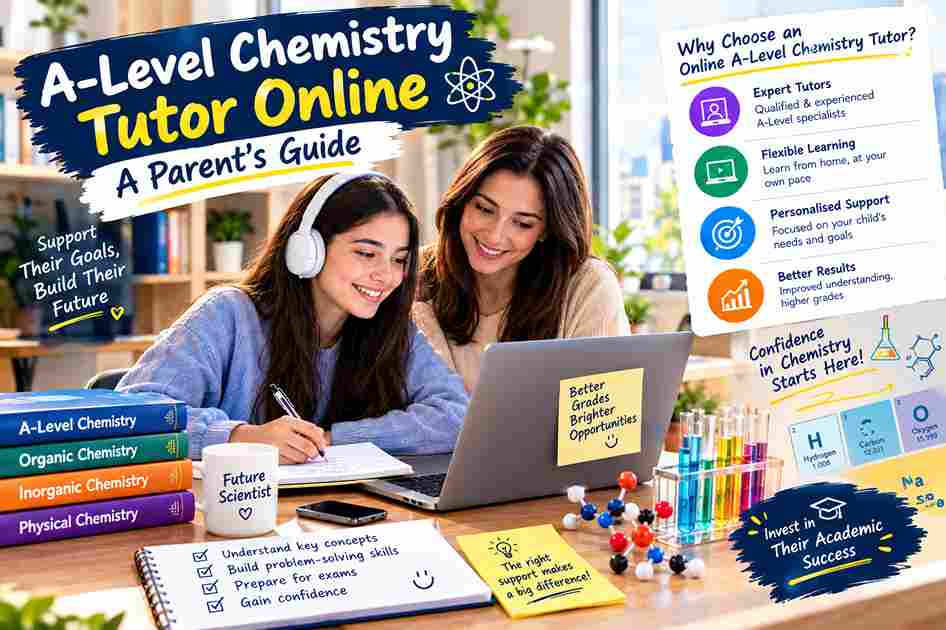
If your son or daughter is studying A-Level Chemistry, you already know how much ground the subject covers. One week it is moles and equilibrium, the next it is reaction mechanisms that seem to come from nowhere. Many students in the UAE reach the middle of the course feeling capable in class but unsure when they sit down alone with a question paper. An online A-Level Chemistry tutor can help close that gap. You get one-to-one attention, a pace that suits your child, and a steady routine that stops last term's topics from quietly slipping away.
This guide is for parents who are thinking about that step. It explains what good support looks like, what to ask before booking, and how EdFlik's live online classes can fit around a family's week. Please check the current official specification from your child's exam board, because content and assessment details can change over time.
Why A-Level Chemistry Feels Different From Earlier Science
A-Level Chemistry asks students to connect ideas. A student might need to use energy changes from one topic to explain a result in another, or apply the logic of equilibrium to a question about an industrial process. That joined-up thinking is what separates a good answer from a great one. It is also often the hardest skill to build in a busy classroom, where the teacher must keep the whole group moving at the same pace.
One-to-one tutoring creates space for that connecting work. The tutor can pause at the moment a student says, "I understand the words but not the reason," and rebuild the idea from the ground up. Parents often notice the change in their child's confidence first. Questions that once caused panic start to feel more like puzzles to solve.
What a Strong A-Level Chemistry Tutor Covers
Chemistry is usually taught in three strands: physical, inorganic and organic. Each one needs a different kind of practice, so it helps to know what your child is working on before the first lesson.
Physical chemistry includes topics such as energetics, kinetics, equilibrium and acid-base calculations. Students need to be comfortable with numbers, units and rearranging formulas, and they must show their working clearly. A good tutor will check this habit in every lesson, because a correct answer without a visible method can still lose marks in an exam.
Inorganic chemistry covers periodicity, group trends, transition metals and the chemistry of common ions. It rewards careful memory, but it becomes much easier when facts are linked to patterns. Tutors who explain why a trend happens help students remember more with less effort than those who rely on lists alone.
Practical skills deserve attention too. Many exam boards assess experimental understanding in some form. Students should be able to explain how an experiment is planned, how results are analysed and how errors are discussed. A tutor who asks, "How would you check that result?" during a lesson is building exam skills, not just subject knowledge.
Making Sense of Organic Chemistry
Organic chemistry is where many students feel most lost. There are names to learn, three-dimensional shapes to picture, and reaction mechanisms that demand careful, step-by-step thinking. The most useful approach is to build from a small set of ideas: functional groups, how bonds break, which molecules act as electron pair donors and which act as acceptors, and how those patterns repeat across different reactions.
When you speak to a potential tutor, ask how they teach mechanisms. A strong answer will mention drawing curly arrows carefully, practising with familiar examples and returning to the same reaction types over several weeks so they become second nature. Isomerism is another area where visual practice helps. Using models or sketches to test whether two structures are really the same molecule can clear up confusion quickly.
Organic chemistry is also a reliable source of exam marks once students learn to recognise question patterns. Synthesis routes, for example, usually follow a logic that can be practised until it feels familiar. A tutor can build a short list of these patterns and revisit them regularly, so that your child is not meeting each one for the first time under exam pressure.
Using Past Papers the Right Way
Past papers are one of the most valuable tools in A-Level preparation, but only when they are used with care. Attempting a paper once and checking the final score tells a student very little. The real learning happens during review.
A good review routine looks like this. Your child attempts the paper under timed conditions, marks it against the official mark scheme, notes every question where marks were lost, and then works through those questions until the reasoning is clear. Examiner reports, where your child's exam board publishes them, can show which mistakes are common across students. A tutor can use these reports to shape the next lesson, so practice is aimed at real weaknesses rather than guesswork.
Parents can help by asking, "What did you learn from that paper?" rather than only asking for the score. That question encourages reflection and tends to reduce the stress that often comes with results. It also gives your child a chance to explain their thinking, which is good practice for the written answers they will give in the exam.
Fitting Lessons Around a UAE Family Schedule
Many UAE families juggle school, activities and work commitments, so timing matters. Online lessons remove the travel time to a tutoring centre and make it much easier to keep a consistent weekly slot. EdFlik classes are delivered live and in real time, and families can book times that suit their local schedule, subject to tutor availability. Lessons run for about one hour, which is long enough for a focused topic without overwhelming a student who has already had a full school day.
Consistency matters more than the exact time of day. A regular weekly slot, ideally one that is not directly after a long school day or a sports session, helps a student arrive ready to learn. If plans change because of an exam, a family event or a school trip, easy rescheduling keeps the overall plan on track without losing momentum.
A Practical Checklist for Parents
Use this list when you are comparing options for your child:
- Confirm the exam board and specification your child follows, and ask the tutor how they keep up to date with it.
- Ask how the tutor teaches organic mechanisms and physical calculations, and listen for a step-by-step approach.
- Request a free trial class so your child can test the teaching style before you commit.
- Check whether lessons include past-paper review, mark scheme practice and examiner-report insights.
- Agree how progress will be shared, such as through regular written updates.
- Choose a weekly slot that fits around school, meals and rest.
- Ask your child afterwards which parts felt clear and which still feel confusing.
How EdFlik Can Help
EdFlik offers live, one-to-one online tutoring for students aged 3 to 18, including A-Level Chemistry support. Lessons are about one hour long and are taught by experienced teachers who work with your child's current topics, practice papers and exam board specification. Parents receive monthly progress reports, so you can see what has been covered and where more practice is needed.
Classes start from AED 45 per class. Free trial classes let your child meet the tutor and experience the teaching style before you decide. There is no pressure to commit, and our team is happy to talk through your child's goals so you can choose the right next step with confidence.
If you would like to explore A-Level Chemistry support, book a free trial at www.edflik.com or email support@edflik.com. Tell us your child's exam board, the topics that feel hardest and the times that work for your family.
Conclusion
A-Level Chemistry rewards students who connect ideas, show their reasoning and practise with purpose. The right tutor makes that process clearer and less stressful. Look for someone who explains the why behind each concept, teaches organic mechanisms step by step, uses past papers as a learning tool and keeps you informed about progress. When those pieces fit together, your child has a much better chance of feeling prepared and capable. Start with a free trial, see how your child responds, and take the next step at a pace that suits your family.
Frequently Asked Questions
Which topics are covered?
Online A-Level Chemistry support at EdFlik can include physical, inorganic and organic chemistry, along with practical understanding and past-paper practice. Topics are matched to your child's exam board specification. Because details can change, please check the current official specification for the latest content before booking.
How can I judge a tutor's subject strength?
Ask the tutor to explain a mechanism or calculation in simple terms. Notice whether they check understanding rather than simply giving answers. A strong tutor will also ask about your child's exam board, recent past-paper results and the topics that feel hardest to them.
Can lessons fit UAE evening timings?
Yes, many families book evening lessons. EdFlik classes are live and delivered in real time, so you can choose a slot that suits your local schedule, subject to tutor availability. A regular weekly time helps students stay consistent through the term.
What does a free trial include?
A free trial class lets your child meet a tutor, share their current topics and experience a lesson. It is a no-pressure way to judge teaching style and comfort. Afterwards, you can ask questions and our team can help you plan the next steps if you decide to continue.
How is progress shared with parents?
EdFlik parents receive monthly progress reports from their child's tutor. These summarise what has been covered and where more practice is needed. You can also raise questions at any time by emailing support@edflik.com.