How to Compare Non-Fiction Texts in IGCSE English Language: Step-by-Step Comparative Grid
Last Updated: October 2026 | By EdFlik Education Team
For high school students preparing for Cambridge IGCSE English Language (0500 / 0990) or Pearson Edexcel International GCSE English Language (4EA1), mastering non-fiction reading comprehension and comparative analysis represents one of the most critical hurdles on Paper 1 or Paper 2.
Routinely featuring as high-tariff, extended-response synthesis and comparison questions (often worth 15 to 25 marks), comparative non-fiction tasks test your ability to look across two distinct texts—such as nineteenth-century travel writing paired with a modern journalistic blog, or two opposing argumentative opinion pieces—and analyze both explicit and implicit similarities and differences.
Every exam session, capable students lose valuable top-band marks not because they lack comprehension skills, but because they fall into the sequential trap: writing an isolated paragraph summarizing Text A followed by a separate paragraph summarizing Text B, with zero explicit cross-referencing between them.
In this comprehensive, exam-focused masterclass guide, our expert IGCSE English educators break down the assessment objectives, introduce the Comparative Grid Method, provide a step-by-step writing protocol, expose common examiner traps, and supply a 100% copy-paste JSON-LD schema markup for your study resources.
Part 1: Deconstructing the Assessment Objectives (AO3 - Comparison)
Examiners do not want a narrative summary of what each text is about. They are assessing your ability to synthesize, evaluate, and compare writers' viewpoints, perspectives, and methods.
                      THE THREE PILLARS OF COMPARATIVE READING
                                         |
        +--------------------------------+--------------------------------+
        |                                |                                |
 1. IDENTIFYING CONNECTIONS              2. SYNTHESIS & CONTRAST         3. EVALUATING WRITER'S CRAFT
 • Finding points where both texts       • Moving beyond surface content   • Analyzing *how* tone, stylistic
   agree, disagree, or approach the        to analyze contrasting attitudes, devices, and structural choices
   same core subject from different        tones, and underlying purposes.   create distinct emotional effects.
   angles.
Part 2: The Comparative Grid Method (Your Secret Weapon)
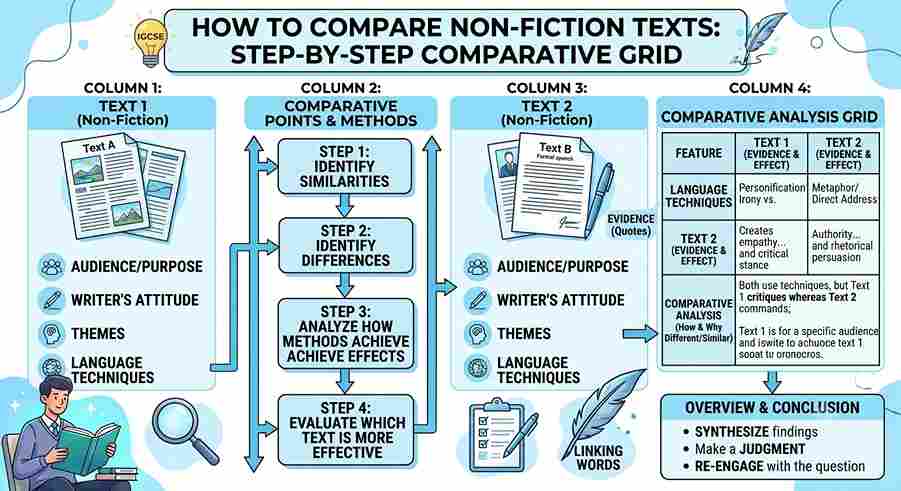
The single most effective way to eliminate confusion during a timed IGCSE reading paper is to construct a Comparative Grid on your rough working paper before writing a single sentence of your response.
Structure of a 4-Column Comparative Grid:
When you receive the two source texts, sketch a quick table with four columns:
| Thematic Point / Sub-Topic | Text A Evidence & Detail | Text B Evidence & Detail | Comparative Link (Similar / Different) |
| Writer's Initial Attitude | Quote / Reference from A | Quote / Reference from B | Contrast: A is nostalgic; B is cynical. |
| Tone & Register | Quote / Reference from A | Quote / Reference from B | Similarity: Both use urgent, persuasive language. |
| Impact on the Reader | Quote / Reference from A | Quote / Reference from B | Contrast: A evokes fear; B empowers action. |
By mapping out 3 to 4 robust thematic points before writing, you guarantee that your essay will be structurally comparative from start to finish.
Part 3: Step-by-Step Comparative Writing Protocol
When transitioning from your comparative grid to your final essay response, follow this proven 4-step execution protocol:
                  THE 4-STEP COMPARATIVE WRITING PROTOCOL
                                   |
  Step 1: The Thematic Topic Sentence ---> State the clear point of comparison (similarity or difference)
  Step 2: Evidence from Text A       ---> Embed a short, precise quotation from Text A with analysis
  Step 3: Direct Bridge to Text B    ---> Connect Text B immediately using comparative connectives
  Step 4: Evaluate Writer's Purpose  ---> Analyze *why* the writers adopted these specific perspectives
Worked Comparative Paragraph Framework:
Prompt: Compare how the writers present their experiences of exploring unfamiliar urban environments in Text A and Text B.
- Step 1 (Topic Sentence): While both writers experience initial disorientation when navigating crowded city streets, Text A’s narrator feels overwhelmed by sensory claustrophobia, whereas Text B’s author embraces the chaos with exhilarating curiosity.
- Step 2 (Text A Evidence & Analysis): In Text A, the oppressive atmosphere is established through heavy tactile imagery, noting how the "suffocating crush of humanity" presses in from all sides. The aggressive verb "crush" evokes a feeling of physical entrapment, reflecting the writer's defensive attitude toward the modern metropolis.
- Step 3 (Text B Comparison): Conversely, Text B portrays the urban landscape as an electrifying playground. Rather than feeling trapped, the writer describes the crowd as a "vibrant mosaic of motion," utilizing dynamic visual metaphors that completely invert Text A's sense of dread.
- Step 4 (Synthesis & Purpose): Thus, while Text A serves as a cautionary critique of unchecked urbanization, Text B functions as an enthusiastic celebration of street-level discovery.
Part 4: Comparing Language, Tone, and Viewpoint
To secure the highest bands (Level 5 / Band 1), you must evaluate how linguistic and stylistic choices shape meaning. Pay close attention to these four comparative axes:
                       COMPARATIVE AXES FOR NON-FICTION
                                       |
        +------------------------------+------------------------------+
        |                              |                              |
 1. PURPOSE & AUDIENCE          2. TONE & REGISTER            3. RHETORICAL DEVICES
 • Is the text a formal opinion   • Is the tone satirical,      • Compare how irony, hyperbole,
   editorial, a personal travel   somber, humorous, or urgent?  anecdotes, or emotive appeals are
   memoir, or a promotional       Analyze shifts in register.   deployed to persuade the reader.
   brochure?
Part 5: Top 4 Traps That Cost Students Marks in IGCSE Reading
- Writing Sequentially (The "Ping-Pong" Error): Writing an entire multi-paragraph section analyzing Text A, and then writing a completely separate section analyzing Text B. Comparison must be integrated within the same paragraphs using connective phrases ("In contrast to Text A...", "Similarly, Text B demonstrates...").
- Retelling the Story Instead of Analyzing Craft: Summarizing what happens in the travel memoir or news article rather than examining the writer's perspective, tone, and lexical choices.
- Over-Quoting Long Chunks of Text: Copying 3 lines of text verbatim into your answer instead of embedding short, punchy 2-to-4 word quotations seamlessly into your own sentence structures.
- Ignoring Implicit Meanings: Sticking only to literal, surface-level facts while ignoring subtext, irony, underlying bias, and implied attitudes.
Preparing for Cambridge (0500/0990) or Pearson Edexcel (4EA1) IGCSE English Language exams and aiming for an $A^$ / Grade 9? EdFlik connects international school students globally with expert, 1-to-1 online IGCSE English tutors, helping you master comparative non-fiction writing, reading comprehension, transactional writing, and past-paper strategies. *Book a Free Demo Class Today!
Frequently Asked Questions (FAQs)
Q1: How many points of comparison should I include in an extended IGCSE reading response?
Ans: Aim for 3 to 4 well-developed thematic points of comparison. Quality and depth of analysis across comparative paragraphs matter far more than listing a superficial quantity of brief points.
Q2: Should I focus more on similarities or differences?
Ans: Always let the texts dictate your focus, but examiners generally look for a balanced mix. If the prompt asks "how far do the writers agree," your comparative grid must explicitly weigh areas of consensus against areas of sharp divergence.
Q3: How do I embed quotations effectively in comparative essays?
Ans: Weave short words or phrases directly into your grammatical sentence structure. For example: Instead of writing: According to Text A, "the street was loud." Write: Text A characterizes the thoroughfare as "disorientingly loud," whereas Text B...
Q4: How does EdFlik support IGCSE English Language students?
Ans: EdFlik connects international school students worldwide with vetted, expert 1-to-1 online tutors specializing in Cambridge (0500/0990) and Pearson Edexcel (4EA1) IGCSE English Language. Our personalized coaching focuses on mastering reading analysis, comparative grids, transactional writing, and structured past-paper drilling.