IGCSE English Language 0500/0990: The Complete Tutoring Guide for Dubai Students
The Challenge: Why Strong Readers Sometimes Fail IGCSE English Language
Your child loves reading. They read novels, write stories, participate in class discussions. Yet when IGCSE English Language exams arrive, they freeze.
Why? Because IGCSE English isn't about loving literature — it's about mastering *specific writing formats* and *precise comprehension techniques* within timed exam conditions.
Paper 1 demands persuasive or creative writing in exactly 45 minutes. Paper 2 demands reading comprehension answers that match the examiner's mark scheme word-for-word. Students who've never been taught the *structure* of a persuasive essay, or the *technique* for finding evidence in a text, stumble badly.
Add Cambridge's specific rubric (tone, vocabulary, sentence variety) and suddenly a naturally strong student is scoring 4s instead of 7s.
EdFlik's English tutors teach the *system* — the proven structures that get high marks.
What Makes an Effective IGCSE English Language Tutor
1. Mastery of Paper 1 Writing Formats
Paper 1 asks students to write:
· Persuasive essays (arguing a viewpoint)
· Formal letters (applying for something, complaining)
· Articles (for a newspaper/blog)
· Reviews (books, films, products)
· Creative writing (short stories, descriptions)
Most students write well *for themselves* but not in exam format. They meander. They use weak vocabulary. They lack structure.
A good tutor teaches:
· **Hook & thesis** — how to grab attention in the first sentence
· **Argument structure** — topic sentences, evidence, explanation in each paragraph
· **Persuasive techniques** — rhetorical questions, emotive language, statistics, expert opinion
· **Vocabulary range** — moving beyond "good" and "bad" to sophisticated synonyms
· **Sentence variety** — mixing simple, compound, complex sentences
· **Conclusions** — ending with impact, not repetition
By exam day, your child has written 10+ persuasive essays and knows the formula by heart.
2. Paper 2 Reading Comprehension Technique
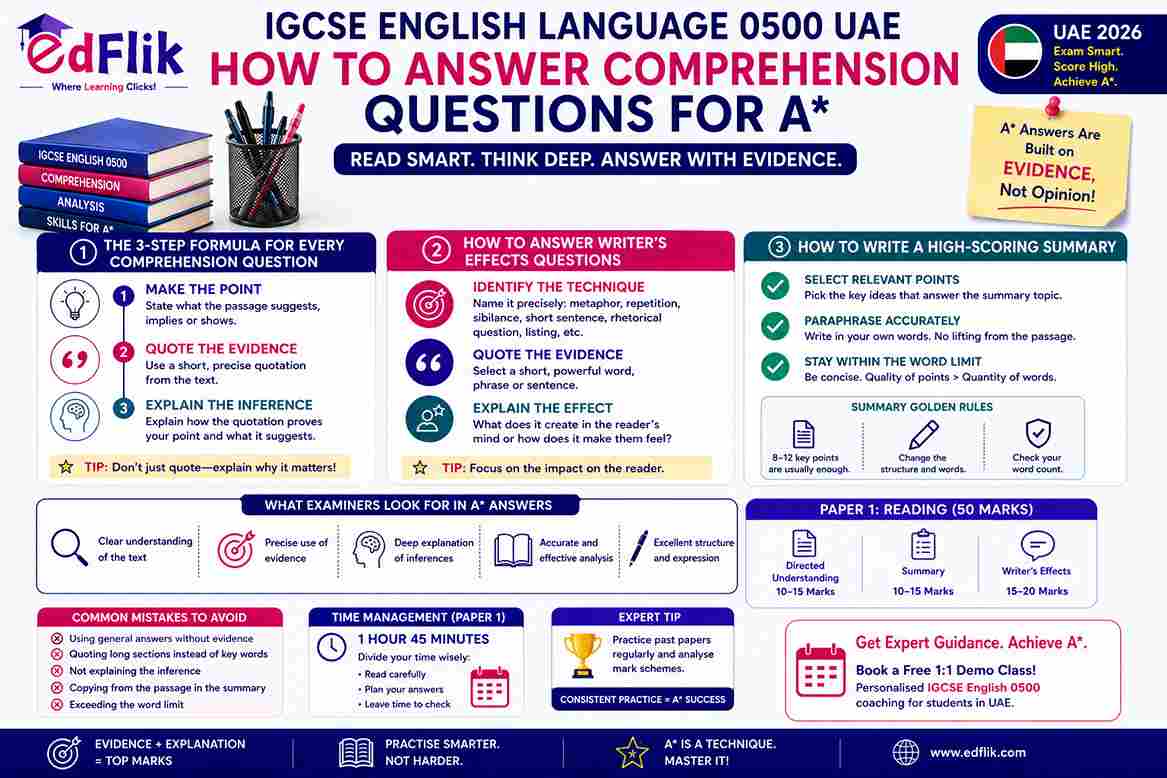
Paper 2 tests reading comprehension with tight mark schemes. "Understand the text" isn't specific enough. Students need to know:
· **How to locate evidence** — the examiner is looking for a *specific phrase* or example, not a paraphrase
· **How to explain technique** — when asked "how does the writer create tension?", the answer is specific (short sentences, exclamation marks, repetition) not vague ("the writing is scary")
· **How to compare texts** — comparing two passages and finding both similarities and differences with specific evidence
· **How to infer meaning** — reading between the lines to find implied information
A good tutor provides sample texts and teaches students to annotate ruthlessly, find evidence methodically, and explain techniques precisely.
3. Functional Text Mastery
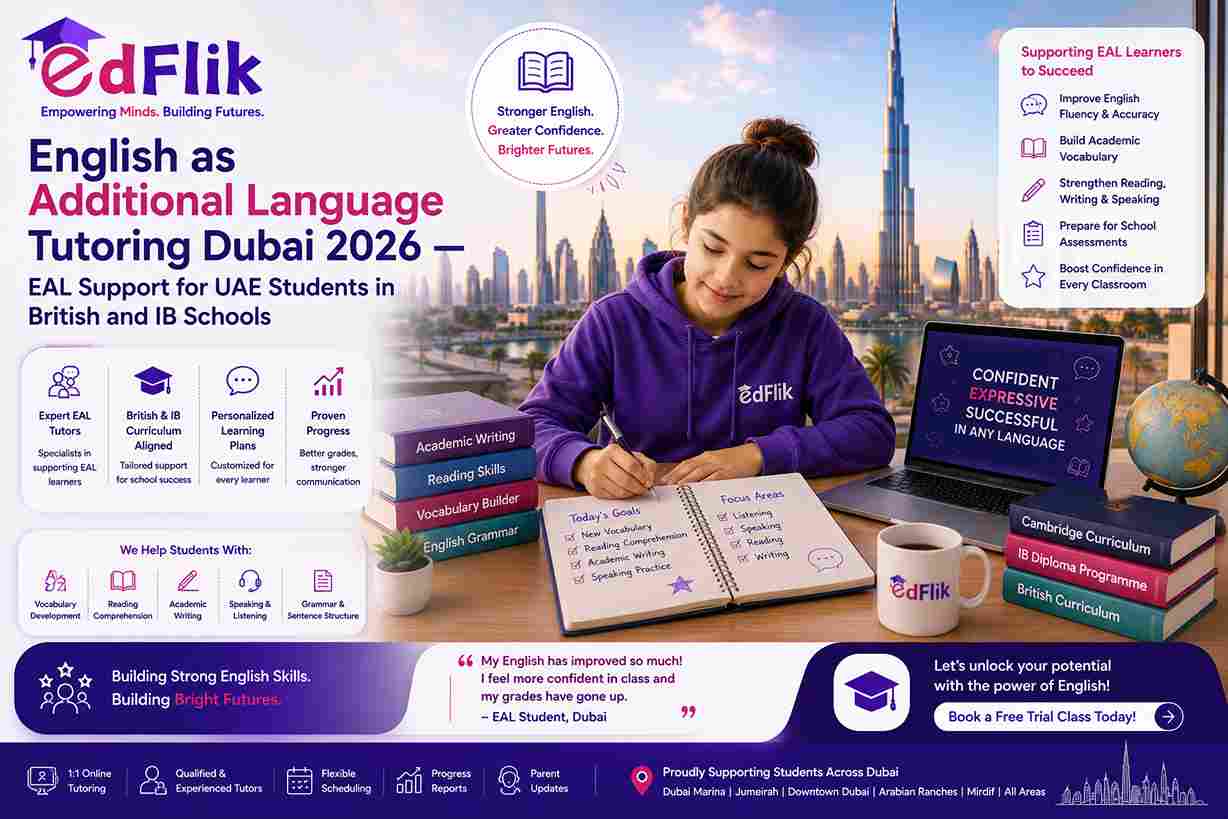
IGCSE includes functional texts (forms, instructions, brochures, websites, advertisements). Students must identify purpose, audience, and techniques used. Many students underestimate these — then lose marks on exam day.
A tutor who teaches functional text analysis explicitly wins.
Book Your Free Trial Now
Transform your child's writing and reading.
Book a free trial class with an IGCSE English Language specialist. WhatsApp **+91 88788 96600** or www.edflik.com
Most students see writing confidence improve within 3–4 weeks.
5 Tutoring Mistakes Dubai Parents Make (And How to Avoid Them)
Mistake 1: Treating English as "Natural"
Parent thinks: "They speak English, so they'll do fine in IGCSE English."
Reality: IGCSE English is a specific, teachable skill set. Teaching the *system* — persuasive structure, comprehension technique, vocabulary choice — matters enormously.
Mistake 2: Not Teaching Writing Structure
Many tutors read student essays and give vague feedback: "good" or "needs work." Effective tutors teach the *architecture* — hook, three body paragraphs with topic sentences, evidence, explanation, conclusion.
Mistake 3: Confusing Literature with Language
IGCSE English Language (0500/0990) is different from IGCSE English Literature (0475). Language focuses on comprehension, writing, functional texts. Literature focuses on analyzing poems/novels. Hiring a Literature tutor for a Language student is a mismatch.
Mistake 4: Ignoring Vocabulary Building
Vocabulary range is marked separately. A student who writes "The character is sad" loses marks. "The character is melancholic, despondent, or forlorn" earns higher marks. Tutors who ignore vocabulary are costing your child points.
Mistake 5: Waiting Until March to Start Writing Practice
Writing requires practice. Starting in January gives 4 months for 15–20 practice essays, feedback, and revision. Starting in March means only 2–3 essays before the exam. Start early.
Why EdFlik IGCSE English Tutors Get Results
Certified English Teachers
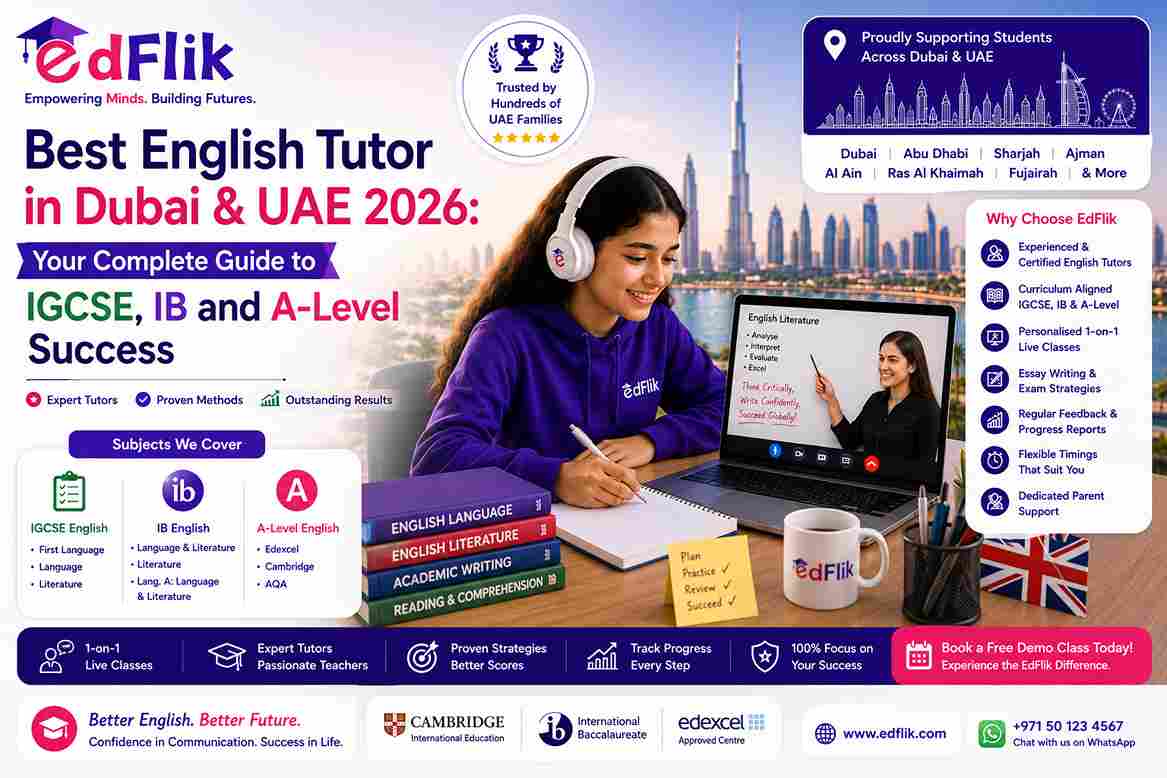
Our tutors have taught IGCSE English Language for 5+ years. They've marked hundreds of student papers. They know exactly what the examiner is looking for.
Writing Structure Framework
We teach students a proven five-paragraph essay structure for persuasive writing:
1. Hook + clear thesis
2. Argument 1 with evidence & explanation
3. Argument 2 with evidence & explanation
4. Argument 3 with evidence & explanation (or counterargument + refutation)
5. Conclusion that reinforces the thesis
By exam day, students can produce a well-structured persuasive essay in 45 minutes without thinking about structure — it's automatic.
Comprehension Annotation Technique
We teach a three-step annotation method:
1. Highlight key evidence that answers the question
2. Identify the technique used (metaphor, repetition, short sentences, etc.)
3. Explain *how* the technique supports the meaning
This methodical approach turns comprehension from intuition into a teachable system.
Vocabulary Expansion
Every week, students learn 10–15 sophisticated synonym pairs (good/excellent/exceptional, sad/melancholic/forlorn). By exam day, their vocabulary has visibly expanded.
Monthly Writing Feedback
Every month, students submit a new essay. Tutors provide feedback using the Cambridge mark scheme, highlighting strengths and areas for improvement. This targeted feedback drives improvement faster than generic praise.
IGCSE English Language 0500/0990 Curriculum
Paper 1 — Writing (2 hours, 40 marks):
· Persuasive writing (arguing a viewpoint)
· Formal/informal letter writing
· Article/blog post writing
· Creative writing (short story, description)
· Review writing
Paper 2 — Reading & Comprehension (2 hours, 40 marks):
· Reading unseen texts (extracts from books, articles, advertisements)
· Comprehension questions (finding evidence, explaining techniques, comparing texts)
· Functional text analysis (forms, instructions, brochures, websites)
Speaking & Listening (Optional, 0490 variant, 20 marks if chosen):
· Individual presentation
· Group discussion
· Responding to spoken texts
How It Works: 6 Steps to English Mastery
Step 1: Contact EdFlik
WhatsApp +91 88788 96600 or www.edflik.com. Tell us your child's weak areas (writing or reading?) and exam date.
Step 2: Tutor Matching
Within 24 hours, we match an IGCSE English Language specialist.
Step 3: Free Trial
Your child attends 1–2 free classes. Judge the tutor's feedback style and teaching approach.
Step 4: Structured Learning
2 sessions per week (typically 2–3 hours total). Early focus on structure & technique; later focus on timed writing practice.
Step 5: Monthly Essay Feedback
Every month, students submit a practice essay. Tutors provide detailed feedback using the Cambridge rubric. This drives improvement faster than classroom feedback alone.
Step 6: Exam Readiness
By exam month, your child has written 15–20 practice essays and has strong technique in reading comprehension.
What Students Say
*"I didn't know how to structure a persuasive essay until my tutor showed me the five-paragraph framework. Then essays became so much easier."*
— Leila Al-Kaabi, Dubai
*"My vocabulary was limited, but my tutor gave me synonym lists every week. By the exam, I felt confident using sophisticated language."*
— Amira Hassan, Sharjah
*"Reading comprehension stressed me out because I didn't know what the examiner wanted. My tutor's annotation technique changed everything."*
— Ravi Patel, Ajman
FAQs:-
Q: Language or Literature — which should my child choose?
A: Language focuses on writing, reading, and functional texts. Literature focuses on analyzing poems and novels. Choose based on your child's strengths (writing = Language, analyzing books = Literature).
Q: How much tutoring is needed?
A: 2 sessions per week (2–3 hours total) works for most. Writing especially needs feedback cycles, so regular tutoring is valuable.
Q: Can my child improve by exam day?
A: Yes. Writing is learnable. We've seen students improve from 4s to 6s or 7s in 4–5 months of tutoring with consistent practice and feedback.
Q: What if my child hates writing?
A: Many students dread writing until they learn *structure*. Once they understand the framework, writing feels less overwhelming. Most students enjoy writing more after tutoring.
Q: Should my child take Speaking & Listening?
A: It's optional (0490 variant, 20% of grade). Most students take it if they're comfortable speaking publicly. It's often easier marks than written papers.
Q: What's the cost?
A: Starting at 45 AED per hour. Most families invest 180–270 AED per week on tutoring.
Q: How do I know it's working?
A: Monthly essays with tutor feedback are concrete evidence. You'll see clearer structure, richer vocabulary, and more confident explanations in comprehension answers.