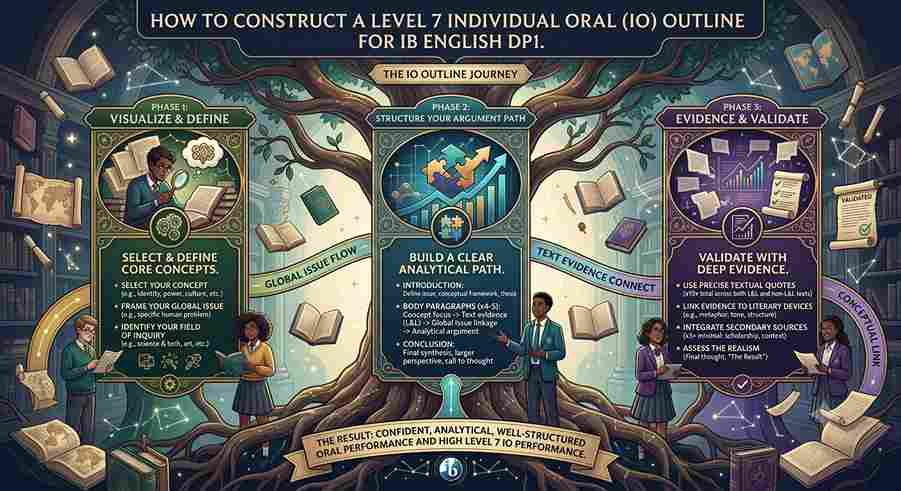
How to Construct a Level 7 Individual Oral (IO) Outline for IB English DP1
Last Updated: October 2026 | By EdFlik Education Team
For high school students embarking on the International Baccalaureate (IB) Diploma Programme (DP), the Individual Oral (IO) is one of the most intimidating yet rewarding internal assessments. Accounting for 20% of your final English A: Language and Literature or English A: Literature grade (SL and HL), the IO requires you to speak for exactly 10 minutes, followed by 5 minutes of teacher questions, centered around a single guiding question.
Every exam session, thousands of students lose marks not because they don't understand their texts, but because their 10-bullet-point outlines lack structural cohesion, fail to link literary/stylistic features directly to the global issue, or run out of time due to poor planning. Scoring a Level 7 (18–20/20) requires more than just a deep appreciation of literature; it demands a disciplined, formulaic blueprint that guides the examiner seamlessly through your argument.
In this comprehensive, exam-focused masterclass guide, our expert IB English educators break down the official assessment criteria, provide a bullet-by-bullet template for your 10-bullet outline card, and share advanced strategies to help you secure a Level 7.
Part 1: Decoding the IB Individual Oral Assessment Criteria
Before drafting your outline, you must master the four criteria against which your oral will be graded (each worth 5 marks, totaling 20 marks):
                   IB INDIVIDUAL ORAL ASSESSMENT CRITERIA
                                     |
        +----------------------------+----------------------------+
        |                            |                            |
  CRITERIA A: KNOWLEDGE        CRITERIA B: FOCUS            CRITERIA C: BODY           CRITERIA D: LANGUAGE
  • Understanding of texts     • Addressing the guiding     • Analysis of stylistic    • Clarity, precision, and
    and global issue             question and balance         & literary features        register of spoken delivery
1. Criterion A: Knowledge, Understanding, and Interpretation (5 Marks)
- What it tests: Your comprehension of both chosen texts (one literary work and one non-literary body of work, or two literary works for Literature) and how insightfully you connect them to your chosen global issue.
- Level 7 Secret: Do not treat your texts as separate summaries. Your interpretation must be comparative and thematic, showing how different cultural or literary lenses illuminate your global issue.
2. Criterion B: Focus and Organization (5 Marks)
- What it tests: How effectively you maintain focus on your guiding question and structure your oral presentation logically from introduction to conclusion.
- Level 7 Secret: Every single body paragraph must explicitly tie back to your guiding question. If a point does not answer the guiding question, cut it!
3. Criterion C: Understanding and Analysis of Stylistic/Literary Features (5 Marks)
- What it tests: Your ability to analyze how the authors/creators construct meaning using stylistic devices (e.g., metaphor, structure, juxtaposition, camera angles, typography, tone).
- Level 7 Secret: Avoid "feature-spotting." Never say, "The author uses a metaphor here." Instead, explain the effect of the feature: "The extended maritime metaphor functions to convey the inescapable weight of generational trauma..."
4. Criterion D: Language (5 Marks)
- What it tests: Clarity, precision, grammar, and vocabulary of your spoken delivery.
- Level 7 Secret: Use an academic, sophisticated register without sounding memorized. Avoid colloquialisms or filler words ("like," "um").
Part 2: The Anatomy of the 10-Bullet-Point Outline Card
The IB permits you to bring one single-sided A4 sheet containing a maximum of 10 bullet points into the oral examination room. This card is your roadmap; it must not be a script. Reading off a card results in severe penalties under Criterion D.
Here is the ultimate 10-bullet structural blueprint used by Level 7 students:
Introduction (Bullets 1–2)
- Bullet 1: Hook, Global Issue, and Texts Introduction
- Drafting Tip: Define your global issue (local in origin, transnational in scope, of critical significance) and name your two texts and creators immediately.
- Bullet 2: Guiding Question and Thesis Statement
- Drafting Tip: State your guiding question verbatim and outline your core thesis argument addressing how both texts explore the issue through distinct forms.
Body Paragraph 1: Text 1 Analysis (Bullets 3–4)
- Bullet 3: Text 1 Context & First Literary/Stylistic Feature
- Drafting Tip: Introduce Text 1, ground it in its context, and name your first specific feature (e.g., structural framing in Marjane Satrapi’s graphic novel Persepolis).
- Bullet 4: Text 1 Detailed Evidence and Impact on Global Issue
- Drafting Tip: Cite exact details/quotes, analyze the mechanism, and explain how it shapes the global issue.
Body Paragraph 2: Comparative Shift to Text 2 (Bullets 5–6)
- Bullet 5: Transitional Link & Text 2 Feature
- Drafting Tip: Transition smoothly to Text 2 (e.g., “While Satrapi utilizes visual juxtaposition, Art Spiegelman in Maus employs zoomorphic metaphor…”).
- Bullet 6: Text 2 Detailed Evidence and Impact on Global Issue
- Drafting Tip: Analyze Text 2's stylistic features, comparing or contrasting its perspective on the global issue with Text 1.
Body Paragraph 3: Deeper Synthesis / Counter-Perspective (Bullets 7–8)
- Bullet 7: Deeper Analytical Convergence or Divergence
- Drafting Tip: Examine a secondary aspect or nuance of the global issue across both texts (e.g., how institutional power versus individual agency is portrayed).
- Bullet 8: Comparative Feature Integration
- Drafting Tip: Bring in a second stylistic feature from either text to reinforce your overarching argument.
Conclusion (Bullets 9–10)
- Bullet 9: Synthesis of Main Arguments
- Drafting Tip: Summarize how both texts successfully answer your guiding question without introducing brand-new evidence.
- Bullet 10: Final Evaluative Thought on the Global Issue
- Drafting Tip: Conclude with a powerful, memorable statement regarding what these texts reveal about human nature or society in relation to your global issue.
Part 3: Step-by-Step Blueprint to Constructing Your IO
Step 1: Crafting a Bulletproof Global Issue
A weak global issue is the #1 reason students fail to score a Level 7. Your global issue must meet three IB mandates:
- It has a transnational scope: It cannot be isolated to a single school or obscure town.
- It is recognized in daily human experience: E.g., systemic misogyny, the erosion of privacy in the digital age, or the psychological toll of political displacement.
- It is clearly linked to your texts: Both texts must genuinely engage with the issue.
Step 2: Selecting the Right Extracts (10-Line Rule)
You must select one extract (approx. 30 lines of text or a short visual sequence) from Text 1 and one extract from Text 2.
- Tip: Choose extracts that are dense with stylistic features. It is much easier to analyze 10 lines packed with metaphors and structural shifts than an entire 300-page novel in 10 minutes.
Step 3: Practicing with the 10-Minute Clock
Time management is critical.
- Minutes 0–3: Introduction and Text 1 analysis.
- Minutes 3–6: Text 2 analysis and comparative synthesis.
- Minutes 6–9: Deeper exploration and conclusion.
- Minute 9–10: Final wrap-up. Record yourself multiple times against a stopwatch to ensure you finish naturally around the 9.5-minute mark.
Part 4: Top 4 Traps That Prevent Students from Getting a Level 7
- Writing Full Paragraphs on the 10-Bullet Card: Packing your A4 sheet with dense paragraphs of text, leading to monotone reading and poor Criterion D scores. Keep your bullets to short, punchy 5-to-8 word prompts!
- Choosing a Global Issue That Is Too Broad: Selecting a vague global issue like "War" or "Love." Refine it to something specific and analytical, such as "The commodification of trauma in modern wartime journalism."
- Neglecting the Guiding Question: Answering a general essay prompt instead of constantly referencing your specific guiding question throughout your oral.
- Imbalance Between Texts: Spending 8 minutes discussing Text 1 and rushing Text 2 in the final 2 minutes. Aim for a balanced 50/50 split between both texts.
Preparing for IB English Individual Orals and aiming for a Level 7 grade? EdFlik connects international school students globally with expert, 1-to-1 online IB English tutors, helping you refine global issues, structure outline cards, master literary analysis, and practice under timed exam conditions. Book a Free Demo Class Today!
Frequently Asked Questions (FAQs)
Q1: Can I bring notes other than my 1-page 10-bullet outline into the IB Individual Oral?
Ans: No. The IB strictly permits only one single-sided A4 sheet containing a maximum of 10 bullet points. Bringing cue cards, annotations on your texts, or a full script will result in immediate disqualification or severe penalties.
Q2: What happens during the 5-minute teacher question period after the oral?
Ans: Following your 10-minute presentation, your teacher will ask questions for 5 minutes. These questions are designed to give you an opportunity to clarify points, expand on aspects of the global issue you didn't have time to cover, or address alternative interpretations. This Q&A is included in your final IO grade.
Q3: How do I choose between English A: Literature and English A: Language and Literature for my IO?
Ans: If you take Literature, both of your chosen works must be literary works studied in class. If you take Language and Literature, you must choose one literary work and one non-literary body of work (such as a collection of advertisements, political cartoons, opinion columns, or photographs).
Q4: How does EdFlik support IB English students?
Ans: EdFlik connects international school students worldwide with vetted, expert 1-to-1 online tutors specializing in IB DP English A (Literature and Language & Literature). Our personalized coaching focuses on selecting compelling global issues, structuring 10-bullet outline cards, refining oral delivery, and practicing mock orals under exam conditions.