How to Design a Scoring IB Chemistry IA: Localized UAE Data & Reaction Kinetics Ideas
Last Updated: October 2026 | By EdFlik Education Team
For International Baccalaureate (IB) Diploma Programme (DP) Chemistry students across the United Arab Emirates—whether attending international schools in Dubai, Abu Dhabi, Sharjah, or Ras Al Khaimah—the Internal Assessment (IA) represents 20% of your final grade.
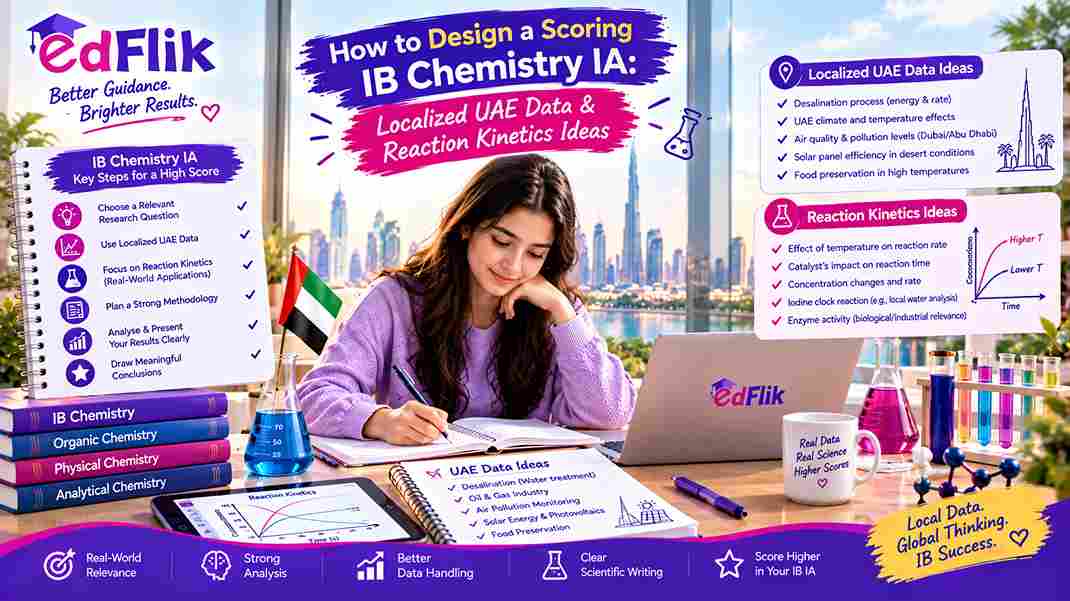
While many students struggle to find a unique angle, leveraging localized UAE environmental and industrial contexts paired with Reaction Kinetics (Topic 6 / Topic 16) provides the ultimate formula for a high-scoring report.
Reaction kinetics allows for clean, quantitative data collection, precise error analysis, and straightforward graphical modeling (such as determining reaction orders and calculating activation energy $E_a$ via the Arrhenius equation). Combining kinetics with UAE-specific real-world applications instantly fulfills the IB criteria for Personal Engagement and Scientific Context.
In this masterclass guide, our expert IB Chemistry tutors break down the 24-mark assessment criteria, share high-scoring localized kinetics research ideas, and provide a step-by-step layout for an A-grade report.
Part 1: Deconstructing the 24-Mark IB Chemistry IA Criteria
To achieve a 7 in IB Chemistry, your report must address all four official assessment criteria (6 marks each):
                     THE 4 IB CHEMISTRY IA CRITERIA (24 MARKS)
                                        |
      +---------------------------------+---------------------------------+
      |                                                                   |
CRITERION A: Research Design (6M)                                  CRITERION B: Data Analysis (6M)
• Focused Research Question with units                             • Raw data with uncertainties (±)
• Fully controlled variables & methodology                         • Processing, error propagation & graphing
• Comprehensive risk & safety assessment                           • Statistical analysis & line of best fit
      |                                                                   |
      +---------------------------------+---------------------------------+
                                        |
      +---------------------------------+---------------------------------+
      |                                                                   |
CRITERION C: Conclusion (6M)                                       CRITERION D: Evaluation (6M)
• Direct answer to Research Question                               • Realistic identification of errors
• Justification linked to chemical theory                         • Specific, actionable methodological
• Comparison with accepted literature values                       improvements & extension ideas
- Criterion A: Research Design (6 Marks): Requires a fully focused Research Question (RQ), clear identification of independent, dependent, and controlled variables, a reproducible step-by-step method, and a robust safety/environmental risk assessment.
- Criterion B: Data Analysis (6 Marks): Focuses on quantitative raw data collection with associated measurement uncertainties ($\pm$), correct error propagation, significant figures, and processed graphs with error bars.
- Criterion C: Conclusion (6 Marks): Demands a detailed scientific conclusion directly addressing the RQ, supported by chemical theory (e.g., Collision Theory, Arrhenius model) and compared against literature values.
- Criterion D: Evaluation (6 Marks): Requires a critical analysis of methodological limitations, identifying systematic vs. random errors, and proposing specific, realistic improvements.
Part 2: 4 High-Scoring Localized UAE Reaction Kinetics IA Ideas
Here are four localized research ideas combining Reaction Kinetics with real-world UAE applications:
                     LOCALIZED UAE REACTION KINETICS IDEAS
                                       |
        +------------------------------+------------------------------+
        |                                                             |
1. DESALINATION SCALE REMOVAL                                  2. SOLAR UV DYE DEGRADATION
Determining $E_a$ of $CaCO_3$ dissolution in citric acid.      Kinetics of methylene blue breakdown under UAE UV index.
        |                                                             |
        +------------------------------+------------------------------+
                                       |
        +------------------------------+------------------------------+
        |                                                             |
3. CONCRETE CORROSION KINETICS                                 4. ANTIOXIDANT THERMAL DECAY
Effect of salinity on metal displacement rates in coastal UAE. Kinetics of Vitamin C degradation in local date extracts.
1. Kinetics of Desalination Scale Removal ($CaCO_3$ Dissolution)
- Localized UAE Context: Thermal desalination plants across Abu Dhabi and Dubai suffer from calcium carbonate ($CaCO_3$) scale buildup in high-temperature heat exchangers. Acid washing using eco-friendly organic acids (like citric acid or sulfamic acid) is widely used for descaling.
- Research Question: "What is the activation energy ($E_a$) for the dissolution of solid calcium carbonate ($CaCO_3$) in $0.5\text{ M}$ citric acid across a temperature range of $25^\circ\text{C}$ to $65^\circ\text{C}$, as determined by mass-loss rate monitoring over time?"
- Kinetics Methodology: Measure the rate of$CO_2$ gas evolution or mass loss on a digital balance over time at different temperatures, then construct an Arrhenius plot ($\ln k$ vs.$1/T$).
2. Solar Photocatalytic Degradation of Organic Dyes
- Localized UAE Context: Industrial wastewater treatment facilities in Al Ain and Sharjah utilize solar photocatalysis to break down synthetic textile dyes under intense regional ultraviolet (UV) radiation.
- Research Question: "How does varying the concentration of hydrogen peroxide ($H_2O_2$) from $0.05\text{ M}$ to $0.25\text{ M}$ affect the pseudo-first-order rate constant ($k$) for the photochemical degradation of methylene blue under simulated UAE UV radiation, measured via colorimetry at $665\text{ nm}$?"
- Kinetics Methodology: Use a colorimeter/spectrophotometer to measure absorbance over time, plot $\ln(\text{Absorbance})$ vs. time to verify first-order kinetics, and calculate the pseudo-first-order rate constant $k$.
3. Corrosion Kinetics of Rebar Steel in Coastal Saline Environments
- Localized UAE Context: Coastal infrastructure projects in Jumeirah and Ras Al Khaimah face accelerated concrete rebar corrosion due to high ambient humidity and atmospheric sea-spray salinity.
- Research Question: "What is the reaction order with respect to chloride ion concentration ($[Cl^-]$ ranging from $0.1\text{ M}$ to $2.0\text{ M}$) in the oxidation kinetics of iron nails in an acidified hydrogen peroxide medium, measured via gas pressure sensors or mass displacement?"
- Kinetics Methodology: Track the initial rate of oxidation by measuring gas pressure changes or iron dissolution rates across varying sodium chloride concentrations.
4. Thermal Degradation Kinetics of Antioxidants in Local Date Extracts
- Localized UAE Context: Native Emirati date varieties (such as Khalas or Lulu) are stored and processed at high ambient summer temperatures, impacting their nutritional antioxidant profiles.
- Research Question: "What is the activation energy ($E_a$) for the thermal degradation of ascorbic acid (Vitamin C) in local date palm extracts heated between $40^\circ\text{C}$ and $80^\circ\text{C}$, as determined by iodometric titration rate kinetics?"
- Kinetics Methodology: Heat date extract samples at fixed temperatures for varying time intervals, perform iodometric titrations to track remaining Vitamin C concentrations, and determine the rate constant$k$ and activation energy$E_a$.
Part 3: Step-by-Step Data Analysis Guide for Kinetics IAs
To secure full 6 marks in Criterion B (Data Analysis), execute these mathematical steps for your reaction kinetics dataset:
                   REACTION KINETICS DATA PROCESSING FLOW
                                     |
  Step 1: Calculate Initial Rates  ---> Find initial gradient of Concentration vs. Time
  Step 2: Determine Reaction Order ---> Plot $\ln(\text{Rate})$ vs. $\ln[\text{Reactant}]$
  Step 3: Calculate Rate Constants ---> Extract $k$ values at varying temperatures
  Step 4: Arrhenius Equation Plot  ---> Plot $\ln(k)$ vs. $1/T$ (Kelvin)
  Step 5: Extract Activation Energy---> $E_a = -\text{Gradient} \times R$ ($R = 8.314\text{ J mol}^{-1}\text{ K}^{-1}$)
The Arrhenius Equation Equation & Plot Mechanics:
The Arrhenius equation links the rate constant $k$ to absolute temperature $T$ (in Kelvin):
$$k = A e^{-\frac{E_a}{R T}}$$
Taking the natural logarithm ($\ln$) yields a linear equation ($y = mx + c$):
$$\ln k = -\frac{E_a}{R} \cdot \frac{1}{T} + \ln A$$
- X-Axis: Inverse absolute temperature $\frac{1}{T}$ in $\text{K}^{-1}$.
- Y-Axis: Natural log of the rate constant $\ln(k)$.
- Gradient ($m$): $-\frac{E_a}{R}$.
- Activation Energy Calculation:$$E_a = -\text{Gradient} \times 8.314 \text{ J mol}^{-1} \text{ K}^{-1}$$
Part 4: Top 4 Traps That Lose Marks in IB Chemistry IAs
- Unfocused Research Questions: Writing a vague RQ like "Investigating reaction rates at different temperatures". Always specify the exact independent variable range, dependent variable measurement method, and chemical species.
- Temperature Unit Mistakes: Plotting $1/T$ using degrees Celsius ($^\circ\text{C}$) instead of converting to Kelvin ($\text{K} = ^\circ\text{C} + 273.15$). This completely invalidates the Arrhenius analysis.
- Ignoring Measurement Uncertainties: Reporting raw data without absolute uncertainties (e.g., balance$\pm 0.001\text{ g}$, thermometer$\pm 0.2^\circ\text{C}$) and failing to propagate percentage uncertainties through final$E_a$ calculations.
- Vague Evaluation Improvements: Suggesting generic improvements like "use a better timer" or "do more trials". Instead, suggest specific methodological changes, such as "using a thermostatically controlled digital water bath ($\pm 0.1^\circ\text{C}$) to eliminate temperature drops during gas volume logging".
Preparing your IB Chemistry IA in Dubai, Abu Dhabi, or across the UAE and aiming for a grade 7? EdFlik connects IB students globally with expert, 1-to-1 online IB Chemistry tutors, helping you refine research questions, execute data processing, and master criteria requirements. Book a Free Demo Class Today!
Frequently Asked Questions (FAQs)
Q1: How long should an IB Chemistry IA report be?
Ans: According to official IB regulations, the Chemistry IA has a maximum length recommendation of 12 pages. Exceeding 12 pages can lead to mark deductions under Communication and Research Design.
Q2: Can I use secondary data for my IB Chemistry IA?
Ans: While primary lab-based data collection is standard for IB Chemistry, database IAs or secondary data modeling are permitted if they demonstrate sufficient personal engagement, complex variable processing, and deep chemical evaluation.
Q3: What is the difference between SL and HL IB Chemistry IAs?
Ans: Both SL and HL students are assessed using the exact same 24-mark rubric and page-count expectations. However, HL students are expected to demonstrate deeper theoretical understanding, often incorporating advanced kinetics modeling (such as multi-step rate-determining mechanisms or reaction order derivations).
Q4: How does EdFlik support IB Chemistry IA preparation?
Ans: EdFlik connects IB Diploma students worldwide with vetted, expert 1-to-1 online tutors specializing in SL and HL IB Chemistry. Our personalized coaching covers topic selection, experimental methodology design, data analysis error propagation, and report review aligned with official IB marking schemes.