IB chemistry stoichiometry guide, mole concept practice questions, IB chemistry tutor UAE
Last Updated: September 2026 | By EdFlik Education Team
For students enrolled in the International Baccalaureate (IB) Diploma Programme (DP) studying Chemistry Standard Level (SL) or Higher Level (HL) across international schools in the UAE (including Dubai, Abu Dhabi, and Sharjah), Topic 1: Stoichiometric Relationships is the absolute bedrock of the entire course. Whether you are calculating percentage yields in organic chemistry, determining concentrations in titrations, or predicting gas volumes, mastering the mole concept is non-negotiable.
Many students struggle not because they lack mathematical ability, but because they fail to convert units correctly, get confused by limiting reagents, or view stoichiometry as a collection of memorized formulas rather than a logical framework of proportionality.
In this comprehensive guide, our expert IB Chemistry tutors break down essential stoichiometry revision notes, walk through challenging mole concept practice questions, and explain why working with an expert IB chemistry tutor UAE can help you secure a Grade 7.
Part 1: Revision Notes — The Mole Concept and Stoichiometric Relationships
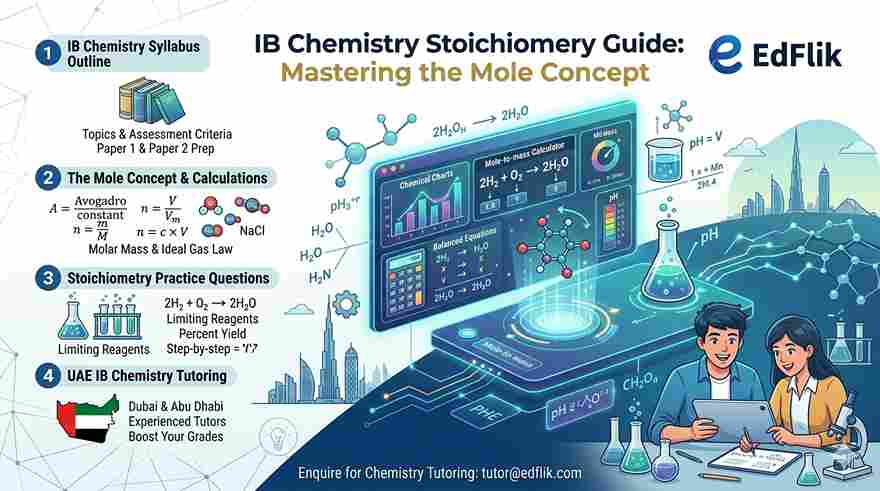
Stoichiometry is the quantitative study of reactants and products in chemical reactions. At its core, it relies on the concept of the mole as the chemist's counting unit.
1. Avogadro’s Constant and Molar Mass
- The Mole ($n$): Defined as the amount of substance containing exactly $6.02 \times 10^{23}$ representative particles (atoms, molecules, or ions). This number is known as Avogadro’s constant ($L$ or $N_A$).
- Molar Mass ($M$): The mass of one mole of a substance, expressed in grams per mole ($\text{g}\cdot\text{mol}^{-1}$), numerically equal to its relative atomic mass ($A_r$) or relative molecular mass ($M_r$).
- The Golden Triangle Formula:$$n = \frac{m}{M}$$where $n = \text{number of moles}$, $m = \text{mass in grams}$, and $M = \text{molar mass}$.
2. Solutions, Concentrations, and Gas Laws
- Solution Concentration ($c$): Measured in moles per cubic decimeter ($\text{mol}\cdot\text{dm}^{-3}$):$$n = c \times V$$where $V$ is volume in $\text{dm}^3$ (remember to divide milliliters by $1,000$!).
- Molar Volume of an Ideal Gas: At standard temperature and pressure (STP), one mole of any ideal gas occupies $22.7 \, \text{dm}^3$ (under current IB data booklet standards):$$n = \frac{V}{V_m}$$
Part 2: Step-by-Step Masterclass on Limiting Reactants and Percentage Yield
In real-world chemistry and IB exam papers, reactants are rarely mixed in exact stoichiometric ratios. One reactant will always run out first, stopping the reaction.
1. How to Identify the Limiting Reactant
- Write and balance the chemical equation.
- Calculate the number of moles of each reactant available.
- Divide the number of moles of each reactant by its respective stoichiometric coefficient from the balanced equation.
- The reactant with the smallest resulting ratio is your limiting reactant; it dictates the maximum theoretical amount of product that can be formed.
2. Theoretical, Actual, and Percentage Yield
- Theoretical Yield: The maximum amount of product calculated from the limiting reactant using stoichiometric ratios.
- Actual Yield: The amount of product actually obtained experimentally (usually given in the question).
- Percentage Yield Formula:$$\text{Percentage Yield} = \left( \frac{\text{Actual Yield}}{\text{Theoretical Yield}} \right) \times 100\%$$
Part 3: IB Chemistry Mole Concept Practice Questions
Let’s test your skills with two typical IB-style stoichiometry questions.
Question 1: Solution Stoichiometry and Titrations
Problem: $25.0 \, \text{cm}^3$ of $0.200 \, \text{mol}\cdot\text{dm}^{-3}$ sodium hydroxide ($\text{NaOH}$) is completely neutralized by $20.0 \, \text{cm}^3$ of a sulfuric acid ($\text{H}_2\text{SO}_4$) solution. Calculate the concentration of the sulfuric acid.
Solution Steps:
- Write the balanced equation:$$\text{H}_2\text{SO}_4(aq) + 2\text{NaOH}(aq) \rightarrow \text{Na}_2\text{SO}_4(aq) + 2\text{H}_2\text{O}(l)$$
- Calculate moles of $\text{NaOH}$:$$n(\text{NaOH}) = c \times V = 0.200 \, \text{mol}\cdot\text{dm}^{-3} \times 0.0250 \, \text{dm}^3 = 0.00500 \, \text{mol}$$
- Use the molar ratio ($1:2$ ratio between $\text{H}_2\text{SO}_4$ and $\text{NaOH}$):$$n(\text{H}_2\text{SO}_4) = \frac{0.00500}{2} = 0.00250 \, \text{mol}$$
- Calculate concentration of $\text{H}_2\text{SO}_4$:$$c = \frac{n}{V} = \frac{0.00250 \, \text{mol}}{0.0200 \, \text{dm}^3} = 0.125 \, \text{mol}\cdot\text{dm}^{-3}$$
Question 2: Limiting Reactants
Problem: $10.0 \, \text{g}$ of magnesium metal is added to $10.0 \, \text{g}$ of hydrochloric acid according to the equation:
$$\text{Mg}(s) + 2\text{HCl}(aq) \rightarrow \text{MgCl}_2(aq) + \text{H}_2(g)$$
Identify the limiting reactant and calculate the mass of hydrogen gas produced. ($M(\text{Mg}) = 24.31 \, \text{g}\cdot\text{mol}^{-1}$, $M(\text{HCl}) = 36.46 \, \text{g}\cdot\text{mol}^{-1}$).
Solution Steps:
- Find moles of reactants:
- $n(\text{Mg}) = \frac{10.0}{24.31} = 0.411 \, \text{mol}$
- $n(\text{HCl}) = \frac{10.0}{36.46} = 0.274 \, \text{mol}$
- Determine limiting reactant using coefficients:
- For $\text{Mg}$: $\frac{0.411}{1} = 0.411$
- For $\text{HCl}$: $\frac{0.274}{2} = 0.137$ (Smaller ratio, so $\text{HCl}$ is the limiting reactant).
- Calculate moles of $\text{H}_2$ produced using $\text{HCl}$ ratio ($2:1$ ratio):$$n(\text{H}_2) = \frac{0.274}{2} = 0.137 \, \text{mol}$$
- Convert moles of $\text{H}_2$ to mass ($M(\text{H}_2) = 2.02 \, \text{g}\cdot\text{mol}^{-1}$):$$\text{Mass} = 0.137 \, \text{mol} \times 2.02 \, \text{g}\cdot\text{mol}^{-1} = 0.277 \, \text{g}$$
Part 4: The Advantage of Working with an IB Chemistry Tutor in the UAE
IB Chemistry is notorious for its challenging exam questions that combine multiple concepts into a single multi-part problem (e.g., combining stoichiometry with gas laws and thermodynamics).
Partnering with an expert IB chemistry tutor UAE offers tailored advantages:
- Step-by-Step Method Mastery: Breaking down complex calculation problems into manageable, foolproof steps so you never panic under exam pressure.
- Targeted Past Paper Practice: Working through official IB Paper 1 and Paper 2 questions to identify recurring traps and question styles.
- Internal Assessment (IA) Support: Guidance on designing, executing, and analyzing data for your experimental chemistry IA.
Part 5: Top 4 Strategies to Secure a Grade 7 in IB Chemistry
- Never Round Until the Final Answer: Intermediate rounding errors compound quickly in stoichiometry calculations. Keep full calculator values on your screen and only round your final answer to the appropriate number of significant figures (usually 3 sig figs in the IB).
- Always Check Unit Conversions: The #1 cause of lost marks in stoichiometry is forgetting to convert milliliters to liters ($\text{dm}^3$) or milligrams to grams. Make unit checking a mandatory habit.
- Memorize Your Data Booklet Constants: Know where to find molar masses, Avogadro's constant, and molar gas volumes in your IB Data Booklet so you don't waste precious seconds during exams.
- Master Empirical and Molecular Formulas: Practice combustion analysis and percentage composition problems repeatedly until solving them becomes second nature.
Struggling with the mole concept, limiting reagents, or preparing for your IB Chemistry exams in the UAE? EdFlik offers expert, 1-to-1 online tutoring customized specifically for the IB Diploma Programme, helping you build analytical confidence and secure a Grade 7.Book a Free Demo Class Today!
Frequently Asked Questions (FAQs)
Q1: What is the difference between empirical formula and molecular formula?
Ans: An empirical formula shows the simplest whole-number ratio of atoms of each element in a compound (e.g., $\text{CH}_2\text{O}$ for glucose). A molecular formula shows the exact actual number of atoms of each element in a molecule (e.g., $\text{C}_6\text{H}_{12}\text{O}_6$ for glucose).
Q2: Why do we use $22.7 \, \text{dm}^3\cdot\text{mol}^{-1}$ instead of $22.4 \, \text{dm}^3\cdot\text{mol}^{-1}$ in IB Chemistry?
Ans: The IB uses $22.7 \, \text{dm}^3\cdot\text{mol}^{-1}$ as the molar volume of an ideal gas at Standard Temperature and Pressure (STP), which is defined as $0^\circ\text{Celsius}$ ($273.15 \, \text{K}$) and $100 \, \text{kPa}$ (1 bar). (Older syllabi used $22.4 \, \text{dm}^3$ at $0^\circ\text{C}$ and $101.3 \, \text{kPa}$ / 1 atm, but the IB updated this to align with IUPAC standards).
Q3: How can I access official IB Chemistry past papers?
Ans: Official past papers, mark schemes, and subject reports can be accessed through your school's coordinator via the IB store or reliable educational archive platforms specialized in IB DP resources.
Q4: How can EdFlik help me find an expert IB Chemistry tutor in the UAE?
Ans: EdFlik connects students across Dubai, Abu Dhabi, and the UAE with vetted, experienced 1-to-1 online tutors specializing in IB Chemistry SL and HL. Our personalized sessions focus on clarifying difficult topics, working through past papers, and refining exam technique.